
Sharp increase in clashes and casualties across the West Bank
Use of live ammunition by Israeli forces triggers concerns about excessive use of force
The period between June and August 2014 was marked by heightened tensions across the West Bank, in which clashes between Palestinians and Israeli forces intensified and led to casualties and many arrests of Palestinians (see section below on Arrests).
Initially triggered by Israeli military operations following the abduction and killing of three Israeli youths near Bethlehem on 12 June, the protests continued in the wake of the abduction and killing of a Palestinian boy in East Jerusalem on 2 July, and against the Israeli offensive in the Gaza Strip. Stringent restrictions imposed by the Israeli authorities on Palestinian access to Al Aqsa Mosque during the month of Ramadan (29 June to 27 July) also contributed to the tensions and clashes. These events exacerbated pre-existing frustrations resulting from ongoing settlement expansion and the collapse of peace negotiations.
According to the Israel Security Agency (previously known as the General Security Service or Shabak), July witnessed a record number of attacks carried out by Palestinians against Israeli forces and settlers across the West Bank (including East Jerusalem). A total of 507 attacks were recorded during that month, of which 90 per cent involved the throwing of firebombs, compared with less than 100 in May and June.[1]
In virtually all of the clashes, Palestinians threw stones, and in several cases Molotov cocktails and fireworks, at Israeli forces. The use of live fire against Israeli forces was also reported on a few occasions. Israeli forces responded by shooting tear gas, rubber-coated metal bullets, rubber bullets and live ammunition. The large number of Palestinian casualties during those incidents has prompted serious concerns about excessive use of force.[2]
Fatalities
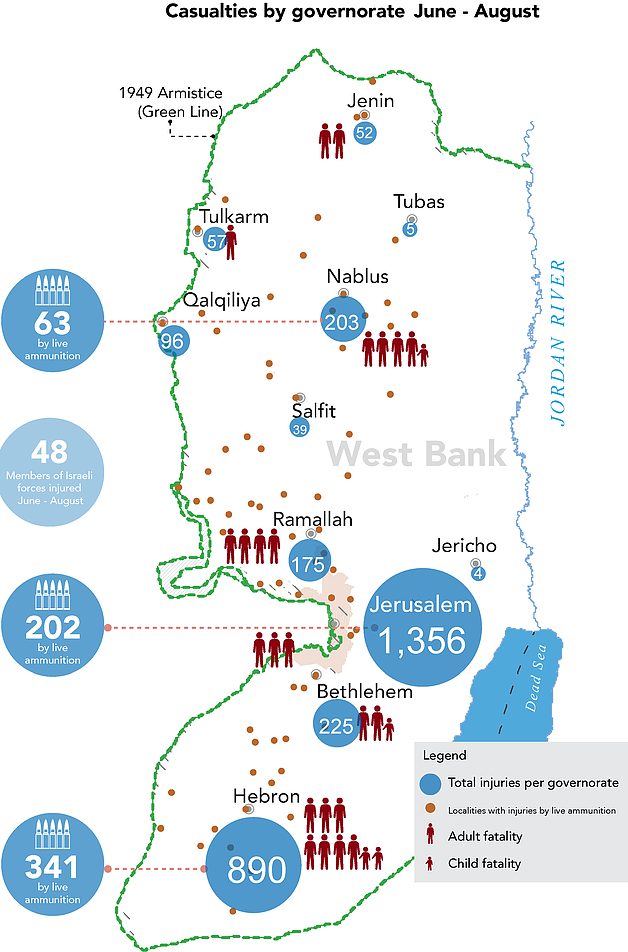
Between 1 June and 31 August 2014, Israeli forces killed a total of 27 Palestinians throughout the West Bank, including East Jerusalem, of whom five were children. This is more than double the number of Palestinians fatalities recorded in the first five months of the year, and equals the figure of Palestinians killed by Israeli forces during all of 2013. No fatalities were recorded among Israeli forces during these clashes.
Half of the fatalities (14) were incurred in clashes that erupted following protests against the Gaza hostilities and restrictions on access to Al Aqsa Mosque; seven deaths resulted from confrontations during search and arrest operations; one in the context of a clash following a settler attack;[3] and the remaining five in unclear or disputed circumstances.
A third of all fatalities (nine) during this period, including three children, occurred in Hebron governorate. Of these, three people were killed on 25 July in Beit Ummar village during a protest against the Israeli offensive on Gaza; one of the fatalities (aged 47) was a staff member with a Palestinian child rights organization, Defence for Children International. Further clashes afterwards led to the killing of another two men, one of them while attempting to help the other, who had been shot. According to eyewitnesses, the three fatalities were shot by snipers positioned on the rooftops of the surrounding buildings, and none of the victims were taking part in the confrontations or posing a threat to soldiers at the time of the incident.
Also in Hebron governorate, on 10 August in Al Fawwar camp (Hebron), Israeli forces shot and killed an 11-year-old boy in the back with live ammunition. Eyewitnesses reported that the incident occurred as Israeli forces were leaving the camp following a search and arrest operation and no stone throwing or clashes were ongoing at the time.[4]
Injuries
 During the reporting period, Israeli forces injured at least 3,102 Palestinians, including 460 children, representing a three-fold increase on figures for injuries in the first five months of 2014. At least 48 members of the Israeli military and police forces were also injured during this period.
Nearly a quarter of all Palestinian injuries during this period (757) were from live ammunition, a sharp rise compared with previous periods, both in absolute terms and as a percentage of all injuries. For example, between January and May 2014, live ammunition accounted for 15 per cent of all injuries (147 people), in 2013 it was four per cent (161 people), and two per cent (60 people) in 2012. The remaining injuries during the three-month period resulted mainly from rubber and rubber-coated metal bullets, tear gas inhalation, and physical assault.
The highest number of injuries was in Jerusalem governorate (45 per cent). The frequency and intensity of clashes in Jerusalem, particularly within the Israeli-declared municipal boundaries of Jerusalem, peaked during the first week of July following the abduction and killing of a 16 year old boy from Shu’fat by a group of Israelis. The number of injuries increased again during the week of 22-28 July as a result of protests against the Gaza offensive and access restrictions to Al Aqsa Mosque during the final week of Ramadan: the total of 493 injuries was the highest recorded in a single week by OCHA in Jerusalem governorate since 2006. Overall, 38 Israeli forces were injured due to stone-throwing in the Jerusalem area and the infrastructure of the Jerusalem light train in Shu’fat and Beit Hanina neighbourhoods was set on fire.
In East Jerusalem municipal areas located on the ‘Jerusalem side’ of the Barrier, where crowd control is handled by the Israeli civil police (also referred as the ‘blue police’), there were no recorded Palestinian casualties (deaths or injuries) by live ammunition or by rubber-coated metal bullets. Although the intensity of protests and clashes in East Jerusalem was similar to those in West Bank areas, the Israeli civil police adopted regulations prohibiting the use of live ammunition and rubber-coated metal bullets for crowd control, unlike the Israeli army and Border Police.[5]
Concerns over excessive use of force
The increased number of fatalities and serious injuries highlights longstanding concerns over the use of force by Israeli forces in the West Bank, in cases documented by the UN in past years.[6] According to initial information available, it appeared that the individuals killed or injured posed little or no threat to the soldiers at the time of the incident. This phenomenon is noted as a serious concern by the UN Secretary-General in a forthcoming report.[7]
In the West Bank, Israeli forces act in a law enforcement capacity and are therefore bound by Article 6 of the International Covenant on Civil and Political Rights and Article 43 of the Hague Regulations. Under these provisions, the use of firearms is only permitted in limited circumstances, primarily in self-defence or defence of others against imminent threat of death or serious injury. In any event, the intentional lethal use of firearms is only permissible when strictly unavoidable to protect life.
Criminal investigations have been opened by the Israeli military police into most of the fatalities occurring during the reporting period and the conclusions are all pending. While the opening of investigations is in itself positive, human rights organizations are concerned that this type of investigation is frequently not conducted in a thorough and robust manner as required by international law; some cases are subject to serious delays and remain open for years. No similar investigations have been opened into incidents that resulted in serious injuries.[8]
The UN Secretary-General and the High Commissioner for Human Rights have recommended a review, possible modification of and compliance with rules of engagement, meaningful accountability procedures, and reparation and remedy for victims.[9]
* This article includes input from the Office of the High Commissioner for Human Rights
[2] Unless otherwise stated, all data on casualties are from OCHA’s Protection of Civilians database.
[3] On 25 July, in Huwwara village (Nablus), Israeli forces killed a 22-year-old man with live ammunition during clashes that erupted after a settler killed a 19-year-old Palestinian and injured five others in the village.
[4] For further details on this incident, see the findings of an investigation carried out by the Israeli human rights group B’Tselem, available here.
[5] Following the recommendations of the Orr Commissions investigation into the conduct of the Israeli police during the events of October 2000, in which police killed 12 Israeli citizens and one Palestinian, the police prohibited the use of rubber-coated bullets within Israel, barring exceptional cases for which the Chief Police Commissioner’s authorization must be obtained. No prohibition was imposed on Israeli forces operating in the West Bank and Gaza Strip, available here.
[6] United Nations Secretary-General’s report to the General Assembly on Israeli practices affecting the human rights of the Palestinian people in the Occupied Palestinian Territory, including East Jerusalem, forthcoming; Report of the United Nations High Commissioner for Human Rights on the implementation of Human Rights Council Resolutions S-9/1 & S-12/1, A/HRC/25/40.
[7] Ibid.
[8] 8 For further detail see OCHA, Fragmented Lives: Humanitarian Overview 2013, pp. 7-9. Also see A/HRC/25/40, para. 50 to 54.
[9] Ibid and A/HRC/25/40, para. 76 and 77.


subscribe to our mailing list
SUBSCRIBE TO RECEIVE OCHA'S INFORMATION PRODUCTS
 SUBSCRIBE
OCHA Sites










Follow Us
Support
Your donations go to relief organizations delivering quick and effective support to Palestinians in need.