
Humanitarian Situation Update #356 | West Bank
One Humanitarian Situation Update is being issued every week. The next Humanitarian Situation Update on the Gaza Strip will be issued on 11 February and the next Humanitarian Situation Update on the West Bank will be issued on 18 February.
We invite you to take a moment to provide feedback on OCHA's regular publications covering the humanitarian situation in Gaza and the West Bank. You can access the survey athttps://surveys-kobo.unocha.org/single/fdgdeISC. The survey is anonymous.
Key Highlights
- Nearly 700 Palestinians in nine communities have been displaced due to settler attacks so far in 2026, including 600 displaced from Ras Ein Al Auja Bedouin community in Jericho governorate.
- Large-scale operations by Israeli forces have significantly expanded beyond the northern West Bank to include the central and southern governorates, including in Qalandiya refugee camp and Kafr Aqab in Jerusalem governorate.
- Repeated Israeli settler attacks on the Ein Samiya wells east of Ramallah damaged critical infrastructure and blocked repairs, cutting the main water supply intermittently for three days and affecting an estimated 100,000 Palestinians across eastern Ramallah governorate.
- About 170 Palestinians have been displaced since the beginning of 2026 by the demolition of homes for lack of Israeli-issued building permits, following a record year in 2025 when more than 1,700 Palestinians were displaced due to lack-of-permit demolitions in Area C and East Jerusalem.
Humanitarian Developments
- Between 20 January and 2 February 2026, Israeli forces killed three Palestinians, including a child, in the West Bank, including East Jerusalem. Another 111 Palestinians, including 12 children, were injured, including 78 by Israeli forces and 33 by Israeli settlers. These include four Palestinians shot with live ammunition by Israeli forces while they attempted to cross the Barrier to reach East Jerusalem and Israel. During the same period, three Israelis were injured, including one by Palestinians and two by settlers. The following are details of the incidents that resulted in fatalities during the reporting period:
- On 23 January, Israeli forces shot, killed and withheld the body of a Palestinian farmer while he was reportedly working his land in Madama village, in Nablus governorate. The exact circumstances of the incident remain unclear. The Palestine Red Crescent Society (PRCS) reported that Israeli forces obstructed medical access.
- On 27 January, Israeli forces shot and killed a 17-year-old Palestinian child and injured another during a raid in Adh Dhahiriya town, south of Hebron city. According to the Israeli military, the boy had thrown a Molotov cocktail at the soldiers and another threw stones and was shot. No injuries among Israeli forces were reported. According to eyewitnesses, there were no clashes at the time of the incident and the child was walking with his friend when Israeli forces opened fire.
- On 28 January, Israeli forces killed and withheld the body of a Palestinian man at the Tunnels checkpoint on Road 60, near Beit Jala, in Bethlehem governorate, who was reportedly attempting to carry out a stabbing attack against Israeli soldiers. The man’s family reports that he had special needs.
- On 3 February, outside the above reporting period, Israeli forces shot and killed a Palestinian man near Ras at Tira village in Qalqiliya, reportedly after he crossed the Barrier towards Israel. On 3 February, Israeli forces shot and killed a Palestinian man during a raid in Jericho city. This brings the total number of Palestinians killed by Israeli forces between 1 January and 3 February to eight.
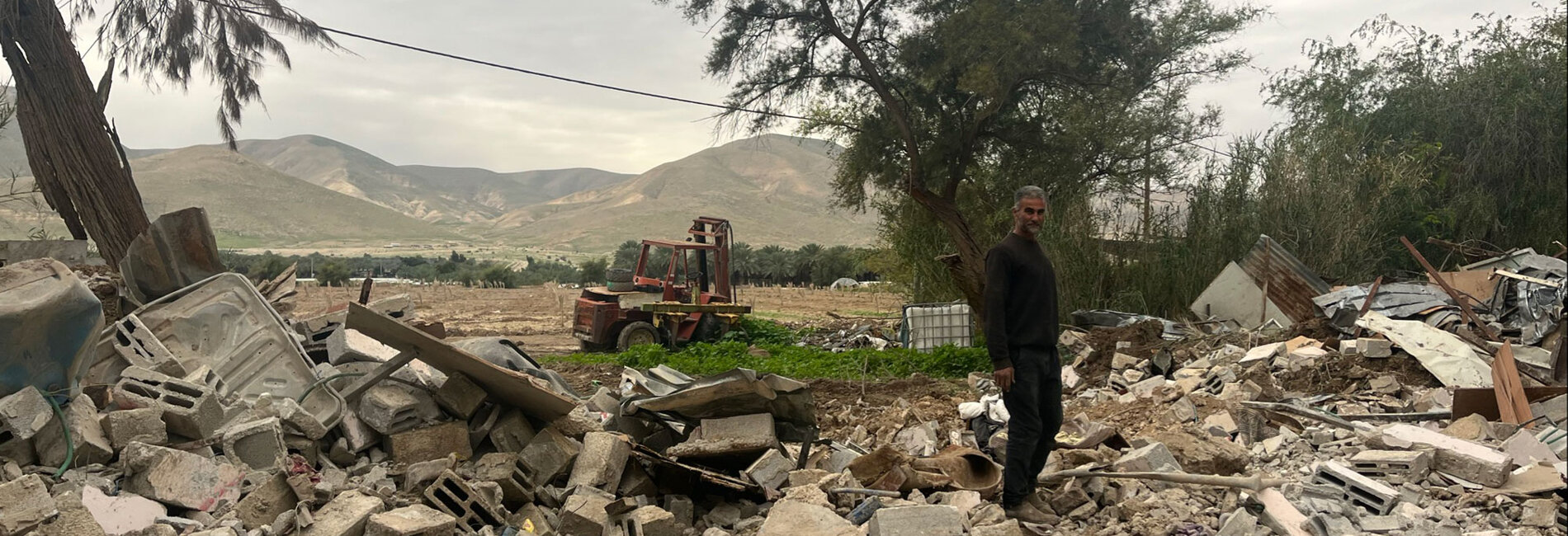
- Between 20 January and 2 February, OCHA documented the demolition of 69 Palestinian-owned structures for lacking Israeli-issued building permits, which are almost impossible for Palestinians to obtain, including 63 in Area C of the West Bank and six in East Jerusalem. Demolished structures included 22 residences (of which 21 were inhabited), 32 agricultural and livelihood structures, and 15 water and sanitation and other structures. Ten of the demolished structures had been provided as humanitarian assistance. In addition, Israeli forces demolished at least 35 (mainly livelihood) structures in Kafr Aqab on the West Bank side of the Barrier on 26 February (please see below). In total, 131 Palestinians, including 74 children, were displaced, of whom 32 were in East Jerusalem and 99 in Area C. The highest levels of displacement were in Shuqba village in Ramallah (24 people), Silwan in East Jerusalem (15 people), Khashem ad Daraj and Mirkez in Hebron (15 and 10 people, respectively), Tell al Khashaba in Nablus (11 people), and Al Khader in Bethlehem (10 people). Since 1 January, Israeli authorities demolished or forced owners to demolish 101 structures, including 33 homes, across the West Bank for lacking building permits, resulting in the displacement of 184 people, 98 of whom were children. In 2025, more than 1,700 Palestinians were displaced by lack-of-permit demolitions – the highest annual total on record since OCHA began to systematically document demolitions in 2009.
- On 2 February, Israeli authorities demolished with explosives on punitive grounds a residential apartment in a four-storey building in Area A of Halhul town near Hebron city. The apartment belongs to the family of a Palestinian man who carried out a stabbing and shooting attack with another Palestinian in Gush Etzion settlement block on 10 July 2025, killing an Israeli security guard. Both Palestinians were killed by Israeli forces on the spot. As a result, six people, including two children, were displaced.
- On 27 and 28 January, electricity and water were cut from a number of UNRWA facilities across East Jerusalem including Shu’fat refugee camp, as provisions of the Israeli legislation amended in December 2025 targeting UNRWA came into effect. The cuts affect UNRWA schools, health centres, and other vital service provision points for Palestine refugees. In the previous week, a fire broke out in the UNRWA headquarters in East Jerusalem, which was demolished by Israeli authorities on 20 January.
- On 1 February, Israeli forces extended a military order titled “Restriction of Movement and Traffic” for Tulkarm, Nur Shams and Jenin refugee camps and areas within the surrounding neighbourhoods until 31 March 2026. The order designates “closure areas,” as delineated on annexed maps, where entry and exit are prohibited without a permit issued by the Israeli military commander or an authorized official; such permits may be personal or general and limited by area, time, purpose, or route.
- In the context of these restrictions, for over two months, Israeli forces have repeatedly and temporarily displaced 11 Palestinian refugee families comprising 41 people from the Az Zahra neighbourhood, adjacent to Jenin refugee camp. According to local community sources, these families have been forced to leave their homes almost daily, typically between 06:00 and 20:00, severely disrupting their daily life and access to basic services. During these periods, the families have relied primarily on relatives and friends for shelter while Israeli forces reportedly occupied their homes and consumed food, health and hygiene supplies. Ongoing daily raids, repeated displacement and uncertainty have also heightened psychosocial distress, underscoring the need for psychological support for affected residents.
Raids and Operations by Israeli Forces
- Large-scale Israeli operations observed throughout 2025 continued into early 2026, with an expanded geographic spread beyond the northern West Bank to include the central and southern areas. Between 20 January and 2 February, OCHA documented at least 130 raids as well as search and other operations by Israeli forces across the West Bank, which entailed mass detentions, temporary home evacuations, and movement restrictions, including a large-scale operation in Qalandiya refugee camp and Kafr Aqab.
- In the northern West Bank, between 20 January and 2 February, Israeli forces took over at least 16 Palestinian homes for military use and temporarily evacuated at least 100 Palestinian families, alongside mass detentions, house searches, and widespread disruption of access to basic services in at least five communities, as follows:
- On 20 and 21 January, Israeli forces carried out operations in Ajja and Ya’bad towns, in Jenin governorate. In Ajja, the forces searched about 40 houses, detained about 30 Palestinians, and took over a two-storey residential building, using it for several hours as an interrogation site. In Ya’bad, Israeli forces evacuated eight residential houses after nearly two and a half months of military use and simultaneously occupied a new three-storey residential building, forcibly displacing three families of eight people and leaving extensive damage in the vacated homes.
- On 26 January, during operations in Tulkarm governorate, Israeli forces took over one house in Seida village and four houses in Illar town, using them as interrogation sites. In Illar, five families were evacuated, about 70 Palestinians were detained, and seven men were injured, while schools and municipal services were suspended in both communities for one day, affecting about 1,900 students.
- On 27 January, in Madama village, south of Nablus, Israeli forces carried out an overnight operation that lasted eight hours, taking over an uninhabited residential house to interrogate dozens of detained Palestinians.
- On 29 January, Israeli forces raided Nablus city ahead of an Israeli settler visit to Joseph’s Tomb, temporarily evacuating about a dozen Palestinian families from their homes for approximately four hours, before allowing them to return following the withdrawal of forces and settlers.
- On 30 January and again on 2 February, in Tulkarm city, Israeli forces ordered large-scale evacuations of residential areas near Nur Shams refugee camp ahead of planned detonations of explosive devices reportedly present in the streets, temporarily displacing nearly 30 families in the first incident and over 50 families in the second. Most families were allowed to return the same day.
- Since 26 January, Israeli forced have carried out an operation in Qalandiya refugee camp and Kafr Aqab, dubbed operation “Capital Shield,” aimed to reinforce control over the “seam line” areas, strengthen the Barrier and increase security measures. OCHA documented the demolition of at least 35 Palestinian-owned (mainly livelihood) structures in the area. Daily life has been severely disrupted, particularly on the first two days, with schools suspended and restrictions imposed on residents’ movements and access to livelihoods and basic services.
- Also in Jerusalem governorate, Israeli forces carried out an operation in Hizma village for three days, between 27 and 29 January, closed the town’s two main entrances, blocked alternative roads, and imposed restrictions on the movement of the town’s 8,000 residents. The operation included dozens of home raids, during which numerous residents were subjected to field interrogations. As a result, daily life was paralysed, all schools serving hundreds of students were closed, and residents faced restricted access to livelihoods, services, and essential goods. Although forces withdrew after two days, they re-entered the town shortly thereafter and reportedly fired stun grenades near commercial shops, forcing businesses to close temporarily.
- On 27 January, Israeli forces raided a residential building in Jabal Johar, in the H2 area of Hebron city, and issued a military order authorizing its use as a military post. As a result, three of the building’s 10 apartments were forcibly evacuated, and the affected families, comprising 17 people, temporarily relocated to other apartments belonging to extended family members within the same building. As of the time of reporting, Israeli forces continue to control the building’s main entrance, restricting residents’ movement and allowing exits only intermittently for essential needs, such as food purchases or medical care, affecting a total of 47 people, including 23 children. OCHA is working with humanitarian partners to identify priority needs of the families and ensure they receive the needed support.
Israeli Settler Attacks
- Between 20 January and 2 February, OCHA documented at least 52 Israeli settler attacks against Palestinians that resulted in casualties, property damage, or both. The attacks led to the displacement of 134 people (see the below section for additional details), the injury of 42 Palestinians, including four children. Of the wounded Palestinians, 33 were injured by Israeli settlers and nine by Israeli forces. In addition, three Israelis were injured, including a settler by Palestinians and two Israeli activists who were pepper-sprayed by Israeli settlers. Most incidents (33 out of 50 incidents) occurred in Nablus and Ramallah governorates. Settler attacks, threats, and harassment predominantly affected communities located near old or newly established settlement outposts and involved repeated assaults, raids and damage to residential structures and denied access to agricultural areas.
- During the reporting period, almost half of Palestinian injuries (15 out of 33) were recorded in communities in southern Hebron governorate, particularly in Masafer Yatta, reflecting a sustained escalation in settler-related violence in the area. Since early 2023, Masafer Yatta has witnessed a sharp increase in the frequency and severity of settler attacks, resulting in casualties, widespread damage to homes, livestock and agricultural assets, and growing displacement risks for affected communities. Only 18 settler incidents were documented in the area between 2006 and 2020, compared with 318 incidents between 2021 and 2025, and the monthly average of settler attacks rose from about three between 2021 and 2022 to about seven between 2023 and 2025, reflecting a sustained deterioration in the protection environment.
- Key settler incidents resulting in casualties during the reporting period include:
- In Nablus governorate, on 24 January, Israeli settlers reportedly from a newly established outpost broke into Palestinian homes in Qusra village, triggering confrontations with residents. Settlers allegedly opened fire, while Palestinians threw stones. Israeli forces subsequently raided the village, fired tear gas, searched several houses, and physically assaulted and injured one Palestinian. On the same day, in Beit Furik town, armed Israeli settlers broke into a Palestinian home and physically assaulted six Palestinians, including a woman. Israeli forces later raided the town and fired tear gas canisters. Six Palestinians were treated for tear gas inhalation. According to local sources, the same family has been repeatedly threatened by Israeli settlers to leave their home in the area.
- In Ramallah governorate, on 24 January, in one of four settler attacks in Birzeit town, four Palestinians, including an elderly woman, were injured and hospitalized, and a residential structure was damaged. According to local sources, settlers grazed livestock adjacent to the home, and when the elderly woman asked them to leave, settlers pushed her and threw stones, causing a head injury. Her son intervened and threw stones at the settlers, injuring one. The settlers then physically assaulted him and both he and his mother were subsequently transported to hospital. Israeli forces and settlers later raided the home, damaged doors and windows, and detained and assaulted male family members; two were hospitalized with fractures and bruises after their release. Following the incident, the affected family, including the elderly woman, temporarily relocated to relatives’ homes, citing fear of further settler attacks.
- This attack reflects a broader pattern observed since the establishment of a new Israeli settlement outpost in Area B on the eastern outskirts of Atara village in Ramallah governorate in August 2025. Since then, settler attacks resulting in casualties, forced displacement, and extensive property damage have sharply increased, with at least 30 such attacks documented by OCHA between August 2025 and January 2026, compared with only one incident recorded between January 2020 and July 2025. During this period, 12 Palestinians were injured, and 31 Palestinian herders across Atara, Birzeit and Ein Siniya were forcibly displaced, following sustained threats, trespassing and violence. Property damage has been widespread, including the vandalism of at least 15 vehicles, racist graffiti, damage to surveillance camera systems, theft of water tanks and agricultural equipment, and systematic grazing of livestock on cultivated lands, resulting in damage to hundreds of olive and fruit trees, as well as agricultural structures, fodder and fencing. Over time, attacks expanded from surrounding agricultural and grazing areas into residential spaces, cutting off farmers and herders from their livelihoods and triggering displacement from more densely populated village areas, as illustrated by the incident above.
- In Hebron governorate, on 24 January, Israeli settlers raided a Palestinian home in Masafer Bani Na’im, physically assaulting residents and injuring three Palestinians, including a woman. The settlers vandalized the house, breaking windows and damaging kitchen furniture. On 25 January, armed Israeli settlers attacked Palestinian herders grazing sheep in an area near Khallet al Maiyya, injuring three Palestinian children, including a 17-year-old girl. The settlers ran over two children with a vehicle, pepper-sprayed the girl, and threatened the group with weapons. On 27 January, about 100 Israeli settlers raided four communities in Masafer Yatta located in Firing Zone 918, namely: Khirbet al Fakhiet, Halaweh, Mirkez and At Taban. Settlers attacked residents with sticks fitted with knives, stole about 300 sheep, burned approximately three tons of firewood, and vandalized two homes and two vehicles. Six Palestinians were physically assaulted and injured, including one child and two women.
- On 25 and 26 January 2026, Israeli settlers carried out repeated attacks on water infrastructure in the Ein Samiya area, which serves as the main water supply to communities in the eastern Ramallah governorate, and assaulted water maintenance staff. On 25 January, for the third time in one month, settlers broke into the Ein Samiya wells site and destroyed key components of the water network, including the control panel and connecting cables belonging to the Jerusalem Water Undertaking (JWU), forcing maintenance staff who attempted to carry out repairs to leave the site following threats and intimidation; as a result, the water supply was cut at around 16:00 on 25 January. On 26 January, following coordination with the Palestinian DCL, a repair team returned to the site, but Israeli settlers again approached the staff and attacked them with a weapon, physically assaulting and injuring one worker, who was subsequently transferred to a clinic for treatment; settlers also erected metal fences, blocking the road leading to the wells. According to JWU, the water supply was cut intermittently for at least three days between 25 and 27 January, affecting the primary water source for about 20 villages and a partial source for additional communities, impacting an estimated 100,000 Palestinians in eastern Ramallah governorate.
Displacement due to Settler Violence
- Between 20 January and 2 February, 24 herding families comprising 134 people, including 76 children, were displaced due to settler attacks and access restrictions, all in the Jordan Valley area.
- On 26 January, following repeated attacks and threats by Israeli settlers from four surrounding settlement outposts, the remaining 100 residents of Ras Ein al ‘Auja Bedouin community were forced to leave their community. This follows the displacement of 98 Palestinian households comprising 485 people on 8 and 19 January. The community, one of the largest Bedouin communities in the West Bank with a total population of about 600, has now become fully displaced. Over the past two years, settlers repeatedly trespassed into the community, grazed livestock among residential shelters, intimidated residents, damaged or blocked herders’ access to surrounding pastures, and prevented them from using the nearby Al ‘Auja Spring, severely undermining their livelihoods. This was in addition to incidents of livestock theft and frequent attacks resulting in injuries and property damage.
- On 24 January, 19 people, including 17 children, were forced to leave Al Hadidiya herding community, in Tubas governorate, following repeated settler attacks that escalated following the establishment of an outpost near the community in late November 2025. Since then, four attacks that resulted in damage to property in the community have been recorded. These included cutting off electric cables and stealing water tanks. In addition, settlers forced shepherds out of grazing areas and broke into houses on several occasions.
- Since the beginning of the year, 694 Palestinian, including about 350 children, were displaced, affecting nine villages and herding communities. These include 600 displaced from Ras Ein al ‘Auja Bedouin community, marking the highest single-community displacement due to settler attacks and access restrictions over the past three years (see chart below). January 2026 marks the second highest single‑month displacement since the October 2023 peak, with displacement due to settler attacks exceeding the total for all of 2024 (621) and comprising over 40 per cent of the 2025 total (1,658).

- In a statement on 28 January, the UN Human Rights Office (OHCHR) stated that settler violence has become a key driver of forced displacement in the West Bank, particularly in Area C and parts of Area B, including the Jordan Valley. OHCHR noted that recurrent settler attacks, intimidation, destruction of property, and restrictions on access to land, water and grazing areas, often in the vicinity of newly established settlement outposts, have created a coercive environment that compels Palestinian Bedouin and herding communities to leave their homes and emphasized that the “[f]orcible transfer of Palestinians within the occupied West Bank is a war crime and may amount to a crime against humanity.”
- For key figures and additional breakdowns of casualties, displacement and settler violence between January 2005 and December 2025, please refer to the OCHA West Bank December 2025 Snapshot.
Funding
- As of 30 January 2026, Member States disbursed approximately US$211 million out of the $4 billion (5 per cent) requested to meet the most critical humanitarian needs of nearly 3 million out of 3.6 million people identified as requiring assistance in Gaza and the West Bank, including East Jerusalem, under the 2026 Flash Appeal for the OPT. Nearly 92 per cent of those required funds are for the humanitarian response in Gaza, with just over eight per cent for the West Bank. In January, the oPt Humanitarian Fund managed 102 ongoing projects, totalling $56.4 million, to address urgent needs in the Gaza Strip (89 per cent) and the West Bank (11 per cent). Of these projects, 49 are being implemented by international NGOs, 43 by national NGOs and 10 by UN agencies. Notably, 48 out of the 59 projects implemented by international NGOs or the UN are being implemented in collaboration with national NGOs. For more information, please see OCHA’s Financial Tracking Service webpage and the oPt HF webpage.
SUBSCRIBE TO RECEIVE OCHA'S INFORMATION PRODUCTS
 SUBSCRIBE
OCHA Sites










Follow Us
Support
Your donations go to relief organizations delivering quick and effective support to Palestinians in need.