
Humanitarian Situation Update #354 | West Bank
One Humanitarian Situation Update is being issued every week. The next Humanitarian Situation Update on the Gaza Strip will be issued on 28 January and the next Humanitarian Situation Update on the West Bank will be issued on 4 February.
We invite you to take a moment to provide feedback on OCHA's regular publications covering the humanitarian situation in Gaza and the West Bank. You can access the survey at https://surveys-kobo.unocha.org/single/fdgdeISC. The survey is anonymous.
Key Highlights
- Some 25,000 residents of Hebron’s H2 area have been placed under curfew and severe movement restrictions since 19 January, as part of a large-scale Israeli operation, disrupting access to food, health care, and education.
- The UN Secretary-General strongly condemned the unlawful entry into and demolition of UNRWA facilities in occupied East Jerusalem, warning that these actions violate the inviolability of United Nations premises and raise concerns about the continued delivery of essential services to Palestine refugees.
- Ongoing settler attacks, threats, and intimidation, which have disrupted access to homes, pastures, and water and undermined residents’ sense of safety, have displaced over 100 Palestinian Bedouin and herding households from five communities across the West Bank over the past two weeks, the majority from Ras Ein al ‘Auja in Jericho governorate.
- More than 72,000 farming and herding families, nearly two-thirds of all agricultural families, require urgent emergency agricultural assistance, according to a recent Food and Agriculture Organization survey.
Humanitarian Developments
- Between 6 and 19 January 2026, two Palestinians, including one child, were killed by Israeli forces in the West Bank, including East Jerusalem. Another 87 Palestinians, including four children, and three Israelis, were injured. Of the injured Palestinians, 67 were by Israeli forces and 20 by Israeli settlers. The following are details of the incidents that resulted in fatalities during the reporting period:
- On 10 January 2026, Israeli forces shot and killed a Palestinian man, who was driving with his daughter and three grandchildren in the H2 area of Hebron city, outside of the restricted area. According to local sources, Israeli forces prevented medical teams from providing medical assistance. Initially, Israeli forces alleged that the man attempted to ram his car into a group of Israeli soldiers present in the area but later stated that no evidence was found indicating that it was an intentional attack and that the incident remained under review. No Israeli soldiers were injured during the incident. After withholding the body, Israeli forces returned it to the family for burial on 12 January. The four passengers who were in the vehicle at the time of the shooting were transported to the hospital and treated for psychological trauma.
- On 16 January, Israeli forces shot and killed a 15-year-old Palestinian child during a raid in Al Mughayyir village, in Ramallah governorate. The raid took place during Friday prayers as Palestinian residents were leaving mosques. Palestinians threw stones and Israeli forces fired live ammunition, striking the child in the chest. According to local sources and video footage, Israeli forces also physically assaulted a person with a disability during the raid. Following the incident, Israeli forces restricted movement in and out of the village until the following day by sealing off the village’s western entrance, the only entrance usually open following the closure of the village’s main eastern entrance with a road gate since mid-2023.
- Between 6 and 19 January 2026, three Palestinians were shot and injured by live ammunition, and one was physically assaulted by Israeli forces while attempting to cross the Barrier to reach East Jerusalem and Israel. Three of the incidents occurred near Ar Ram and Dahiyat al Bareed and one near Qalandiya, both in Jerusalem governorate. While not exhaustive, OCHA has documented the killing of 16 Palestinians and the injury of more than 249 others while attempting to cross the Barrier since 7 October 2023, when Israeli authorities revoked or suspended most permits that had allowed Palestinian workers and others to access East Jerusalem and Israel.
- On 11 January 2026, Israeli forces conducted a large-scale operation in the Old City of Nablus, primarily in the Al Yasmina and Al Qaryoun neighbourhoods. Israeli media reports indicate that one Israeli soldier was shot and wounded by live ammunition. Overall, 26 Palestinians were injured; three were shot and injured by live ammunition, one was injured by rubber-coated metal bullets, and two were physically assaulted and transferred to hospital for treatment. Twenty additional people, including journalists, suffered from tear gas inhalation and were treated on site by medical teams. The Palestine Red Crescent Society (PRCS) reported evacuating 12 Palestinians from a mosque, where they had been detained by Israeli forces for about six hours following dawn prayers. Medical sources further reported that their teams came under Israeli forces’ fire while providing assistance in the Old City and were subsequently detained for about two hours. Israeli forces also detained two Palestinian journalists.
- During two raids in the Nablus governorate, Israeli forces temporarily took over two residential buildings for military use. On 6 January, Israeli forces took over an inhabited two-storey residential building in Al Lubban ash Sharqiya village for three days, during which they used it as a military post and confined the Palestinian family residing in the building to a single room. On 8 January, Israeli forces took over a three-storey residential building in Madama village for about eight hours, confining the family to one floor while the remainder was used as a military post.
- On 19 January, Israeli forces began a large-scale operation in Jabal Johar in the H2 area of Hebron city, part of which is located in the restricted area, that remains ongoing as of the time of reporting. According to the Israeli military, the operation’s objective is to dismantle militant infrastructure and seize illegal weapons. The forces have imposed a curfew and severe movement restrictions on about 25,000 residents, who have had limited access to food, medicine and fuel and constrained access to the area’s two primary health care centres and main hospital. Israeli forces deployed armoured vehicles and snipers on rooftops, closed at least six internal roads with earth mounds, gates and roadblocks, and detained at least eight Palestinians. About 7,200 students at 18 schools in the area and nearby have since shifted to e-learning modalities. As of 20 January, PRCS carried out emergency evacuations of seven kidney dialysis patients and delivered essential injections to two chronic patients inside the closed area. More than 460 chronic patients are estimated to live there. Prior to the operation, armed clashes among Palestinian families had resulted in damage to transmitters which resulted in a power outage. Electricity supply was only restored on 20 January after a 30-hour outage, once Hebron municipality technicians were permitted by Israeli forces to access the area and repair transmitters. On 21 January, the curfew was temporarily lifted from 17:00 to 20:00, allowing residents to purchase essential items. During this three-hour period, four bakeries, grocery shops, and pharmacies were permitted to operate and pedestrian movement was allowed, while vehicular movement remained prohibited.
- According to the UN Population Fund (UNFPA), approximately 232,000 women and girls, including 14,800 pregnant women, are estimated to have limited access to reproductive health services in the West Bank due to ongoing operations by Israeli forces, record levels settler violence, and movement restrictions, particularly in Jenin, Tulkarm, and Tubas governorates. Between October and December 2025, UNFPA and partners continued to deliver critical services, reaching nearly 19,000 people with comprehensive sexual and reproductive health (SRH) services through five UNFPA-supported mobile clinics in Area C and the northern West Bank. They also trained 318 health professionals in maternal and SRH service provision. Protection and mental health interventions were scaled up, including the operation of six mobile safe spaces, the distribution of dignity, adolescent and postpartum kits to vulnerable women, girls and new mothers, and the provision of mental health and psychosocial support to more than 9,000 people.
- On 12 January, Israeli forces forcibly entered a health centre run by the United Nations Relief and Works Agency for Palestine Refugees (UNRWA) in Bab az Zahira, in Jerusalem’s Old City, and ordered the removal of UN signage. A temporary closure order was issued for one month. Open for more than seven decades, the clinic is the primary health facility for some 36,000 Palestine refugees in East Jerusalem. On 20 January, Israeli forces forcibly entered and demolished buildings within the UNRWA compound in Sheikh Jarrah, in East Jerusalem, on land leased by UNRWA from the Government of Jordan since 1952, in what the United Nations Country Team described as a “grave violation” of the privileges and immunities afforded to UN property. These developments follow amendments to the anti-UNRWA laws passed by the Israeli parliament in December 2025 that prohibit the provision of electricity, water, and other utilities to UNRWA facilities and grant the Government of Israel authority to expropriate the land on which two UN properties in East Jerusalem are located.
- In two separate statements, the UN Secretary-General strongly condemned actions taken by Israeli authorities against United Nations premises in occupied East Jerusalem, including the unlawful entry into the UNRWA Jerusalem Health Centre and demolition of buildings in UNRWA’s compound in Sheikh Jarrah. He urged the Government of Israel to restore access and essential services to UNRWA sites and to uphold its obligations under international law, emphasizing that: “These measures are a violation of the inviolability of United Nations premises, and an obstacle to the implementation of the clear mandate of the General Assembly for UNRWA’s continued operations in the Occupied Palestinian Territory, including East Jerusalem. As recently confirmed by the International Court of Justice, any executive, administrative, judicial or legislative action against United Nations property and assets is prohibited under the Convention on the Privileges and Immunities of the United Nations.”
Forced Displacement Risks, Demolitions and Israeli Settler Attacks
- On 8 January, according to official Palestinian sources, the Israeli authorities formally notified lawyers representing Bedouin communities and the municipality of Al Eizariya of their intention to begin, with a 45-day-notice, the construction of a road intended to reroute Palestinian traffic away from the area designated for the E1 settlement plan. Approved by the Israeli Security Cabinet on 29 March 2025, the road forms part of a broader, alternative road network designed to divert Palestinian traffic from Road 1, which connects Jerusalem and Jericho. The area is also slated to be encircled by the Barrier, which was approved by the Israeli Cabinet in 2006 but not yet completed. Last month, on 10 December 2025, Israeli authorities published a tender for 3,401 settlement housing units in the area, following approval in August 2025 to advance the E1 settlement plan. According to Peace Now, a record 9,629 settlement housing units were tendered in 2025, more than the previous six years combined, including over 6,700 units in Ma’ale Adumim settlement. The UN and its partners are concerned these settlement expansion plans would further isolate East Jerusalem from the rest of the West Bank, severely undermine territorial contiguity between the northern and southern West Bank, and heighten the risk of forced displacement for some 18 Bedouin communities, comprising over 4,000 people, living in the area. Referring to these and other recent developments related to forced displacement and settlement expansion in and around East Jerusalem, the UN Human Rights Office (OHCHR) reiterated that the International Court of Justice has “called on Israel to bring to an end its unlawful presence in the Occupied Palestinian Territory, including ceasing all new settlement activities immediately and evacuating all settlers from the territory.”
- Between 6 and 19 January, OCHA documented the demolition of 27 Palestinian-owned structures for lacking Israeli-issued building permits, which are almost impossible for Palestinians to obtain. Twenty-five (25) of the structures were in Area C of the West Bank and two in East Jerusalem. In total, 50 Palestinians, including 23 children, were displaced and more than 70 people were otherwise affected. Demolished structures included 10 residences (of which nine were inhabited), 15 agricultural and livelihood structures, and two water and sanitation and other structures. Among those displaced, nine families comprising 35 people, including 14 children, were due to two major demolition incidents in Nablus governorate: the demolition of multi-unit residential buildings on the southern outskirts of Nablus city as well as residential and livelihood-related structures in Duma village.
- Between 6 and 19 January, Israeli forces demolished two homes on punitive grounds in the West Bank, resulting in the displacement of two families.
- On 14 January, Israeli forces detonated an apartment on the second floor of a three-storey building in Qabatiya town, in Jenin governorate. The home belonged to the family of a Palestinian man who killed two Israelis in Israel on 26 December 2025. The man was arrested and remains in Israeli custody. As a result, one Palestinian family of six, including three children and a pregnant woman, was displaced.
- On 15 January, Israeli forces, accompanied by the Israeli Civil Administration, demolished a two-storey residential building in the Wadi al Hariyah area of Hebron city. The house belonged to the family of a Palestinian man who killed one Israeli and injured two others in a ramming and stabbing attack in the Gush Etzion settlement area on 18 November 2025. The perpetrator was killed during the attack. As a result, a Palestinian family comprising a mother and her three children was displaced.
- Between 6 to 19 January 2026, OCHA documented at least 55 Israeli settler attacks against Palestinians that resulted in casualties, property damage, or both. The attacks led to the injury of 30 Palestinians, including one child, and two Israeli settlers. Of the wounded Palestinians, 20 were injured by Israeli settlers and ten by Israeli forces. Palestinians physically assaulted and injured two Israeli settlers on 12 January in Al Mughayyir village in Ramallah governorate, after settlers attacked Palestinian farmers ploughing their land. During the same period, settler attacks led to large-scale displacement in five communities in Ramallah, Jerusalem and Jericho governorates (see below).
- In multiple settler attacks over the past two weeks, Israeli settlers targeted water and education-related structures, as illustrated in the following examples:
- On 6 January, Israeli settlers severed the main water pipe supplying a compound of Palestinian houses on the outskirts of Turmus’ayya town and diverted the water toward a nearby settlement outpost in Area B. According to local source, the disconnection affected seven households comprising 31 people, including 13 children, who have since been forced to rely on on-site water wells.
- On 9 January, Israeli settlers, believed to be from the Ahiya and Esh Kodesh settlement outposts, cut the fence and broke into Jalud’s secondary mixed school, which serves about 210 students. Settlers threw flammable materials into a classroom and spray-painted slogans on the walls.
- On 14 January, Israeli settlers threw stones at a vehicle carrying educational staff in Khirbet Ibziq, in Tubas governorate, causing damage.
- On 14 January, Israeli settlers damaged water network cables in Ein Samiya, east of Ramallah, disrupting a primary water source serving at least 20 villages and affecting an estimated 100,000 Palestinians from 22:00 to 9:00 the next morning, when the damage was repaired. According to the Jerusalem Water Undertaking, settlers have repeatedly damaged water wells in the area. In 2025, OCHA documented nine incidents in which settlers caused damage to surveillance cameras and other equipment connected to the water stations and wells in Ein Samiya – an area where a Bedouin community was fully displaced following settler attacks in May 2024.
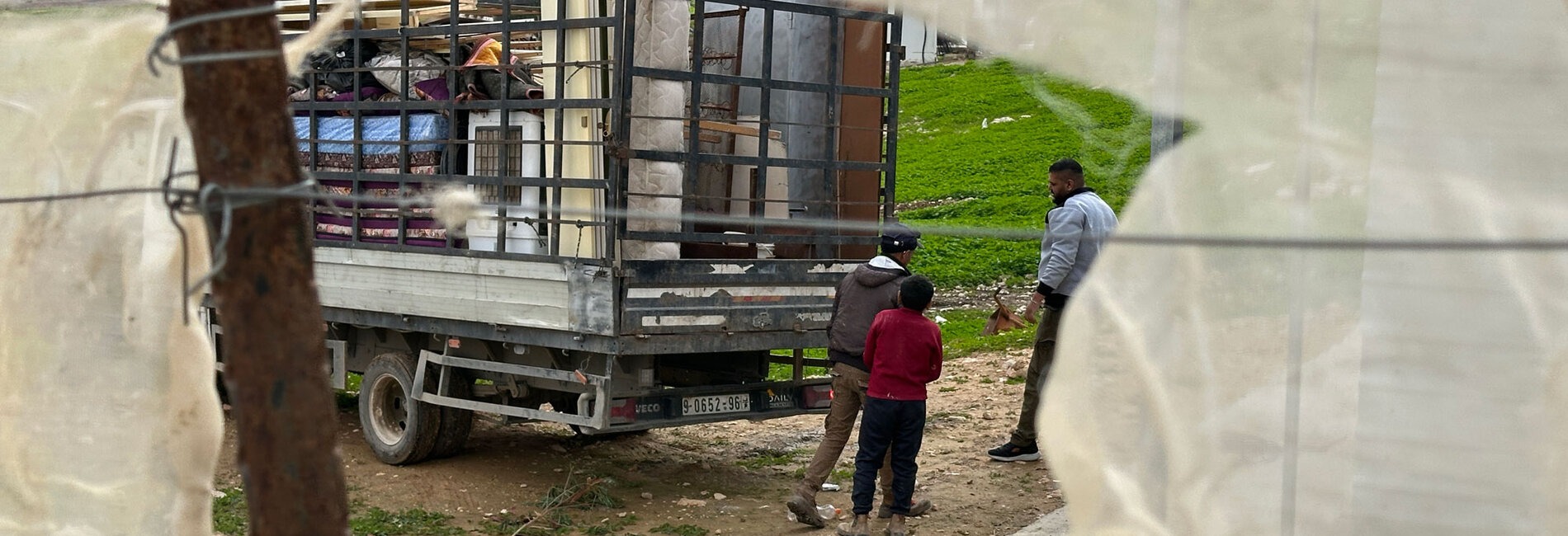
- On 19 January, at least 77 Palestinian Bedouin and herding households, comprising 375 people (including 186 children and 91 women) began dismantling their structures and relocating from the Ras Ein al ‘Auja community, in Jericho governorate, following intensified attacks, threats and intimidation by Israeli settlers, particularly during night-time hours. This displacement followed the forcible displacement of 21 families (110 people, including 61 children) on 8 January, after a series of settler attacks that included the physical assault and injury of an elderly man, cutting of solar electricity cables, and ploughing of privately owned land. Settlers continued to trespass into the community and graze livestock near residential shelters while families dismantled their homes, issuing threats that forced some households to abandon structures and belongings. Some families have fully relocated, others are in the process of moving, and additional households remaining in the community are assessed to be at imminent risk of displacement.
- Ras Ein al ‘Auja Bedouin community is surrounded by four settlement outposts, all established since April 2024, including one located approximately 700 metres southwest of the community and another near Al ‘Auja Spring. Between 2017 and 2023, OCHA recorded only two settler attacks resulting in casualties and/or property damage in Ras Ein al ‘Auja. By contrast, 36 such attacks were documented in 2024 and at least 38 in 2025. Over the past two years, residents have endured near-daily settler incursions, resulting in injuries, property damage, restricted access to pastures and the nearby Al ‘Auja Spring, and the theft of hundreds of livestock. Access to water has been especially compromised; settlers believed to be from these settlement outposts have repeatedly cut or damaged water pipes connected to Al ‘Auja spring, blocked access roads used for water collection and delivery, emptied households’ water tanks, and intimidated or assaulted residents and herders attempting to collect water, severely undermining livelihoods, living conditions and the community’s ability to sustain traditional herding activities. According to the Food Security Sector (FSS), the ongoing displacement is rapidly deteriorating food security and livelihoods in Ras Ein al ‘Auja, severely disrupting access to food, markets, and livestock-based livelihoods. The FSS assesses a high risk of acute food insecurity among displaced households and those at imminent risk, and highlights the urgent need for immediate food assistance, protection of remaining livestock assets (including veterinary care and fodder), and improved access to water and shelter for livestock in relocation areas to prevent further irreversible losses.
- On 17 January, dozens of masked Israeli settlers attacked the Mikhmas Bedouin community in Jerusalem governorate, injuring two Palestinians and two foreign activists, burning four residential structures, and displacing a Palestinian household of two people. According to local sources, at around 21:00, settlers broke into a residential structure while the couple was inside, sprayed them with pepper spray, beat them with clubs, dragged them outside and set the structure on fire. During the same attack, settlers assaulted other community members and the two foreign activists, who were providing protective presence following repeated settler attacks in the area, set fire to two vehicles, burned additional residential structures and water tanks, damaged an animal shelter, and partially damaged other structures and solar panels.
- Following the establishment of an Israeli settlement outpost near Atara village in August 2025, a series of settler attacks resulted in the forcible displacement of Palestinian herders across three villages in Ramallah governorate. Affected families in all three locations reported repeated raids, trespassing, intimidation, and direct threats, which forced them to dismantle their residential and herding structures and relocate to more densely populated village areas, where access to grazing land and livelihoods is severely constrained.
- On 6 January, four Palestinian herders, all men from the same extended family, including one person with a disability, were displaced from a traditionally used seasonal herding site in Area B of Ein Siniya village and relocated to Dura al Qare’, following near-daily threats, intimidation, and attacks by settlers believed to be from a newly established settlement outpost near Atara village.
- On 13 January, six Palestinian herders from an extended family were forcibly displaced from Area B at the entrance of Atara village and relocated to Burham village, after settlers established an outpost adjacent to their residential and herding structures and carried out repeated incursions and harassment, grazed livestock between shelters, damaged fodder, obstructed access to grazing land, and issued threats to kill and steal livestock.
- On 13 January, four Palestinian herding households, comprising 21 people including 12 children and two elderly persons, were displaced from Area B on the eastern outskirts of Bir Zeit town to a more central location in the town, following sustained settler attacks linked to the same outpost.
- For key figures and additional breakdowns of casualties, displacement and settler violence between January 2005 and December 2025, please refer to the OCHA West Bank December 2025 Snapshot.
Food Security and Livelihoods
- According to the World Food Programme (WFP) Market Monitor covering December, the economic situation in the West Bank throughout 2025 unfolded against a backdrop of escalating protection and displacement pressures, coupled with increased movement and access restrictions. These dynamics further disrupted livelihoods, trade flows, and access to markets, compounding the economic strain on households and undermining already fragile coping mechanisms. Citing the Palestinian Central Bureau of Statistics and the Palestine Monetary Authority, WFP noted that the West Bank economy experienced a significant contraction, with Gross Domestic Product (GDP) declining by 13 per cent between 2023 and 2025, despite a 4.4 per cent increase between 2024 and 2025. With an unemployment rate of 28.5 per cent (293,000 people) in the third quarter of 2025, total consumption fell by 12 per cent compared with 2023, reflecting weakened purchasing power, reduced incomes, and continued uncertainty affecting household spending and market activity.
- WFP further highlighted that the cost of living continued to rise. By November 2025, the Minimum Expenditure Basket increased by two per cent compared with pre-October 2023 levels, driven primarily by higher shelter and food costs. While most food prices remained stable or declined on a month-to-month basis in 2025, this stabilization occurred at levels that were already elevated compared with pre-October 2023. As a result, despite limited monthly price changes, in November the Consumer Price Index remained 0.6 per cent above pre-October 2023 levels, indicating a continued erosion of household affordability and purchasing power.
- Agriculture remains a critical livelihood and food security pillar; of approximately 700,000 families living in the West Bank, about 16.4 per cent (115,000 households) depend on agriculture for their livelihoods. Based on the results of an October survey conducted by the UN Food and Agriculture Organization (FAO), agricultural and herding families in the West Bank are facing acute and compounding pressures. Nearly 90 per cent of agricultural households, about 100,000 families, have experienced at least one recent shock, most commonly conflict and violence, rising living costs, or job loss. Income losses are widespread, with about 90 per cent of families working in agriculture reporting reduced earnings, driven by declines in crop and livestock production and sales. Moreover, the loss of off-farm employment since October 2023, combined with water scarcity, movement and land-access restrictions, limited availability of affordable inputs, and high fuel and transport costs, has significantly undermined household resilience. As a result, more than 72,000 farming and herding families, nearly two-thirds of all agricultural households, were found to require agricultural assistance to stabilize livelihoods, protect productive assets, and prevent further deterioration of food security.
- According to WFP, in December alone, more than 137,000 people (26,700 households) received emergency food vouchers under the shock response plan in the West Bank, while the regular voucher programme assisted more than 197,000 vulnerable people (about 46,200 households). Additionally, more than 40,600 Bedouin and herders in Area C of the West Bank received food vouchers or in-kind assistance. Meanwhile, 14,646 people (3,283 households) displaced by operations carried out by Israeli forces in the northern West Bank received digital cash transfers (ILS 1,680 / US$450 per household) to meet essential needs. About 4,000 workers from Gaza who are still stranded in the West Bank continued to receive regular cash assistance.
Funding
- As of 20 January, Member States disbursed approximately $1.7 billion out of the $4 billion (42 per cent) requested by the UN and partners through the 2025 Flash Appeal for the OPT to meet the most critical humanitarian needs of 3 million out of 3.3 million people identified as requiring assistance in Gaza and the West Bank, including East Jerusalem. On 8 December 2025, the UN and its humanitarian partners launched the 2026 Flash Appeal seeking $4.06 billion to address the humanitarian needs of 2.97 million out of 3.62 million people identified as requiring assistance in Gaza and the West Bank, including East Jerusalem. Nearly 92 per cent of those required funds are for the humanitarian response in Gaza, with just over eight per cent for the West Bank. In December, the oPt Humanitarian Fund managed 111 ongoing projects, totalling $61.1 million, to address urgent needs in the Gaza Strip (89 per cent) and the West Bank (11 per cent). Of these projects, 54 are being implemented by international NGOs, 44 by national NGOs and 13 by UN agencies. Notably, 48 out of the 67 projects implemented by international NGOs or the UN are being implemented in collaboration with national NGOs. For more information, please see OCHA’s Financial Tracking Service webpage and the oPt HF webpage.
SUBSCRIBE TO RECEIVE OCHA'S INFORMATION PRODUCTS
 SUBSCRIBE
OCHA Sites










Follow Us
Support
Your donations go to relief organizations delivering quick and effective support to Palestinians in need.