
Humanitarian Situation Update #347 | Gaza Strip
The Humanitarian Situation Updates on the Gaza Strip and on the West Bank are both issued every Wednesday/Thursday. The next Humanitarian Situation Update on the Gaza Strip will be published on 17 or 18 December.
Key Highlights
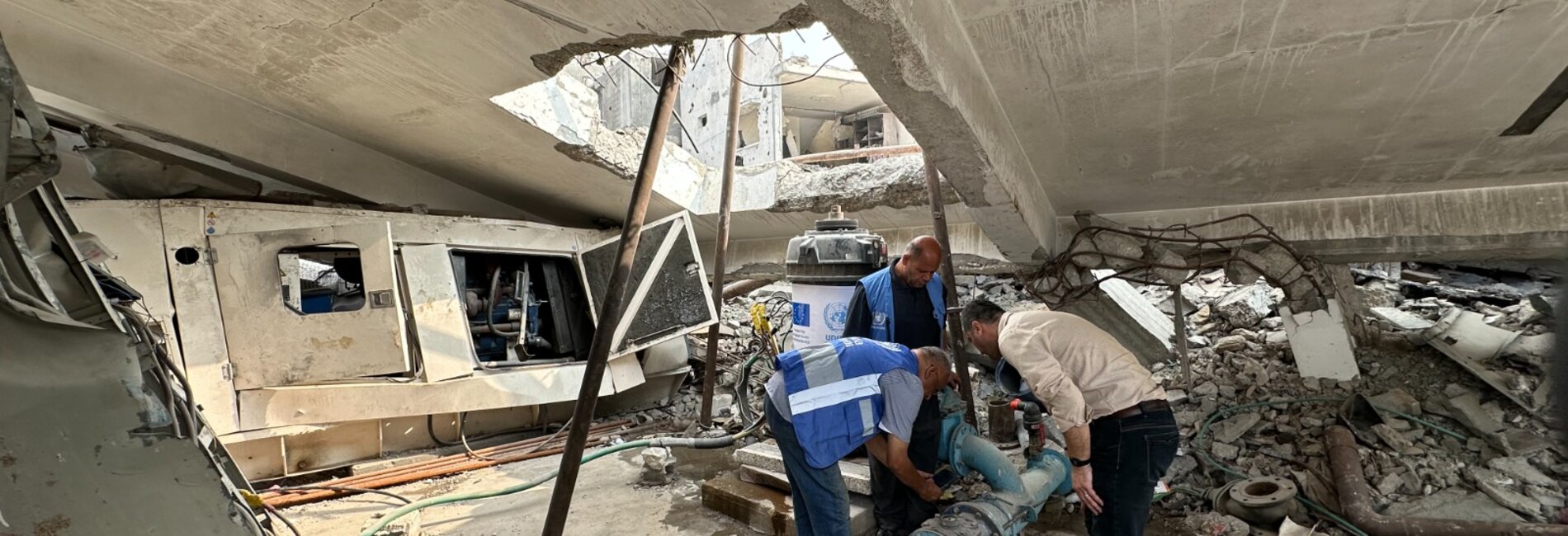
- Access to water has improved in Gaza owing to repairs to critical infrastructure and a near-doubling of water trucking by the UN and its partners.
- In anticipation of heavy rainfall and a deterioration in weather conditions, partners continue to identify displacement sites at high risk of flooding and prioritize winterization activities.
- Every week, about 15 women in Gaza give birth outside hospitals, without skilled attendants, according to the UN Population Fund.
- More aid must enter the Gaza Strip, especially aid that strengthens the health of pregnant and breastfeeding women, UNICEF Communication Manager stated, highlighting the harmful domino effect of maternal malnutrition on newborns.
- The Shelter Cluster estimates that fewer than 50,000 tents for about 270,000 people have entered Gaza.
- The UN and its humanitarian partners launched a US$4.06 billion Flash Appeal for the Occupied Palestinian Territory, allocating 92 per cent of the required funds for the humanitarian response in the Gaza Strip.
Context Overview
- Over the past week, airstrikes, shelling and gunfire continued to be reported across the Gaza Strip, resulting in casualties, including in areas where the Israeli military remains deployed – covering over 50 per cent of the Strip – as well as near and west of the so-called “Yellow Line,” which remains largely unmarked on the ground. Detonations of residential buildings and bulldozing activities continued to be reported, including near the so-called “Yellow Line.” Access to humanitarian assets, public infrastructure and agricultural land in areas where the Israeli military remains deployed, as well as access to the sea, remain severely restricted or prohibited.
- Between 3 and 9 December, the Site Management Cluster (SMC) reported that more than 16,400 displacement movements were recorded across the Strip, compared with over 20,500 the preceding week. The majority (about 16,000) were from southern to northern Gaza, while the remainder were either reverse movements to the south or from eastern to central Gaza city. Since the ceasefire came into effect on 10 October, over 793,700 displacement movements have been recorded, of which about 658,700 were from southern to northern Gaza. In December, over 90 per cent of displacement movements to the north have consisted of families traveling in light trucks, SMC reports, noting that this trend is driven by overcrowded living conditions in Khan Younis displacement sites and lack of access to adequate shelter materials.
- According to the Ministry of Health (MoH) in Gaza, between 3 and 10 December, 19 Palestinians were killed, 70 were injured and 10 bodies were recovered from under the rubble. This brings the casualty toll among Palestinians since 7 October 2023, as reported by the MoH, to 70,369 fatalities and 171,069 injuries. According to the MoH, the total number includes 223 fatalities who were retroactively added between 28 November and 5 December after their identification details were approved by a ministerial committee. MoH reported that since the ceasefire, 379 Palestinians have been killed, 992 injured and 627 bodies retrieved from under the rubble.
- On 7 and 8 December, the Palestinian Civil Defense (PCD) reported completing the transfer of 146 bodies to the Forensic Medicine Department and other authorities for burial in official cemeteries. These include 48 bodies exhumed from temporary graves at Al Ahli Arab Baptist Hospital (including 25 unidentified), and 98 from Al Shifa Hospital (including 55 unidentified). PCD noted that dozens of bodies remain in temporary graves at Al Shifa, which it plans to retrieve in the coming days. According to the International Committee of the Red Cross (ICRC), many families still lack information on missing relatives. The organization is supporting health and forensic authorities in the dignified management, documentation, and identification of the deceased, so families can obtain answers and closure. Under international humanitarian law, the dead must be handled respectfully and their dignity protected, ICRC emphasized.
- According to the Israeli military, between 3 and 10 December, as of noon, no Israeli soldiers were killed in Gaza. The casualty toll among Israeli soldiers since the beginning of the Israeli ground operation in October 2023 stands at 471 fatalities and 2,989 injuries. According to Israeli forces and official Israeli sources cited in the media, more than 1,671 Israelis and foreign nationals have been killed, the majority on 7 October 2023 and its immediate aftermath. On 3 December, according to official Israeli sources, the body of one Thai hostage was returned from Gaza to Israel, bringing to 27 the overall number of returned hostage bodies since the ceasefire. As of noon on 10 December, the remains of one hostage is still in the Gaza Strip.
- On 8 December 2025, the UN and its humanitarian partners launched a Flash Appeal for $4.06 billion to address the humanitarian needs of 2.97 million out of 3.62 million people identified as requiring assistance in Gaza and the West Bank, including East Jerusalem, in 2026. Nearly 92 per cent of those required funds are for the humanitarian response in Gaza, with just over eight per cent for the West Bank. Bureaucratic impediments, access restrictions, and anti-UN rhetoric collectively constrain humanitarian space and the ability to operate at scale. The Appeal stipulates that genuine efforts to enable humanitarian assistance to and throughout the Occupied Palestinian Territory (OPT) requires full compliance by all parties with international humanitarian law, including the protection of civilians, and critical changes to the operating environment.
- According to the Protection Cluster, the protection environment across Gaza remains extremely severe due to ongoing displacement, insecurity, and worsening winter conditions. Overcrowded shelters and frequent population movements limit access to services and heighten risks of family separation and exploitation. Flooding, heavy rainfall, and dropping temperatures further degrade unsafe living conditions, particularly for women, children, the elderly, and persons with disabilities. Protection partners report rising demand for psychosocial support and an urgent need for winterization supplies, dignity kits, accessibility improvements, and tents for overcrowded or female-headed households to mitigate risks related to weather and gender-based violence. At the same time, operational constraints – including restricted movement, damaged infrastructure and supply shortages – continue to impede service delivery. Despite challenges, partners are working to sustain coverage through mobile teams, community-based mechanisms, and targeted support to the most vulnerable groups, though growing needs continue to exceed available resources.
- The Protection Cluster reported that in November, 100 mobile protection teams, including emergency protection responders and the Protection from Sexual Exploitation and Abuse (PSEA) Network, conducted 46 joint safeguarding monitoring visits across Gaza, reaching 1,276 people with key protection messages, including on PSEA. The monitoring aimed to strengthen safe and dignified distribution practices, reinforce accountability to affected people, and address protection and PSEA risks at distribution points. Successful measures observed included respectful staff conduct, clear communication with beneficiaries, orderly crowd flow, accessibility measures for the elderly and people with mobility impairment, and supportive interactions between staff and affected people. Several gaps persisted, with only 17 per cent of sites having gender-segregated queues and more than half of distribution teams being entirely male.
Humanitarian Access
- While there have been improvements in the volume of supplies brought into Gaza, the ability of aid actors to operate at scale remains constrained due to insecurity, customs clearance challenges, the limited number of partners authorized by Israeli authorities to bring cargo into Gaza, delays and denials of cargo at operational crossings, and limited routes available for transporting humanitarian supplies within Gaza. In the two months following the 10 October ceasefire, according to the UN 2720 Mechanism, the UN and its partners collected about 100,000 metric tons (MT) from Gaza’s crossings, reflecting a 67 per cent increase in the volume of collected supplies compared with the preceding two months when about 59,800 MT of aid were collected by the UN and its partners. Of the total, 81 per cent was food aid, almost nine per cent were shelter supplies, and about nine per cent comprised health, nutrition and water, sanitation and hygiene (WASH) supplies. The opening of Zikim crossing on 14 November, which has been operating on an alternating offload-and-uplift schedule with Kissufim crossing, has not yet resulted in a substantive increase in the overall volume of aid entering the Strip through the UN and its partners. Between 14 November and 5 December, the UN and its partners collected over 39,400 MT of aid from the three operational crossings, according to the UN 2720 Mechanism, which is comparable to the 38,200 MT collected in the preceding three weeks when only two crossings (Kerem Shalom and Kissufim) were functioning.
- Humanitarian convoys by the UN and its partners inside Gaza continue to require coordination with Israeli authorities to and from crossings and in or near other areas where Israeli forces remain deployed. Between 3 and 9 December, humanitarian organizations coordinated 53 missions with the Israeli authorities, of which 35 were facilitated, three were cancelled, nine were impeded, and six were denied. Despite improved approval rates for humanitarian missions inside Gaza since the ceasefire, access denials persist for critical infrastructure missions, particularly those involving water and sewage systems and some health facilities. Over the past week, three such missions were denied: one to assess a wastewater treatment facility in northern Gaza, another to visit a wastewater treatment plant in Khan Younis, and a third mission to assess conditions at Al Awda and Indonesian hospitals in northern Gaza. The southern section of Salah ad Din Road remains inaccessible; however, on 8 December, an assessment and clearance mission was successfully facilitated to ensure accessibility for humanitarian cargo transport, in anticipation of a possible reopening.
- Livestock remain a vital source of food security, income, and transportation for many families in the Gaza Strip. According to the Food Security Sector (FSS), for the first time since August 2024 and after more than 15 months, some 3,500 veterinary kits entered Gaza on 5 December via UN coordination. During the first day of the kits’ distribution on 9 December, over 130 herders received essential supplies to support the health of their animals, which will contribute to improved public health and safeguarding their livelihoods. Since 10 October, FSS partners have also supplied more than 1,700 animal herders across the Gaza Strip with fodder to sustain surviving livestock and enable the resumption of local production of milk and dairy products. Humanitarian partners continue to face constraints and challenges imposed by Israeli authorities in bringing into Gaza many agricultural inputs, such as seeds, organic fertilizers and irrigation systems, limiting the ability of partners to rehabilitate local food systems and enhance dietary diversity.
- On 8 December, the World Health Organization (WHO) facilitated the medical evacuation of 25 patients from Gaza, in addition to 92 companions. According to WHO, 260 patients and 800 companions have been evacuated since the ceasefire. More than 18,500 patients, including 4,000 children, require medical evacuation, as the advanced care they need is not available in Gaza. WHO stated that the increase, from 16,00 to 18,500 patients awaiting to leave, is partly because people, previously unable to reach health facilities due to the insecurity, are now able to reach hospitals for medical assessment and consideration for evacuation for health care outside Gaza. WHO continues to call for additional support and the opening of all evacuation routes, particularly to the West Bank, including East Jerusalem.
Shelter and Winterization
- In anticipation of heavy rainfall and a deterioration in weather conditions this week, SMC partners continue to prioritize winterization activities, such as improving drainage, clearing pathways and providing empty flour and rice bags (repurposed as sandbags) to protect sites with existing site management structures from flooding. Most of the high-risk displacement sites lack any site management support or viable on-site flood mitigation measures, making evacuation the last-resort option once rain sets. More than 180,000 people in over 200 flood-prone displacement sites have been prioritized for evacuation, out of nearly 850,000 people at 761 sites considered at highest risk of facing floods, according to a recent flood risk analysis by the SMC.
- Families prioritized for relocation are living in low-lying or debris-filled areas along the coastline without drainage or protective barriers. Along the Khan Younis shoreline, more than 4,000 people live in high-risk coastal zones. Of these, around 1,000 people, those directly in wave-impact lines, are being prioritized for evacuation. The remaining 3,000 people will receive reinforced in-situ shelter assistance and other essential items, while also being advised to evacuate to safer areas. On 10 December, SMC partners supported the evacuation of 200 of the prioritized households to Hamad city, and planning is underway to evacuate 300 additional households. Furthermore, the SMC Cluster is working with the Khan Younis Municipality to operationalize two safer evacuation sites and preparation works are underway. Similar evacuation initiatives are ongoing in Deir Al Balah and Gaza city, where authorities, communities, the UN and partners are coordinating to identify suitable land and to ensure that affected families receive timely information to make informed decisions.
- In parallel, Shelter Cluster partners continue to distribute emergency shelter assistance, including tents, tarpaulins, bedding items, winter clothing and vouchers. Taking into account both UN-coordinated aid and bilateral donations, the cluster estimates that less than 50,000 tents (for about 270,000 people) have entered Gaza, of which nearly 40,000 tents (for 220,000 people) have already been distributed. As of 10 December, 1.28 million people remain in need of urgent shelter assistance, while aid partners continue to face major limitations in bringing into Gaza their supply pipeline. At the current pace, the Shelter Cluster warns that existing efforts cannot meet the scale of need. On 10 December, the Norwegian Refugee Council (NRC) highlighted: ‘’International aid organisations remain blocked from bringing in relief and nearly 4,000 pallets of shelter materials have been rejected. Gaza urgently needs heavy machinery, tools and shelter items to prevent catastrophic flooding.’’
- Recent rains have aggravated overcrowding concerns and poor living conditions facing more than 74,000 people sheltering in over 100 United Nations Relief and Works Agency for Palestine Refugees in the Near East (UNRWA) schools-turned-shelters, including 85 displacement sites managed by UNRWA. Most of these sites are in Khan Younis and the remainder in Deir al Balah. UNRWA teams continue to remove water from flooded yards, clear blocked manholes and drainage collectors, repair damaged tents inside school compounds, and distribute tarpaulins and other materials to help families reinforce their shelter spaces against ongoing winter weather. Between 14 November and 8 December, UNRWA reached more than 82,000 households with winterization items, such as tarpaulins, blankets and winter clothes for children. Ongoing distribution of locally produced shelter materials, including wooden panels and metallic sheets manufactured in collaboration with private workshops, is helping UNRWA meet urgent shelter and education needs despite aid entry restrictions. As of 10 December, UNRWA has shelter supplies for up to 1.3 million people pre-positioned outside Gaza, but Israeli authorities continue to ban the Agency from directly bringing humanitarian aid into Gaza.
- According to the Shelter Cluster, the first winter rains have made it clear that tents alone are not a viable shelter solution for people in Gaza. Since mid-November, heavy rains have destroyed thousands of tents. As emergency structures, tents offer limited protection from heavy rain, flooding, or cold, and rapidly deteriorate under prolonged use. The Shelter Cluster stresses the urgent need to complement emergency shelter assistance with a rapid shift towards transitional shelter solutions. These include repairs to damaged housing, upgraded emergency shelter kits, and the provision of stand-alone transitional units. All transitional shelter solutions require the large-scale entry of materials like timber, steel, tools, and tarpaulins, which are currently entering in insufficient quantities or are blocked from entry by Israeli authorities. The Shelter Cluster calls for unimpeded humanitarian access and the immediate entry of shelter materials at scale as the only viable pathway to respond to emergency shelter needs, enable transitional solutions, and ultimately support a shift toward more durable shelter options for displaced people in Gaza.
Maternal Malnutrition and Health care
- Highlighting the scale of malnutrition among pregnant and breastfeeding women during the war, the United Nations Children’s Fund (UNICEF) Communication Manager warned that the “devastating domino effect” of malnutrition will likely result in babies being born with low birth weight for months to come. Recalling a pattern observed as the war progressed, UNICEF noted that "malnourished mothers, giving birth to underweight or premature babies, who die in Gaza’s neonatal intensive care units or survive, only to face malnutrition themselves or potential lifelong medical complications.” In October 2025, 8,300 pregnant and breastfeeding women were admitted for treatment for acute malnutrition. "Low birth weight is generally caused by poor maternal nutrition, increased maternal stress, and limited antenatal care. In Gaza, we witness all three, and the response is not moving fast enough nor at the scale required,” UNICEF stated, warning that low birth weight infants are about 20 times more likely to die than infants of normal weight. Citing MoH data, UNICEF said that in 2022, only five per cent of newborns, or an average of 250 babies per month, had low birth weight (less than 2.5 kilograms). By contrast, in the first half of 2025, 10 per cent of newborns, or an average of 300 babies per month, were born underweight. According to UNICEF, data shows that “the number of babies who died on their first day of life increased 75 per cent – from an average of 27 babies per month in 2022 to 47 babies per month between July and September 2025.”
- UNICEF is replacing destroyed incubators, ventilators and other lifesaving equipment and providing supplements to pregnant and breastfeeding women, among other services. To improve the response, UNICEF Communication Manager noted that “more aid must enter the Gaza Strip, especially aid that strengthens the health of pregnant and breastfeeding women and equips hospitals with everything they need to save lives. This must be supplemented by commercial goods that restock local markets with enough nutritious foods, so the prices continue to fall. And the fear must end. This ceasefire should offer families safety, not more loss. More than 70 children have been killed in the eight weeks since the ceasefire began. The ongoing attacks and the killing of children must stop immediately.”
- Women in Gaza are still giving birth amid ruins. Every week, about 15 women deliver outside hospitals, without skilled attendants or safety and one in three pregnancies is high-risk, according to the UN Population Fund (UNFPA). Only 15 per cent of health facilities offer emergency obstetric care, and neonatal units are operating at up to 170 per cent of their capacity, often requiring newborns to share incubators, UNFPA stated. UNFPA added that about half of maternal and child health medicines are at zero-stock levels, family planning services are scarce, and screening and treatment for breast and cervical cancer have ceased. Since the ceasefire, amid significant challenges, UNFPA and its partners have provided delivery beds and cardiotocography devices, but some life-saving equipment, including five containerized maternity units needed to expand sexual and reproductive health services, remain outside Gaza and denied entry.
Access to Water and Sanitation Services
- Since the beginning of the ceasefire, the volume of water trucked by WASH Cluster partners has nearly doubled compared with the preceding two months, with a daily average of about 26,000 cubic metres (m3) of drinking water and more than 9,300 m3 of domestic water distributed, according to the WASH Cluster. Water trucking operations remain one of the most adaptable humanitarian programmes, as they allow for swift adjustments to provide services in new locations as people move and needs are identified, the WASH Cluster noted.
- The Coastal Municipalities Water Utility (CMWU) and WASH partners, including UNRWA, have repaired and carried out upgrades to critical infrastructure, thereby improving people’s access to piped water and reducing reliance on trucking. According to the WASH Cluster, the increased volume of produced domestic and potable water is now serving more than 1.78 million people across Gaza. Among other accomplishments, CMWU, in cooperation with local municipalities and partners, have completed repairs of the Abu Sharkh well in Jabalya, restoring production to 145 m3 per hour for approximately 25,000 residents. Similarly, the Safa wells, serving key neighbourhoods including Az Zaytoun, Ad Daraj, At Tuffah, and parts of Ash Shuja'iyyeh, have been rehabilitated to restore an estimated 500 m³ per hour, benefiting 250,000-–300,000 residents. In addition, CMWU technical teams have upgraded a key desalination unit at the South Gaza seawater plant, increasing production to 18,000 m³ per day, serving over 800,000 residents across southern and central Gaza.
- Notwithstanding these improvements, the WASH Cluster reported that many locations remain uncovered or severely underserved, particularly in North Gaza (including Beit Lahiya), parts of Deir al Balah, and Al Mawasi. To meet existing gaps, the cluster is re-directing water trucking operations to these locations, rehabilitating local wells and installing community-level water tanks to improve collection.
- According to the WASH Cluster, as of 3 December 2025, the wastewater level at Sheikh Radwan lagoon dropped from high to medium risk, with the increased availability of fuel and following the completion of emergency pump repairs and the outlet pipe to the sea by UNICEF and its partners. The lagoon has become heavily polluted with sewage and stagnant water over the past two years due to widespread destruction of wastewater infrastructure in Gaza city. While the lagoon levels are continuously monitored and pumping rates are regularly adjusted to inflow rates, the WASH Cluster cautions that in the event the lagoon overflows, this would pose significant public health risks, including the spread of water-borne diseases.
- Solid waste management remains a challenge, with the two official landfills still inaccessible, the entry of spare parts for waste collection points limited, and access to essential machinery (such as waste collection trucks) severely constrained. According to the UN Development Programme (UNDP), between October 2023 and November 2025, approximately 900,000 tons of waste have been generated and dumped in temporary dumping sites, but the rate of collection remains limited. Since the ceasefire, 2,500 m3 of solid waste has been collected per day, compared with a daily average of 1,300 m3 collected in September 2025, while an estimated 3,300-3,850 m3 of solid waste is generated every day across Gaza. Temporary dumping sites have been largely saturated, with many located in densely populated areas that face serious environmental and public health risks. Of critical concern is the impact of rainfall and flooding, which may spread accumulated waste into surrounding communities, contaminate water sources, or block drainage systems, thereby heightening the risk of waterborne diseases. Without sustained waste collection and safe disposal, public health risks are expected to escalate throughout the winter season, UNDP warns.
Access to Education
- Extensive damage to school infrastructure has forced a reliance on temporary learning spaces (TLS), with efforts ongoing to expand learning services. According to the Education Cluster, the number of TLS grew from 303 in October to 392 in November. Overall, with support from 5,180 teachers, TLS are currently serving about 220,950 students, or about 34 per cent of school-aged children in Gaza, the majority of whom are in Khan Younis and Deir al Balah governorates. One of the key challenges facing partners in further expanding TLS is the large concentration of displaced people in certain areas, such as Al Mawasi area of Khan Younis and northern Remal neighbourhood in Gaza city, with needs far exceeding existing TLS capacity. Moreover, many school buildings continue to serve as shelters for internally displaced people (IDPs), and widespread debris and the potential presence of unexploded ordnance in school yards prevent or significantly delay the use of those compounds for establishing TLS.
- To expand enrolment capacity, education partners continue to support the rehabilitation of classrooms and have prioritized the rehabilitation of 97 out of over 2,000 classrooms estimated to require rehabilitation. Since the ceasefire, 65 classrooms have been fully rehabilitated, including 44 in November. Additionally, partners continue to submit requests to Israeli authorities to bring into Gaza basic learning materials, including pencils, books and other essential items, amid ongoing restrictions on the entry of educational materials and basic learning equipment. In parallel, partners continue to support local initiatives to manufacture chairs and desks using available resources. Wooden pallets are being repurposed to create seating surfaces, while metal pallets – brought in through Member State contributions – are cut and welded in workshops to form desk frames. These efforts have already produced simple but functional desks, providing immediate support to learning spaces. Between early September and 2 December, 460 high performance tents have entered Gaza through UN coordination, some of which have already been installed as classrooms, TLS, or child-friendly spaces.
- Winter weather and flooding could compromise* TLS expansion efforts, particularly given that widespread destruction of drainage systems, infiltration basins, and stormwater facilities has significantly reduced the Gaza Strip’s capacity to manage seasonal floods, the Education Cluster cautions. Based on recent geospatial analysis conducted by the Cluster, 13 TLS serving over 7,800 students are situated within flood-prone areas and 24 TLS serving more than 16,000 students are located between 11 and 100 metres of a flood-prone area, placing them at high risk of temporary closure.
Funding
- As of 10 December, Member States disbursed approximately $1.6 billion out of the $4 billion (40 per cent) requested to meet the most critical humanitarian needs of 3 million out of 3.3 million people identified as requiring assistance in Gaza and the West Bank, including East Jerusalem, under the 2025 Flash Appeal for the OPT. Nearly 88 per cent of the requested funds is for the humanitarian response in Gaza, with just over 12 per cent for the West Bank. In November, the oPt Humanitarian Fund managed 128 ongoing projects, totalling $73.5 million, to address urgent needs in the Gaza Strip (89 per cent) and the West Bank (11 per cent). Of these projects, 61 are being implemented by international NGOs, 51 by national NGOs and 16 by UN agencies. Notably, 58 out of the 77 projects implemented by international NGOs or the UN are being implemented in collaboration with national NGOs. For more information, please see OCHA’s Financial Tracking Servicewebpage and the oPt HF webpage.
SUBSCRIBE TO RECEIVE OCHA'S INFORMATION PRODUCTS
 SUBSCRIBE
OCHA Sites










Follow Us
Support
Your donations go to relief organizations delivering quick and effective support to Palestinians in need.