
Humanitarian Situation Report | 29 October 2026
Key Highlights
- Families along the “Yellow Line” in Gaza are facing reported arson attacks and recurrent shootings as Israeli forces place additional yellow cement blocks nearby; despite shortages in humanitarian supplies, those displaced as a result of such pressures are receiving rapid support through available stocks.
- Acute respiratory infections represent 60 per cent of all medical consultations reported by the Health Cluster between 18 and 25 October, followed by skin diseases (21 per cent) and acute watery diarrhea (18 per cent).
- Amid multiple reports of strikes affecting humanitarian operations, UNOPS reported three security incidents over three consecutive days affecting its convoys and premises.
- In the West Bank, humanitarian partners are supporting local authorities in responding to the needs of approximately 3,000 Palestinians reportedly displaced during an ongoing operation by Israeli forces in Hebron city, following a shooting attack by two Palestinians who killed two Israeli soldiers. Displacement figures remain under verification.
- October has already recorded the highest monthly number of settler attacks resulting in casualties or property damage since documentation began in 2006, with a total of 397 incidents reported between 1 and 26 October.
- Between 20 and 26 October, 62 settler attacks resulting in casualties or property damage were documented across 49 West Bank communities, including 38 olive-harvest-related attacks.
- In Khirbet Ras al Ahmar, Tubas governorate, 24 Palestinian herding families comprising 94 people, including 40 children, were displaced amid increasing access restrictions and settler attacks.
Gaza Strip
The reporting period is 19-25 October 2026 unless otherwise specified.
Multiple Israeli airstrikes, shelling, shooting and naval fire were recorded, reportedly causing civilian casualties and further destruction. Israeli incursions and demolitions were also reported near the “Yellow Line.” Humanitarian partners continue to operate amid ongoing insecurity. Since 19 October, a UN site in Deir al Balah has come under fire. There have also been three separate shooting incidents near three UN schools. On 26 October UNOPS reported three incidents over three consecutive days affecting their convoys and premises. These were close proximity explosions; drivers detained at checkpoints, and multiple small arms rounds striking one of the UNOPS guesthouses.
| KEY FIGURES | |
|---|---|
| 525 households | 517 of the households |
| supported by the Joint Distribution Consortium following 14 incidents | lost tents or other belongings in airstrikes |
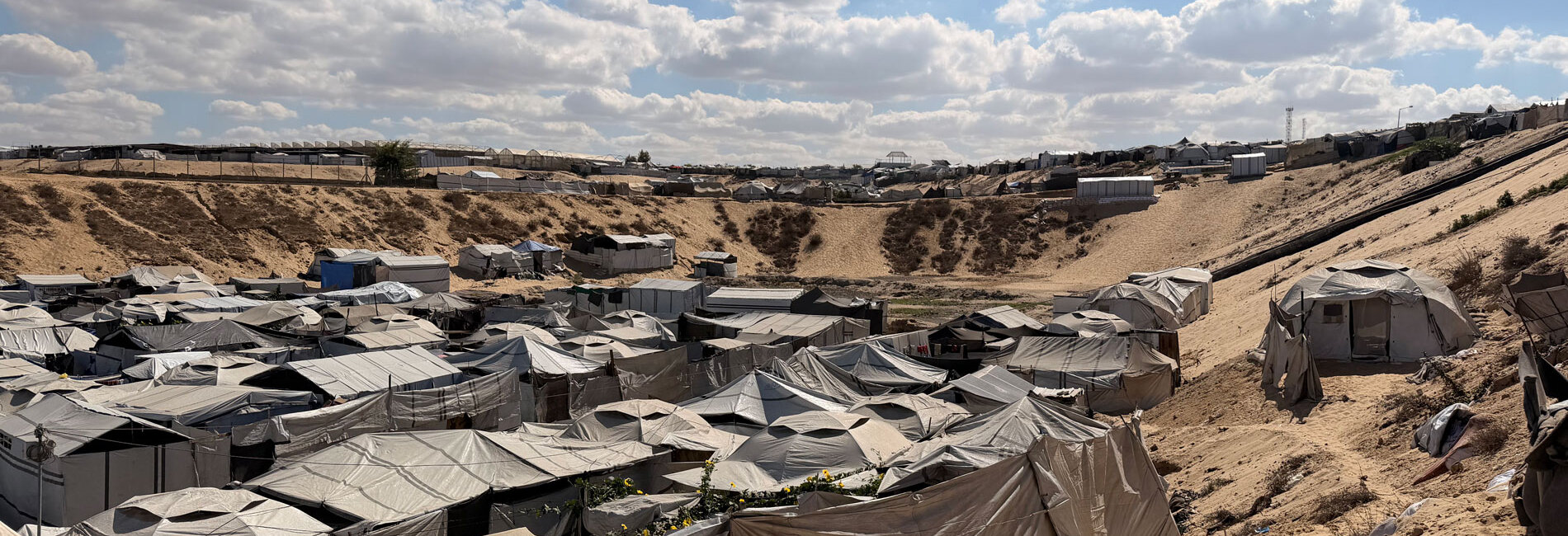
Families in areas along the so-called “Yellow Line” continue to face reported arson attacks, recurrent shooting and the placement of new yellow cement blocks by Israeli forces, which signal that the area is unsafe. In recent days, new blocks have been observed in Ash Shuja’iyyeh and parts of Deir al Balah. On 25 October, tents sheltering displaced households were set on fire in the Ash Shuja’iyyeh area of Gaza city. The UN and partners visited the site on 26 October to assess needs, identifying 9 families affected by the incident, who received emergency assistance and were willing to relocate. This incident followed another fire reportedly instigated by armed Palestinians reportedly linked to Israeli forces a few days earlier, triggering the new displacement of 137 households. Humanitarian partners mobilized support for the affected families, including new tents, tarpaulins, blankets, and hygiene kits. Approximately 130 households remain at the site, living in difficult conditions.
According to the Ministry of Health in Gaza, which operates under the de-facto authorities, 33 Palestinians were reported killed and 188 injured between 20 and 26 October, bringing the total number of casualties since the ceasefire agreement to 1,559 fatalities and 5,608 injuries. Another 42 fatalities were retroactively added to the total number after their identification details were approved by MoH.
The Logistics Cluster reports that, between 19 and 25 October, out of 651 UN and partner trucks carrying humanitarian supplies manifested for entry into Gaza, 586 were successfully offloaded on the Israeli side of Kerem Shalom, of which 291 came from Ashdod, 187 from Egypt and 54 from Jordan. Compared with the previous week, the number of humanitarian trucks manifested for entry decreased by 16 per cent, but the percentage of offloaded trucks remained stable.
The private sector collected 343 commercial truckloads into the Gaza Strip between 19 and 25 October, based on data from the Gaza Chamber of Commerce shared with the Cash Working Group. This represents a 9 per cent increase compared with the previous week (12-18 October), during which a halt in commercial imports was reported in connection with a high fee said to be charged by the de facto authorities, with conflicting narratives over whether that fee was voluntary or imposed.
Of the total, the Chamber of Commerce indicates that 129 carried food supplies, 73 solid fuel, 68 shelter materials, 38 hygiene items, 25 cooking gas, 2 medicines and medical supplies, and one stationery. Seven trucks – or 2 per cent of the total – carried non-essential items, representing a significant drop compared with the 25-35 per cent recorded in the past week (12-18 October).
The reported halt in commercial entries seems to have had a direct impact on bakeries resuming daily production and prices, with the cost of flour and fresh products increasing by over 70 per cent compared to the week (12-18 October), based on information from the Gaza Market Monitoring Committee (GMMC). The Food Security Sector reports that some partners were forced to adjust the cooked meal menu, scale down or pause free bread and fresh produce distribution due to shortages of fruit, vegetables and wheat flour and high prices.
Flood risk mitigation efforts ahead of winter
As the winter approaches, conditions remain dire across the Strip. On 19 October, OCHA and humanitarian partners assessed six displacement sites in the An Nasser neighbourhood of the Khan Younis governorate, none of which has an active organization providing site management presence. Five sites that cumulatively host 750 households are situated in Al Joura, a low-lying area approximately 30 metres below the surrounding ground level. A sixth site, Al Ilm, hosts 250 households, with shelters located both along the cliff edge and in the low-lying area. The team examined flood and erosion risks, explored possible site-improvement measures, and documented priority humanitarian needs requiring partner follow-up. Families reported lacking enough shelter materials, sanitation, water access, food assistance, health care and cash-based support. The team has mobilized support accordingly.
The Water, Sanitation and Hygiene (WASH) Cluster conducted a rapid field assessment of the Abu Rashid stormwater basin and pumping station near the “Yellow Line” in Jabalya, North Gaza; the assessment revealed the basin is incapacitated due to lack of power and access being unsafe. Without an emergency rehabilitation and stabilization intervention, the stormwater lagoon is at risk of flooding during the winter, directly affecting nearby displacement sites at risk of flooding. A further detailed assessment is taking place to explore possible mitigation options.
In the Mawasi area of Khan Younis, the WASH Cluster also implemented mitigation works at a displacement site located within a stormwater basin to reduce the risk of flooding.
Meanwhile, the UN Development Programme (UNDP) reports that its teams are using recycled crushed concrete to raise and level shelter sites ahead of winter.
Communicable diseases
| KEY FIGURES | |
|---|---|
| 60% respiratory diseases | 21% acute watery diarrhea |
| of diseases reported through medical consultation | of diseases reported through medical consultation |
Communicable diseases accounted for 18 per cent of all medical consultations conducted by Health Cluster partners during the reporting period, with acute respiratory infections representing 60 per cent of reported diseases, followed by skin diseases (21 per cent) and acute watery diarrhea (18 per cent). An increase in probable viral and bacterial meningitis cases has also been observed since September, primarily in Gaza governorate. Case investigations, line-listing, cerebrospinal fluid follow-up, and laboratory confirmation activities are ongoing, while access to laboratory supplies remains critical for effective outbreak response.
Humanitarian response activities at a glance – Gaza Strip
19–26 October 2026 (unless otherwise specified)
Food Security: As of 26 October, 16 of 17 commercial bakeries supported through a “fuel-only” production model were operational, while 21 subsidized bakeries continued producing approximately 80,000 two-kilogram bread bundles daily. As of 22 October, partners prepared 586,000 meals daily through 90 kitchens and delivered them to 1,368 locations across the Gaza Strip. During the ongoing October distribution cycle, approximately 422,000 people (116,000 households) received food parcels and wheat flour through 28 distribution points, providing around 50 per cent of minimum caloric requirements. Partners also completed one round of fodder distributions to approximately 2,250 livestock holders and launched a second round targeting 2,250 herders and 730 working-animal owners.
Shelter and Site Management: Shelter Cluster partners reached 8,590 households with shelter and non-food item assistance, distributing 734 tents, 1,891 winter clothing kits, 44 bedding kits, 960 blankets, 1,858 toolkits, 2,190 sealing-off kits, 1,256 sheets of transparent plastic and 123 refugee housing units (RHUs).
Health: WHO started cascade training on polio, disease surveillance and adverse events following immunization across four governorates, targeting approximately 300 medical doctors from international and local NGOs. Partners equipped facilities with infection prevention and control supplies , including alcohol-based hand rub, chlorine, personal protective equipment and environmental cleaning materials. Between 21 and 27 October, 69 patients, including 12 children, were medically evacuated through the Rafah crossing alongside 93 caregivers. Since the announcement of a ceasefire agreement on 10 October 2025, WHO has supported the evacuation of 3,547 patients, along with 5,855 caregivers, through the Rafah and Kerem Shalom crossings, including 2,746 patients and 4,065 companions evacuated via Rafah since its reopening on 2 February 2026.
Water, Sanitation and Hygiene: Partners continued preparing for the cold and rainy season winterization preparedness activities in displacement sites, including through road improvement and flood-mitigation works. They distributed 260 water tanks, 6,500 jerry cans, 7,000 tarpaulins, 9,500 bars of soap and 5,000 kilograms of laundry soap.
Protection: Protection partners reached 13,454 people with direct protection services, including mental health and psychosocial support, psychological first aid, case management, legal assistance, explosive ordnance risk education, disability inclusion support and community accountability activities. An additional 1,803 people received protection-sensitive and intersectoral assistance, including food vouchers, hygiene items, menstrual hygiene management kits, sexual and reproductive health services and assistive devices. Protection monitoring activities included six focus group discussions and 73 key informant interviews, reaching 732 people across 13 neighbourhoods. Partners also supported 230 returnees with psychological first aid, emergency assistance and referral services. Child protection partners reached 4,122 children and 2,564 caregivers with mental health and psychosocial support services, including individual and group counselling, psychological first aid, trauma recovery interventions and parenting support. Partners provided case management services to 138 newly identified at-risk children, facilitated 86 referrals for specialized services, and continued support for 58 children in alternative care. Awareness-raising and community engagement activities reached 1,216 children and 1,064 caregivers. Emergency assistance included the distribution of 10,000 winter clothing kits and 600 stationery kits, while 147 vulnerable children received cash assistance.
Joint Distributions | Emergency Response: Joint Distribution Consortium processed appeals for help following 14 reported incidents affecting 525 households across Gaza. The appeals included seven in Gaza affecting 372 households, five in Khan Younis affecting 59 households, and two in Deir al Balah affecting 94 households. The reported incidents included nine airstrike incidents affecting 517 households, four accidental fire incidents affecting seven households, and one displacement incident affecting one household. Based on rapid assessments, 84 households were classified as high-need, 324 as medium-need, and 117 as low-need. Assistance was prioritized according to the type of incident, level of damage, and assessed household needs.
West Bank
The reporting period is 20-26 October 2026 unless otherwise specified.
| KEY FIGURES | |
|---|---|
| 94 | 37 |
| people displaced due to settler attacks and related access restrictions, including 40 children | people displaced by demolitions, including 19 children |
The humanitarian situation across the West Bank, including East Jerusalem, continued to be affected by operations by Israeli forces, settler violence and restrictions on Palestinian movement and access to essential services. On 23 October, two Palestinians opened fire at an Israeli checkpoint in Hebron city, killing two Israeli soldiers and injuring four others before both Palestinians were killed in an exchange of fire. Israeli forces subsequently imposed extensive movement restrictions and reportedly ordered hundreds of Palestinian families to evacuate their homes in parts of Hebron city, disrupting access to essential services and education (see more information below).
During the reporting period, 57 Palestinians, including nine children, were injured across the West Bank, including East Jerusalem: 23 by settlers and 34 by Israeli forces. Of the total, 27 (47 per cent) were injured by Israeli forces or settlers in the context of settler attacks, including 18 during olive-harvest-related incidents. A total of 62 settler attacks resulting in casualties or property damage were recorded across 49 communities.
Movement restrictions continued to affect access to essential services and livelihoods. In southern Hebron governorate, Israeli forces closed a road gate near the settlement of Carmel on 23 October, restricting movement along key routes serving communities south of Yatta and access to Masafer Yatta, affecting at least 5,800 Palestinians. Israeli authorities also introduced additional restrictions on coordinated vehicle access to “Firing Zone 918,” limiting access to designated days and purposes, further compounding longstanding challenges to education access, including limited school transportation and the previously reported confiscation of vehicles transporting students. In East Jerusalem, a newly installed road gate in Wadi ar Rababa, Silwan, restricted vehicular access for approximately 700 Palestinian residents.
During the reporting period, Israeli authorities demolished or forced Palestinians to demolish 22 Palestinian-owned structures for lack of Israeli-issued building permits, displacing 37 people, including 19 children, and otherwise affecting 94 people, including 44 children. The demolitions included residential structures in Qalandiya Camp, Al Walaja and Qalqiliya city, as well as agricultural and livelihood structures in East Jerusalem and Jericho governorate.
Humanitarian impact of Israeli forces’ operation in Hebron city
| KEY FIGURES | |
|---|---|
| 3,000 | 251,000+ |
| reportedly displaced, according to Hebron Municipality; displacement figures remain under verification | students shifted to remote learning across 691 schools in Hebron governorate, 25–26 October (Source: Education Cluster) |
On 23 October, following a shooting attack by two Palestinians at a checkpoint in the Farsh al Hawa area of Hebron city (see above), Israeli forces launched a large-scale operation in Hebron city, imposing extensive movement restrictions and conducting searches and raids. Israeli forces reportedly ordered residents of the ‘Ein Deir Bahah and Jildah neighbourhoods, where the two Palestinian assailants reportedly lived, to evacuate their homes using loudspeakers, directing them towards four designated evacuation points.
According to Hebron Municipality, approximately 3,000 Palestinians were displaced from an area covering some 350 dunums, although the displacement figures remain under verification. Most displaced families have been staying with relatives, while the number of people remaining inside the closed area is unclear. Most displaced families have been staying with relatives. Israeli forces also reportedly took over several vacated homes for military use. On 26 October, UN High Commissioner for Human Rights Volker Türk expressed grave concern over the Israeli operation in Hebron and called for it to end.
At the start of the operation on 23 October, following an announcement by Israeli authorities that demolitions would be carried out at the location of the shooting attack, the Israeli Civil Administration, accompanied by Israeli forces, demolished an inhabited three-storey residential building, a water cistern and five commercial structures in Farsh al Hawa, in Area C. Israeli authorities cited the lack of building permits and security concerns related to the shooting attack as grounds for the demolitions. The demolitions displaced one family of seven, including three children, and otherwise affected eight families comprising 51 people, including 26 children. The commercial structures, including car salvage businesses and a tile-trading company, were a primary source of livelihood for affected families. Four water tanks and metal fencing were also destroyed, while vehicles, goods and other belongings were reportedly destroyed or confiscated.
On 23 October, a Palestinian man was injured by live fire from Israeli forces while driving in Dura, reportedly after failing to notice a temporary checkpoint. On 25 October, two Palestinians, including an elderly man, were physically assaulted and injured by Israeli forces while attempting to return to their homes in Jildah and ‘Ein Deir Bahah. On the same day, two Palestinian boys were reportedly physically assaulted and arrested by Israeli forces while transporting supplies through a closed road gate south of Hebron city. They were temporarily detained for approximately six hours. On 27 October, displaced families protested at the entrances to the closed neighbourhoods, calling for the lifting of movement restrictions and their return. Israeli forces prevented them from entering the area; no injuries or arrests were reported.
The operation disrupted access to education, health care and other essential services. On 25 and 26 October, 691 schools across Hebron governorate, serving over 251,000 students, shifted to remote learning. According to the Education Cluster, 11 schools serving approximately 4,700 students are located within or near the two neighbourhoods closed off by Israeli forces, including one boys' school serving 700 students inside the closed area. As of 29 October, movement restrictions remained in place, with all main entrances to Hebron city closed, except for limited openings permitting the entry of fuel and commercial goods and the movement of municipal solid-waste collection vehicles.
According to the Health Cluster, as of 27 October, 15 of the 29 locations previously served by one health partner had become inaccessible, while another partner had suspended mobile clinic services in four locations. Other mobile health activities were postponed or adjusted to maintain services in accessible communities. Although most essential medicines remained available in five hospitals in Hebron, shortages or stockouts of medicines used to treat chronic diseases and cancer were reported. Stocks of some critical life-saving medicines were estimated to last approximately two weeks, while movement restrictions also impeded the transportation of medical supplies to Hebron.
Hebron Municipality established an emergency cell to coordinate the response and identify urgent needs with humanitarian partners. Food Security Sector (FSS) partners provided approximately 500 food parcels to municipal teams for distribution to affected families. With markets remaining largely functional, further ad hoc food distributions in response to the operation have been put on hold pending an assessment of affected households' food security needs to inform additional, targeted support. Coordination with Israeli authorities facilitated the entry of trucks carrying food and fuel, as well as solid-waste collection vehicles. WASH partners provided hygiene kits and bottled water to newly displaced families and began assessing additional needs in coordination with Hebron Municipality. Protection partners in coordination with local authorities provided cash assistance, psychosocial support and specialized protection services. Humanitarian partners continued coordinating with local authorities to assess needs and identify response gaps, although movement restrictions constrained assessments and assistance delivery.
Settler violence and olive harvest
| KEY FIGURES | |
|---|---|
| 62 | 397 |
| settler attacks resulting in casualties or property damage across 49 communities during the reporting period | settler attacks between 1 and 26 October, the highest monthly figure since documentation began in 2006 |
Settler violence continued at elevated levels during the reporting period, with 62 attacks resulting in casualties or property damage recorded across 49 communities, compared with a weekly average of 53 incidents so far in 2026. October has already recorded the highest monthly number of such attacks since documentation began in 2006, with 397 incidents recorded between 1 and 26 October.

Ramallah Governorate accounted for 40 per cent of all settler attacks resulting in casualties or property damage during the reporting period (25 of 62 incidents). On 20 October, Israeli settlers, accompanied by Israeli forces, reportedly attacked Palestinian Bedouin families east of Rammun, detained family members and stole approximately 100 sheep from a livestock shelter, herding them towards a nearby settlement outpost. On the same day, in Yabrud, Israeli settlers attempted to steal a Palestinian family's vehicle and physically assaulted three family members who intervened, including one who sustained a skull fracture and an eye injury.
Displacement and movement restrictions remained major concerns. In Khirbet Ras al Ahmar, Tubas Governorate, 24 Palestinian herding families comprising approximately 94 people, including 40 children, were displaced amid increasing access restrictions and repeated settler attacks and intimidation. Most moved from the eastern to the western side of a newly constructed military road, while two families moved to Aqqaba. The construction of the road and installation of a road gate severely restricted access to water, livestock fodder and other essential services. Israeli forces also confiscated vehicles transporting water and fodder, while Israeli settlers obstructed water deliveries, further undermining families' ability to sustain their livelihoods and remain in the area. On 24 October, Israeli settlers damaged three sections of a water pipeline supplying a banana farm and vandalized and seized approximately 1,000 metres of a donor-funded water pipeline, disrupting water supply to nine Palestinian families residing on the eastern side of the community.
On 22 October, Israeli settlers damaged the main water supply network serving Yabrud village, in Ramallah governorate, and diverted two water lines towards nearby settlement outposts, disrupting water supply to approximately 700 residents for two days. Settlers also reportedly attacked and forcibly expelled maintenance crews attempting repairs. Water supply was restored two days later. Additional damage to water infrastructure was reported in Jerusalem, Tubas and Hebron governorates.
The 2026 olive harvest continued to be disrupted by settler violence and restrictions on Palestinian farmers' access to agricultural land. During the reporting period, coordinated access was suspended until further notice in parts of Jenin and Nablus governorates and in areas behind the Barrier in Qalqiliya. In Salfit governorate, Israeli authorities repeatedly cancelled scheduled access to land behind the Barrier near Mas'ha and Az Zawiya, sometimes with less than a day's notice, while farmers in Ya'bad, Jenin governorate, were denied access despite prior coordination. In Al Baqaa near Tuqu', Bethlehem governorate, Israeli forces forced farmers to leave their land following the cancellation of coordinated access. In Beit Iksa, Jerusalem governorate, Israeli forces cancelled coordinated access while families were harvesting olives. Israeli settlers subsequently attacked the farmers, injuring five Palestinians, while Israeli forces confiscated harvesting equipment and olives.
Between 20 and 26 October, 38 olive-harvest-related settler attacks resulting in casualties or property damage were documented across the West Bank, including seven in Area B. Incidents included physical assaults, theft of harvested olives and equipment, destruction of agricultural assets and obstruction of access to farmland. In Burin, Nablus governorate, three Palestinians were injured when Israeli settlers attacked families harvesting olives in Area B. In Area B of Immatin, Qalqiliya governorate, settlers reportedly damaged three agricultural tractors and approximately 20 bags of harvested olives, injuring one Palestinian. In Tammun, Tubas governorate, approximately 130 olive trees were reportedly cut down by Israeli settlers, according to the municipality and local sources. In Madama, Nablus governorate, settlers reportedly forced farmers to leave their land in Area B and stole harvested olives and agricultural equipment. In Al Bwieb, Hebron governorate, Israeli settlers reportedly attacked Palestinian farmers harvesting olives and stole approximately 200 kilograms of harvested olives, while Israeli forces detained 13 international activists accompanying the farmers and one Palestinian farmer. Overall, approximately 1,100 kilograms of olives were reportedly stolen or harvested by settlers in four incidents across Hebron Governorate, including cases where affected families discovered that their trees had been harvested in their absence.
Humanitarian partners continued supporting farmers during the olive harvest. FSS partners provided harvesting tools and machinery across approximately 79 per cent of identified hotspots, while Protection Cluster partners supported volunteer harvesting campaigns and protective presence. However, assistance reached only a limited number of farmers in most locations, leaving significant needs unmet. Restrictions on farmers’ access to agricultural land and continued protection risks further constrained the effectiveness of the response.
Humanitarian response activities at a glance – West Bank
20-26 October 2026 (unless otherwise specified)
Shelter: Between 19 and 25 October, partners reached 512 people (102 households), primarily through rent-free accommodation, housing repairs and rental assistance, with approximately 85 per cent of assistance concentrated in Jenin, Hebron and Jerusalem governorates. In Hebron, partners prepared to respond to potential shelter needs arising from recent demolitions and evacuations, although movement restrictions continued to constrain needs assessments and assistance delivery.
Food security: In Hebron city, partners provided approximately 500 food parcels to municipal teams for distribution to families affected by the ongoing operation by Israeli forces. Partners also supported olive harvesting through the distribution of harvesting tools and machinery across approximately 79 per cent of identified hotspots, although assistance reached only a limited number of farmers in most locations.
Health: In Hebron Governorate, health partners continued operating mobile clinics in accessible communities, adjusting service locations in response to movement restrictions, while other mobile clinic activities were suspended or postponed. Static health facilities remained operational. One partner delivered approximately 25,900 saline bags to five hospitals in Hebron, sufficient for an estimated two to four weeks. Health partners continued monitoring service disruptions and coordinating adjustments to mobile clinic coverage.
Water sanitation and hygiene: In Hebron city, partners provided hygiene kits and bottled water to displaced and affected families and began assessing additional needs in coordination with Hebron Municipality. In Khirbet Ras al Ahmar, Tubas governorate, partners provided hygiene kits, mobile latrines and water storage tanks to displaced families and continued supporting households isolated by the newly constructed barrier. In Masafer Yatta, Hebron governorate, emergency water trucking remained suspended in four communities, affecting 975 people, while deliveries to six other communities continued at reduced frequency due to movement restrictions and settler attacks.
Child Protection: Partners conducted positive parenting and self-care sessions for 170 women in Bethlehem and Hebron, while seven My Right theatrical performances reached 4,300 children and parents in Hebron and Jenin. In Hebron city, movement restrictions imposed following the start of the operation by Israeli forces on 23 October constrained service delivery, although partners with staff in the city were able to maintain some activities. So far in 2026, partners have supported 138 community-based child protection structures and operated 34 child-friendly and adolescent safe spaces across the West Bank.
Education: The Education Cluster mapped 11 schools serving approximately 4,700 students in and around the closed area of Hebron city to inform response planning. In Masafer Yatta, partners coordinated potential transportation assistance for 121 students facing access restrictions.
Funding

** Double asterisks indicate that a figure, sentence, or section has been rectified, added, or retracted after the initial publication of this update.
SUBSCRIBE TO RECEIVE OCHA'S INFORMATION PRODUCTS
 SUBSCRIBE
OCHA Sites









Follow Us
Support
Your donations go to relief organizations delivering quick and effective support to Palestinians in need.