
Humanitarian Situation Report | 15 October 2026
Highlights
- In the Gaza Strip, Israeli airstrikes, shelling and gunfire continued to result in reported civilian casualties, while incursions, demolitions and reported shifts in the “Yellow Line” heightened concerns and risks of further displacement.
- About 950,000 displaced people have been assessed as living in sites at medium to high risk of flooding, including over 400,000 at high risk. Available supplies could partially assist only 18 per cent of the 294,250 families requiring shelter assistance for the rainy season.
- Daily cooked-meal production has declined by 12 per cent to approximately 614,000 amid funding constraints, while shortages of fuel, engine oil and essential supplies threaten the continuity of health and water services.
- In the West Bank, over the past two weeks, five Palestinians were killed and over 240 injured by Israeli forces or settlers, with 74 per cent of injuries occurring in the context of settler attacks.
- Over 160 olive harvest-related settler attacks resulted in casualties, property damage or both over the past two weeks. Since September, some 200 olive harvest-related settler attacks were documented.
- Demolitions displaced 96 Palestinians over two weeks, including 69 in At Tur – the largest displacement in a single demolition incident in East Jerusalem since UN records began in 2009.
Gaza Strip
The reporting period is 29 September – 12 October 2026 unless otherwise specified.
Israeli airstrikes, shelling and gunfire continued across Gaza, reportedly causing civilian casualties, including among displaced people. Israeli incursions and demolitions were also reported near “Yellow Line.” On 10 October, Israeli authorities issued four evacuation orders and two shelter-in-place orders affecting humanitarian sites across three governorates; no damage was reported. On 11 October, Israeli forces reportedly moved the “Yellow Line” markers westward near Ash Shuja'iyyeh junction in Gaza city, raising concerns about further displacement in an area hosting displaced people. The UN Human Rights Office has verified 1,076 conflict-related deaths between the ceasefire announcement on 10 October 2025 and the end of July 2026, including 331 near the “Yellow Line.”
According to the Ministry of Health in Gaza, which operates under the de-facto authorities, 57 Palestinians were reported killed and 319 injured between 29 September and 12 October, bringing the total number of casualties since the ceasefire agreement to 1,493 fatalities and 5,299 injuries.
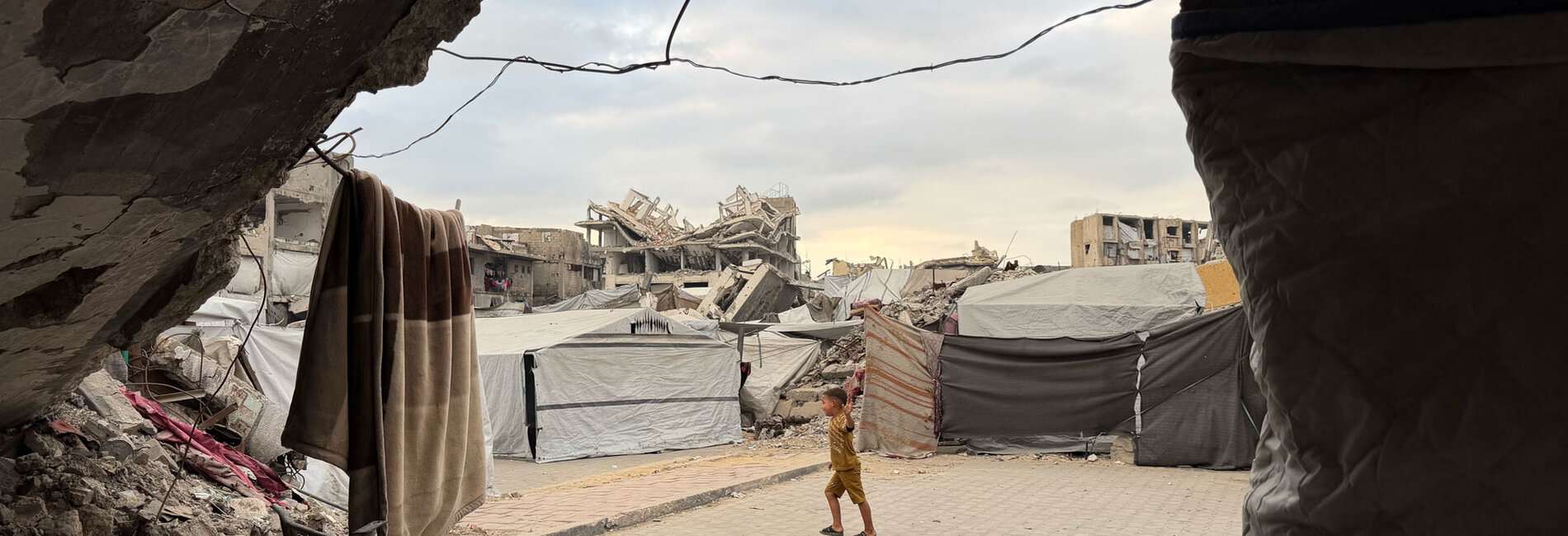
Humanitarian conditions remained critical amid widespread displacement, damaged infrastructure and shortages of essential supplies. Daily cooked-meal production declined by approximately 12 per cent compared with late September, while shortages of fuel, engine oil, spare parts and medicines threatened essential health and water, sanitation and hygiene (WASH) services. Efforts to prepare for the rainy season became increasingly urgent for families in deteriorating shelters and unsafe buildings, but shortages of materials, machinery, and funding – alongside Israeli restrictions on access to suitable land – continued to constrain mitigation and relocation efforts.
Humanitarian cargo movements into Gaza continued to face operational and logistical challenges, including inspection and scanning procedures, limited handling capacity, and coordination requirements across multiple stages of the supply chain. According to the Logistics Cluster, between 29 September and 12 October, 937 trucks carrying humanitarian supplies were manifested and 807 offloaded across five corridors: Ashdod, Egypt, Jordan, Israel and the West Bank. Of those offloaded, 373 were routed through Ashdod, 206 through Egypt, 198 through Jordan, 18 through Israel and 12 through the West Bank. More intensive inspections and scanning procedures contributed to slower cargo movements from Egypt, while additional crossing capacity, improved coordination and more predictable clearance and handling arrangements remained critical to facilitating the timely entry of humanitarian assistance.
Shelter, displacement, and preparations for the cold and rainy season
| KEY FIGURES | |
|---|---|
| 294,250 | ~44,000 |
| Families requiring winter shelter assistance; available supplies could partially assist 52,000 (18%) | People living in more than 2,300 structurally unsafe buildings |
Sources: Site Management Cluster and Shelter Cluster.
Site Management Cluster partners continued assessing flood-prone displacement sites and identifying priority mitigation measures. An estimated 950,000 people were living in displacement sites at medium to high risk of flooding, including more than 400,000 at high risk. During a two-day visit to Gaza, concluding on 12 October, the Acting Special Coordinator for the Middle East Peace Process, UN Resident and Humanitarian Coordinator, Dr. Ramiz Alakbarov, observed community-led winter preparations at a displacement site in Gaza city, including measures to reduce flooding, store water, manage drainage and reinforce shelters. Shortages of heavy machinery and materials, limited access to suitable land and the lack of viable relocation alternatives continued to constrain preparedness.
According to the Shelter Cluster, 1.98 million people require shelter and non-food item assistance. Its June assessment found that more than 65 per cent of displaced households surveyed were living in tents or makeshift shelters, over half of which were in poor or very poor condition. Shelter requirements for the cold and rainy season remained severely underfunded, with US$186.6 million, or 66 per cent of the $283 million required, still unfunded. On 9 October, the International Organization for Migration (IOM) warned that approximately 8,600 emergency shelter kits it pre-positioned outside Gaza continued to be denied entry by the Israeli authorities.
Structural safety remained a major concern, with preliminary estimates indicating that more than 4,000 buildings require full or partial demolition. At An Nahhal Land in Gaza city, Dr. Alakbarov met five families who relocated from a structurally unsafe building slated for demolition. The families described the physical and psychological toll of repeated displacement and emphasized their need to remain close to essential services, relatives and community support, amid limited viable alternatives. A coordinated humanitarian response provided emergency shelter, essential household items, hygiene kits and sanitation facilities.
Food security and nutrition
| KEY FIGURES | |
|---|---|
| 614,000 | 2,800+ |
| Cooked meals prepared daily as of early October, down approximately 12% from late September | Children admitted for malnutrition treatment in September, including more than 360 with severe acute malnutrition |
Sources: Food Security Sector and Nutrition Cluster
Food assistance declined, with daily cooked-meal production falling from 695,000 meals as of late September to 614,000 as of early October, amid funding constraints. Partners increasingly relied on rotational distributions, with some locations receiving meals at reduced or varying frequencies, including every other day rather than daily, amid continued efforts in improving meal quality by incorporating fresh vegetables into recipes whenever possible.
In-kind assistance remained insufficient to meet household food needs. Each monthly distribution of one food parcel and 25 kilograms of wheat flour covered approximately half of minimum caloric requirements. Funding shortfalls, reliance on a single operational cargo crossing, and delays associated with inspections, customs procedures and cargo handling continued to limit the entry of food supplies and the scale and regularity of assistance. With 90 per cent of the population relying on humanitarian food assistance, household food access remained severely limited due to lack of purchasing power despite some improvements in market functioning during September. According to the World Food Programme (WFP) monitoring in the first half of September, 44 per cent of surveyed households reported going to bed hungry at least once in the preceding 30 days, while 45 per cent had completely run out of food at least once during the same period.
Recent nutrition monitoring indicated modest improvements in children's dietary diversity and reductions in food poverty, largely attributed to increased humanitarian assistance and improved market functioning rather than recovery in local food production. Nevertheless, approximately 3,000 children aged 6-59 months continued to be admitted for malnutrition treatment each month. A recent SMART survey found that stunting prevalence among children older than one year was approximately 1.6 times that of infants under one year. Stunting prevalence among infants nevertheless remained high, underscoring persistent nutritional risks and the importance of adequate infant and young child feeding.
With the planting season for winter crops and the olive harvest underway in Gaza, widespread destruction of agricultural land and olive groves, restricted access to farmland, particularly beyond the “Yellow Line,” and restrictions on the entry of agricultural inputs, engine oil and spare parts severely hampered cultivation, harvesting and the operation of the few remaining olive presses. According to the Food and Agriculture Organization (FAO), animal feed distributions over the past year averaged more than 400 metric tonnes per month, four times the rate before the October 2025 ceasefire agreement. Continued entry of animal fodder, veterinary supplies and other essential agricultural inputs remains critical to sustaining livestock survival, supporting herd recovery and enabling local food production.
Health, water and sanitation services
| KEY FIGURES | |
|---|---|
| 18.6% | 34% |
| Of health consultations involved communicable diseases, 4-10 October | Decline in drinking-water production between 6 and 12 October compared with mid-September |
Sources: Health Cluster and WASH Cluster.
Shortages of fuel, engine oil, generator spare parts and essential medicines continued to threaten critical care, including dialysis, cancer treatment and services for people with chronic conditions. According to the Health Cluster, communicable diseases accounted for 18.6 per cent of consultations recorded between 4 and 10 October, with respiratory infections accounting for most of reported communicable disease cases (59 per cent) followed by skin diseases (22 per cent) and acute watery diarrhoea (18 per cent).
Since the ceasefire agreement in October 2025, the World Health Organization (WHO) facilitated the medical evacuation of 3,423 patients from the Gaza Strip for treatment abroad, out of more than 13,800 evacuated since October 2023 for specialized care. Forty-two per cent of the evacuated patients were men (1,443), 30 per cent were children (1,010), and 28 per cent were women (970). Over 2,600 patients (77%) were evacuated via Rafah Crossing, while 775 were evacuated via Kerem Shalom Crossing. Thousands of patients in Gaza continue to urgently require medical evacuation.
Drinking-water production declined, with volumes produced between 6 and 12 October falling to 75 per cent of the previous week's level and 66 per cent of weekly production in mid-September. Disruptions included reduced water flow followed by an interruption of supply from the Gaza city Mekorot pipeline serving northern Gaza for most of an eight-day period due to repairs, a two-day interruption of the Bani Suheila pipeline in Khan Younis, and electricity problems at the Southern Gaza Desalination Plant. Shortages of spare parts and consumables further reduced desalination output.
Funding constraints also threatened the continuity of water distribution, with 11 partners reporting a potential to discontinue activities in the coming months, which would affect 360 sites. Continued shortages of fuel, equipment and essential supplies further undermined the sustainability of water and wastewater services.
Protection and education
| KEY FIGURES | |
|---|---|
| 1 in 4 | 200,000 |
| Households in Gaza headed by women, twice the proportion recorded three years earlier | Children without access to structured learning |
Sources: Protection Cluster and Areas of Responsibility, UN Women, and Education Cluster.
Civilians continued to face serious protection risks from airstrikes, shelling and gunfire, including incidents affecting tents sheltering displaced people in Jabalya, Gaza city and Khan Younis. Monitoring through 19 focus group discussions and 175 key informant interviews highlighted psychosocial distress, poor living conditions and barriers to specialized services, particularly for people with disabilities and those near the “Yellow Line.” Insecurity, movement restrictions and fuel and transport shortages further hampered protection activities.
During his visit to Gaza city, Dr. Alakbarov met displaced families at a site in Ash Shuja'iyyeh hosting approximately 950 households near the “Yellow Line.” Residents reported continued exposure to shelling and gunfire and limited access to water, health care and temporary learning spaces. At a separate displacement site accommodating women-headed households, women identified lighting, replacement tents, improved shelter, children's winter clothing and cash assistance as priorities.
Children continued to face violence, exploitation, family separation and psychosocial distress, with partners reporting injuries from gunfire and strikes, child labour, child marriage and heightened risks of neglect. Children with disabilities and those injured faced additional service barriers. Insecurity, movement restrictions, damaged roads and fuel and transport shortages disrupted outreach, case follow-up and continuity of care, particularly near the “Yellow Line.” Funding shortages led to the closure of at least 10 child protection service points and safe spaces in recent weeks, while another 57 are currently at risk of closure, partial suspension or reduced operations. These challenges have also delayed winterization assistance and weakened referral and support services for at-risk children.
Funding and security constraints also undermined services addressing gender-based violence (GBV). Of 19 Women and Girls Safe Spaces previously reported as closed, 17 remained closed, while two secured funding and resumed service delivery. On 9 October, UN Women highlighted growing needs among female-headed households. Of 14 women's organizations surveyed across Gaza and the West Bank, 13 reported insufficient capacity, while nearly two-thirds had waitlisted or turned away women and girls. Shortages of dignity kits, menstrual hygiene supplies and winterization materials compounded protection concerns.
In education, funding shortages, restrictions on the entry of printed educational materials, limited local printing capacity and shortages of paper and ink constrained learning opportunities and efforts to address learning loss.
Humanitarian response activities at a glance – Gaza Strip
29 September – 12 October 2026 (unless otherwise specified)
Shelter and Site Management: Partners assessed flood-prone displacement sites and undertook drainage clearance, sandbagging and ground levelling. Shelter and household-item assistance reached about 37,500 households, including 5,010 tents, 25,385 tarpaulins, 32,021 solar lights and other essential items. Partners supported emergency repairs to 440 partially damaged housing units, provided 45 transitional shelter units and assisted families relocated from an unsafe building in Gaza city.
Food Security: Daily, 24 partners supported 101 community kitchens preparing approximately 614,000 cooked meals. During the ongoing October distribution, more than 286,000 people (81,000 households) received food parcels and wheat flour through 27 distribution points. As of mid-October, approximately 280 metric tonnes of bread were produced daily with humanitarian support, meeting 33 per cent of estimated needs through subsidized sales and free distributions. Fodder distributions to approximately 2,200 livestock holders continued. Partners also provided harvesting tools to 60 olive farmers and supported six operational olive presses with fuel and cash-for-work labour, reducing costs and enabling subsidized pressing services for smallholder farmers.
Health: A total of 216 reporting health facilities recorded 294,781 consultations between 4 and 10 October. Critical services, including dialysis, cancer treatment and chronic disease care, continued amid shortages. During three medical evacuation operations, 58 patients, including 11 children, were evacuated via Rafah and Kerem Shalom crossings, accompanied by 66 caregivers.
Water, Sanitation and Hygiene: In September, 71 partners provided approximately 25,000 cubic metres of drinking water and 6,000 cubic metres of domestic water daily through 3,465 water points. Partners also resumed production at the Southern Gaza Desalination Plant, repaired wastewater infrastructure serving about 115,000 people in northern Gaza, cleared a sewer blockage benefiting 10,000 people in Nuseirat and removed accumulated waste from the Feras Market temporary dumpsite.
Protection: Protection partners reported over 6,000 service instances weekly, reaching around 5,800 people, some of whom received multiple services. Services addressing GBV reached more than 6,900 people between 28 September and 4 October; partners provided mattresses, dignity kits and agricultural vouchers to at least 1,400 people. Between 29 September and 11 October, Child Protection partners reached 12,800 children with psychosocial support, provided case management to at least 633 children and supported 169 children through family separation prevention and family-based care interventions. Partners completed 14 explosive hazard assessments and reached 13,103 people with explosive ordnance risk education between 1 and 8 October.
Education: Some 695 temporary learning spaces were operational, enrolling approximately 564,000 children, including 18,985 children with disabilities. Partners distributed 84,216 schoolbags, and 2,699 school-in-a-carton kits reaching 107,960 learners.
Joint Distributions | Emergency Response: The Joint Distribution Consortium processed 26 incident appeals affecting 132 households, including 99 households affected by airstrikes. Rapid assessments classified 11 households as high-need, 48 as medium-need and 73 as low-need. Assistance was prioritized by incident type, extent of damage and assessed needs.
West Bank
The reporting Period is 29 September – 12 October 2026 unless otherwise specified.
| KEY FIGURES | |
|---|---|
| 5 killed, 246 injured | 244 |
| By Israeli forces or settlers | Settler attacks resulting in casualties or property damage |
The humanitarian situation in the West Bank, including East Jerusalem, remained severe amid operations by Israeli forces, settler violence, demolitions, damage to homes and productive assets, and restrictions on access to land and essential services. Five Palestinians were killed, including three in settler attacks, and 246 (including 22 children) were injured by Israeli forces or settlers. Of those injured, 181 (74 per cent) were in the context of settler attacks, the majority (122) during olive-harvest-related incidents. Among those killed were a 19-year-old shot by an Israeli settler near a closed gate in Kobar (Ramallah) on 2 October, and a 44-year-old killed during a settler attack on Palestinian olive harvesters near Burqa and Bizzariya (Nablus) on 7 October.
Settler violence remained at exceptionally high levels, with 244 incidents across 113 communities resulting in casualties or damage to homes, agricultural land, livestock, water infrastructure and other assets during the reporting period – an average of 17 incidents per day. Since the beginning of 2026, over 2,060 settler attacks resulting in Palestinian casualties, property damage or both were documented across about 300 communities – an average of seven incidents per day, compared with five incidents per day in 2025. On 5 and 6 October, three Palestinian herding families comprising 15 people, including nine children, were displaced from Ma'azi Jaba' (Jerusalem) and Burqa (Ramallah) following settler attacks. Since January 2023, 133 Palestinian communities have experienced displacement due to settler attacks and related access restrictions, including 49 communities that have been fully displaced, 13 of them since the beginning of 2026.

During the reporting period, Israeli authorities demolished or forced Palestinians to demolish nine Palestinian-owned structures, displacing 96 people. Of those displaced, 93 were affected by demolitions carried out for lack of Israeli-issued building permits, while three were displaced by a punitive demolition. In the latter incident, Israeli forces used explosives to demolish a residential structure in Area B belonging to a Palestinian who had shot and killed an Israeli settler in the Ramallah area on 20 September. On 6 October, the demolition of a five-storey residential building in At Tur, East Jerusalem, displaced 69 Palestinians, including 36 children—the largest number of people displaced in a single demolition incident in East Jerusalem since OCHA began recording demolitions in 2009. Since the beginning of 2026, East Jerusalem has accounted for more than one-third of Palestinians displaced by demolitions for lack of Israeli-issued building permits across the West Bank (636 of 1,755).
Education: access to learning in Masafer Yatta
During the reporting period, Israeli forces confiscated Palestinian-owned vehicles in Masafer Yatta (Hebron), including one used to transport school-children, and reportedly issued a two-year order barring its driver from the area. On 12 October, another vehicle was confiscated in Isfai al Fouqa, following the confiscation of nine vehicles, including agricultural tractors, across five communities in “Firing Zone 918” in September. School transportation was further disrupted by two settler attacks on 12 and 13 October. Settlers blocked a vehicle collecting students from Al Fakheit School for more than two hours and subsequently attacked two school vehicles with stones and sticks, damaging one while students were inside. The incidents affected 24 students from four communities, with no injuries reported. According to the Education Cluster, 121 students received cash assistance for school transportation during the last 2025/26 academic year due to limited transport services in the area.
These incidents compound longstanding barriers to education in Masafer Yatta, including settler violence, operations by Israeli forces, and movement restrictions. Between 18 August and 23 September, demolitions displaced 118 Palestinians, including 58 children, across four communities in “Firing Zone 918.” Child Protection and Education partners report that some girls have stopped attending school, while children with disabilities face additional barriers to rehabilitation and therapy services. The threat of demolitions, including against Jinba School, further jeopardizes education continuity. Humanitarian preparedness planning covers five schools serving approximately 180 students, although funding and access constraints limit response capacity.
Food security and agricultural livelihoods
| KEY FIGURES | |
|---|---|
| 28% | >20,000 |
| unemployment – Q2 2026 | trees and saplings damaged in settler attacks since January 2026 |
Restrictions on agricultural access, settler violence and damage to productive assets continued to undermine Palestinian livelihoods and food security, against a backdrop of declining household incomes and rising costs. According to WFP's Palestine Market Monitor, unemployment declined from 30 per cent in the first quarter of 2026 to 28 per cent in the second quarter but remained more than double the pre-October 2023 level of 13 per cent. Food prices increased by 1.3 per cent month-on-month and 5.5 per cent year-on-year in August, while diesel prices in September were 44 per cent higher than a year earlier.
Since the beginning of 2026, Israeli forces have uprooted or damaged more than 10,000 trees and saplings, predominantly olive trees, during land-clearing operations, mainly in Jenin, Salfit and Nablus governorates, including approximately 4,600 in September alone. Many incidents followed military orders requiring the removal of trees or vegetation, including for stated security purposes, road works or in areas near the Barrier. Separately, documented settler attacks involving damage to agricultural assets have resulted in damage to more than 20,000 Palestinian-owned trees and saplings. The destruction of mature trees, irrigation infrastructure, and other productive assets undermines agricultural production and household income beyond the current harvest season.
Olive harvest season
| KEY FIGURES | |
|---|---|
| 199 | 88,300 |
| Harvest-related settler attacks, 1 Sep - 12 Oct, including 166 between 29 September and 12 October | Dunums requiring “prior coordination” (Peace Now) |
The 2026 olive harvest, officially scheduled to begin on 15 October, is taking place amid escalating settler violence, expanding access restrictions and heightened protection risks for Palestinian farmers. The harvest supports an estimated 80,000-100,000 Palestinian families. According to the Palestinian Ministry of Agriculture, olive oil production could reach approximately 21,000 tonnes in 2026, compared with 7,000 tonnes in 2025, provided farmers can access and harvest their groves. Restricted access, violence and damage to agricultural assets threaten this potential recovery.
Olive-harvest-related settler attacks increased nearly sixfold, from 33 in 2020 to 185 in 2025, the second-highest annual total since 2020. Between 1 September and 12 October 2026, 199 olive-harvest-related settler attacks were documented, resulting in one Palestinian fatality, 124 injuries and damage to over 2,500 trees and saplings. About 60 per cent of the attacks (122) occurred in Ramallah governorate, followed by Nablus (37) where 46 injuries were recorded. Of the 124 people injured, 92 were injured by settlers and 32 by Israeli forces in the context of settler attacks. These preliminary figures cover the period before the official start of the harvest and predominantly reflect incidents in areas not requiring “prior coordination” with Israeli authorities.
During the reporting period, several incidents involved Israeli forces accompanying settlers, restricting farmers' access or intervening against Palestinian harvesters. On 5 October, settlers attacked families harvesting olives near Rammun (Ramallah), forcing them to leave their land. Israeli forces subsequently arrested 15 Palestinians, while settlers reportedly seized 17 bags of harvested olives. In Deir Abu Mash'al (Ramallah), settlers reportedly harvested olives from Palestinian-owned land in Area B on multiple occasions, accompanied by Israeli forces who prevented landowners from approaching their groves. On 7 October, a 44-year-old Palestinian was killed during a settler attack on olive harvesters near Burqa and Bizzariya (Nablus). Israeli forces reportedly delayed three ambulances for approximately an hour and confiscated their keys, obstructing access to the wounded.
Restrictions on agricultural access further compound these protection risks. Since October 2023, the majority of approximately 20,000 Palestinian farming-permit holders have been unable to access their land between the Barrier and the Green Line. Access is regulated through approximately 62 agricultural gates, most of which remain closed throughout the year; during the 2025 harvest, 74 per cent opened for only a limited number of days. Under permit procedures introduced in September 2025, eligibility is determined primarily by assessed agricultural needs rather than land ownership. According to Israeli human rights organization HaMoked, whose petition challenging these restrictions was rejected by the Israeli High Court of Justice in January 2026, the procedures particularly affect olive growers, who account for approximately 95 per cent of farmers in the area, by largely limiting access to the harvest season despite the need for year-round cultivation and maintenance.
Beyond the Barrier, during the 2025 olive harvest, farmers in 98 Palestinian communities across nine governorates were required to obtain prior military coordination to access farmland near settlements, generally only twice a year. According to Peace Now, military orders issued ahead of the 2026 harvest expanded the area subject to “prior coordination” to approximately 88,300 dunums, nearly 30 per cent more than in 2025. More than 40 per cent of the newly designated area is in Jenin governorate, where approximately 12 settlement outposts have been established over the past year.
To inform the 2026 olive harvest response, the Protection Cluster and Food Security Sector, with support from the West Bank Inter-Cluster Coordination Group (ICCG), Protection partners and Food Security partners, conducted three regional preparatory workshops and contributed to the validation of a joint hotspot analysis. The resulting Protection and Food Security and Livelihoods snapshot identifies 123 priority hotspot communities facing heightened protection and agricultural livelihood risks, with 63 per cent concentrated in Ramallah, Nablus and Hebron governorates. According to updated partner planning, approximately 70 per cent of these communities are expected to receive some humanitarian support, leaving around 30 per cent without planned coverage. Even in communities where assistance is planned, substantial needs are expected to remain unmet, while additional needs may emerge beyond the identified hotspots. Response priorities include safe access to agricultural land, protective presence and accompaniment, community-based protection and preparedness, legal assistance, monitoring and documentation, emergency response, harvesting equipment, collective harvesting initiatives and livelihood support. Funding shortages, access restrictions and limited operational capacity continue to constrain the scale and coverage of the response.
The snapshot further highlights that formal authorization does not necessarily translate into safe, predictable or sufficient access to agricultural land. Farmers face interconnected protection risks, including attacks, threats and intimidation, restrictions on movement, theft and destruction of crops and agricultural assets, and barriers to humanitarian assistance and legal remedies. Limited access periods, equipment restrictions and threats of violence can prevent farmers from maintaining their groves or completing the harvest, forcing difficult choices between physical safety and livelihoods. Beyond immediate harm and economic losses, these conditions undermine farmers' ability to access, cultivate and protect their land. The cumulative impact of violence, access restrictions, property destruction and settlement and outpost expansion contributes to an increasingly coercive environment, heightening risks of dispossession and displacement.
Humanitarian response activities at a glance – West Bank
29 September – 12 October 2026 (unless otherwise specified)
Shelter: Partners reached approximately 1,500 people (456 households) through shelter repairs, essential household items and cash assistance, mainly in Nablus, Bethlehem and Hebron governorates.
Food Security: Partners are mobilizing emergency agricultural and livelihood assistance for farming communities affected by settler violence and access restrictions ahead of the 2026 olive harvest. Planned interventions across nine governorates include providing harvesting tools and machinery, organizing collective harvesting, transporting olives to presses, and conducting advocacy and legal awareness activities.
Water, Sanitation and Hygiene: In September, WASH Cluster partners implemented 146 interventions across 91 communities, including connecting nearly 1,300 displaced people to piped water networks, reducing reliance on water trucking. Partners installed or rehabilitated over 32 kilometres of water networks across 14 communities and delivered nearly 6,000 cubic metres of emergency water through trucking in 32 communities. Additional assistance included provision of water storage tanks, benefiting over 5,000 people, distribution of more than 2,500 hygiene kits, installation or rehabilitation of 83 latrines, and collection of 242 tonnes of solid waste from IDP locations in the northern West Bank.
Protection: So far in 2026, Child Protection partners provided case management and referrals to specialized services for 1,613 children, including 471 children with disabilities, and cash assistance to 372 children. Partners also provided psychological first aid to 260 children and recreational and educational activities reaching over 1,000 children. Across the West Bank, 41 Women and Girls Safe Spaces were fully operational. Four partners addressing GBV delivered services through 28 service delivery points, including in Jenin, Jerusalem and Nablus refugee camps. Some 480 people accessed safe spaces, including 17 receiving survivor-centred case management and 47 individual MHPSS counselling. Partners also reported 500 participations in group psychosocial sessions, distributed 400 dignity kits, provided cash-for-protection assistance to 30 survivors and women at risk, and reached 375 people with GBV and PSEA awareness.
Education: Partners provided emergency learning supplies and support to 36 school-aged children displaced by the demolition in At Tur, East Jerusalem. Inter-agency preparedness covered five schools serving approximately 180 students in Firing Zone 918.
Funding

** Double asterisks indicate that a figure, sentence, or section has been rectified, added, or retracted after the initial publication of this update.
SUBSCRIBE TO RECEIVE OCHA'S INFORMATION PRODUCTS
 SUBSCRIBE
OCHA Sites










Follow Us
Support
Your donations go to relief organizations delivering quick and effective support to Palestinians in need.