
Humanitarian Situation Report | 18 November 2026
Key Highlights
- An Israeli airstrike on Nasser Medical Complex in Khan Younis area of Gaza killed six people and damaged critical surgical facilities, further undermining efforts to restore the Strip’s severely overstretched health system.
- As Gaza enters its fourth winter since October 2023, early seasonal rainfall has already caused flooding and damage to thousands of shelters, while humanitarian partners have called for the urgent entry of winter supplies and access to safer locations.
- Food Security Sector partners highlighted the urgent need to facilitate the entry of veterinary kits into Gaza to protect livestock, preserve herding livelihoods and address parasite infestations that pose risks to human, animal and environmental health, particularly during winter.
- In Jericho, West Bank, a 72-year-old Palestinian woman was shot and killed by an Israeli settler. Overall, 40 settler attacks resulting in casualties or property damage were recorded across 30 communities in one week.
- Settler attacks and related access restrictions displaced 68 Palestinians, including 31 children, in Hebron and Ramallah governorates during the same week. The Jordan Valley has accounted for 44 per cent of Palestinians displaced in this context in 2026.
- Since the beginning of 2026, more than 5,150 Palestinians have been displaced across the West Bank due to demolitions, settler violence and related access restrictions, and evictions, averaging more than 16 people per day.
Gaza Strip
The reporting period is 10 to 16 November 2026 unless otherwise specified.
Israeli airstrikes, shooting and shelling continued to affect populated areas across the Gaza Strip, causing casualties, including among displaced people. Heavy rainfall between 6 and 8 November compounded the humanitarian situation, damaging shelters and essential service facilities. Humanitarian operations continued to face insecurity, access restrictions, shortages of supplies and equipment and funding shortfalls. According to the Protection Cluster, demand for protection, mental health and psychosocial support (MHPSS) and emergency assistance continued to exceed available capacity, while gaps in specialized services and referral pathways limited responses to complex cases. Insecurity and movement restrictions near the “Yellow Line”, particularly in central Khan Younis, northern Al Mawasi towards Rafah and parts of Ash Shuja’iyyeh, further restricted protection activities.
According to the Ministry of Health in Gaza, which operates under the de-facto authorities, 38 fatalities were reported between 10 and 16 November, including people newly killed, those who died of wounds sustained earlier and bodies recovered from under the rubble. Another 144 injuries were reported during the same period. On 14 November, another 21 fatalities were retroactively added to the cumulative total after their identification details were approved by MoH. This brought the total number of reported casualties since the October 2025 ceasefire agreement to 1,650 fatalities and 5,975 injuries.
On 12 November, an Israeli airstrike hit the surgery department of Nasser Medical Complex in Khan Younis, killing six people, including a health worker, patients and companions, and injuring at least 27 others, according to the World Health Organization (WHO). The department reportedly sustained extensive damage, with surgical theatres, the recovery unit and intensive care unit also affected. The full extent of the damage remained under assessment. Médecins Sans Frontières teams working at the hospital treated three injured people, including two doctors, all of whom required surgery. Nasser Medical Complex is a major referral facility for southern Gaza, serving an estimated 1.3 million people. Since October 2023, WHO has documented 1,056 attacks on health care in Gaza, resulting in 1,010 deaths and 1,725 injuries.
During the reporting period, the physiotherapy department at Al-Aqsa Hospital commenced operations and approximately 400 assistive devices were distributed. However, access to rehabilitation services remained severely limited due to widespread damage of health facilities and restrictions on the entry of specialized supplies. As of July 2026, only 12 per cent of the 4,600 people who had lost limbs since October 2023 had received prosthetic devices brought into Gaza, according to WHO. Between 10 and 16 November, 97 patients, including 34 children, and 145 companions were medically evacuated from Gaza through the Rafah and Kerem Shalom crossings.
According to the Logistics Cluster, 474 UN and partner trucks carrying humanitarian supplies were manifested for entry into Gaza between 9 and 15 November. Of these, 433 were offloaded on the Israeli side of Kerem Shalom, including 159 from Ashdod, 127 from Egypt, 43 from Israel, 33 from the West Bank and 71 from Jordan. This represented a 90-per-cent increase compared with the preceding week (228 trucks), reflecting increased shipments through several corridors, including the resumption of operations through Egypt following a four-day suspension imposed by Israeli authorities. Shipments from Jordan increased from 18 to 71 trucks, while those from the West Bank doubled. Despite this increase, the entry of sufficient winterization supplies, including tents, tarpaulins and heaters, remained constrained, primarily by limited funding and, in some cases, restricted opportunities to bring in items classified by the Israeli authorities as having “dual-use.”
Livelihoods, markets and food security
| KEY FIGURES | |
|---|---|
| 75% | 90% |
|
of surveyed households reported difficulties accessing markets. Source: WFP, October 2026 |
of respondents identified a stable source of income as key to restoring self-reliance. Source: Ground Truth Solutions, July 2026 |
Recent reports highlight the severe economic vulnerability of families in Gaza and the importance of restoring livelihoods alongside emergency assistance. According to the WFP, unemployment stood at approximately 80 per cent in October 2026. A Ground Truth Solutions survey conducted in July found that while 58 per cent of respondents in Gaza reported that humanitarian assistance had made a meaningful difference, an equal proportion doubted that conditions could improve substantially even with significant aid, and nine in 10 respondents identified a stable source of income as key to restoring self-reliance.
According to WFP's October 2026 Palestine Market Monitor, commercial truck entries into Gaza fell by more than half, from an average of 129 per day in September to 60 in October, contributing to shortages and price fluctuations. Three-quarters of surveyed households reported difficulties accessing markets, with 96 per cent of those affected citing financial constraints. Dietary diversity remained poor, with households consuming vegetables on average twice a week and protein-rich foods once a week.
In a joint statement issued on 17 November, the International Organization for Migration (IOM) and WFP warned that recent improvements in food security remained fragile, driven largely by humanitarian assistance rather than the recovery of livelihoods, markets or local food systems. Winter conditions, access restrictions and funding shortfalls risk reversing these gains. WFP reported that these shortfalls had already forced a shift to alternate-month food distributions for some beneficiaries, reductions in hot meals and limitations on full-value cash transfers. Shortages and high costs of cooking gas and firewood also continued to force many families to burn waste to prepare food.
Food Security Sector partners also highlighted the critical need to facilitate the entry of veterinary kits into Gaza, particularly during winter. Humanitarian partners last brought these supplies into the Strip in December 2025. The kits, which include insecticides for livestock, are needed to improve animal health, preserve herding livelihoods and address ectoparasite infestations, which remain a public health concern for affected communities.
Humanitarian impact of winter storms and ongoing mitigation efforts
| KEY FIGURES | |
|---|---|
| 162 of 356 | At least US$9 million |
|
identified flood-risk hotspots where winterization activities were reported (45.5%). Source: Site Management Cluster |
required in the coming months to extend support to all displacement sites, including those assessed as medium risk. Source: Site Management Cluster |
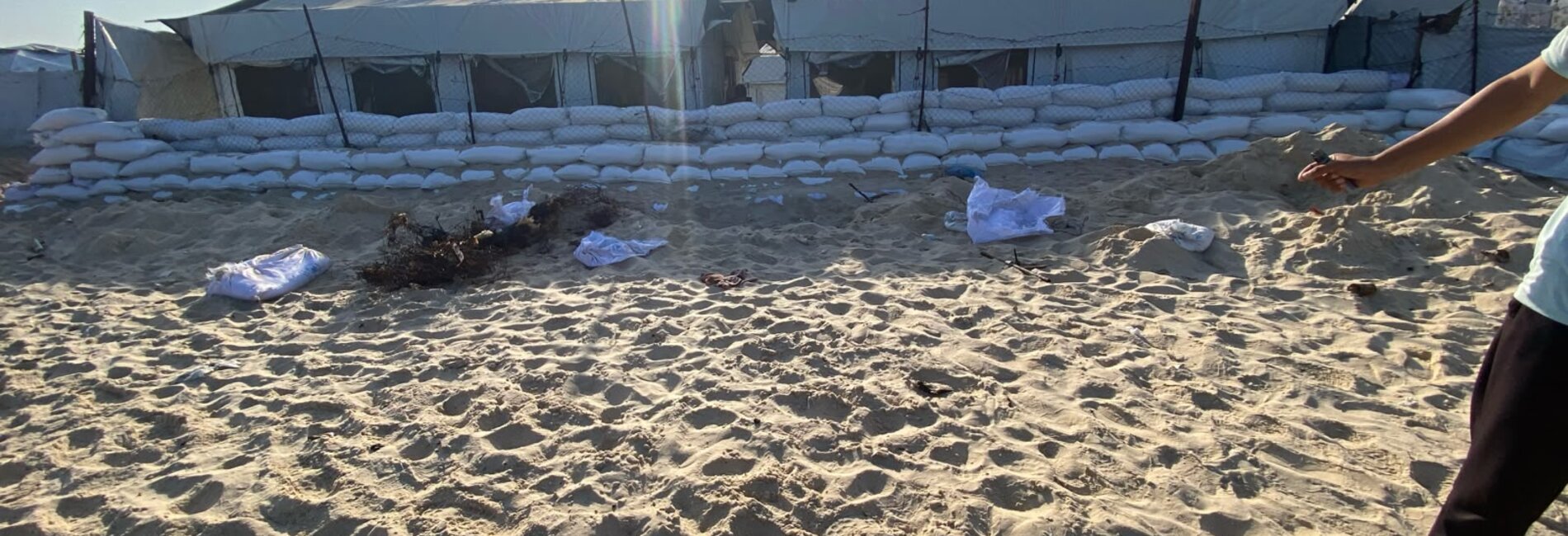
As Gaza enters its fourth winter since October 2023, heavy rainfall and flooding have exposed the vulnerability of displaced families living in deteriorating tents and makeshift shelters. At least five people were reportedly killed when a sand bank collapsed onto a tent, while on 13 November, MoH reported the death of a nine-month-old infant from hypothermia.
As previously reported, preliminary assessments following rainfall between 6 and 8 November indicated that approximately 46,000 households (226,000 people) may have been affected, with more than 5,000 households reportedly sleeping without shelter. The Site Management Cluster (SMC) recorded approximately 487 alerts, while damage was reported to over 40,000 shelters, including more than 9,000 beyond repair, and 960 latrines. Floodwaters also damaged household food supplies and affected at least 12 health facilities and service delivery points. In a 17 November briefing, the IOM warned that tents and tarpaulins provided inadequate protection against winter conditions, estimating that at least 60,000 of the more than 90,000 tents it had brought into Gaza over the preceding two and a half years required replacement.
According to the Education Cluster, approximately 201 temporary learning spaces, representing nearly a third of the 633 operational learning spaces in Gaza, were affected by heavy rainfall and flooding, with education partners continuing to repair damaged facilities and restore learning activities. The storms also heightened protection risks, damaging belongings, compromising privacy and disrupting access to essential services, including child-friendly spaces and sanitation facilities. Flooding damaged some child protection service points and temporarily interrupted activities, while exposing children to cold, contaminated water and unsafe movement conditions. Persons with disabilities faced additional barriers due to flooded and damaged roads and limited transportation, resulting in missed appointments and interruptions to services.
Flooding compounded existing public health risks associated with damaged drainage and sanitation infrastructure. According to the Water, Sanitation and Hygiene (WASH) Cluster's October Light-Touch Monitoring Survey, conducted before the storms, 45 per cent of assessed households reported sewage or sludge within 10 metres of their shelters, while 28 per cent reported nearby solid waste piles. Solid waste management capacity remained severely limited, with only 50 per cent of Gaza's solid waste management fleet operational in October. In a 13 November briefing, WHO warned that flooding, overflowing sewage, overcrowding and poor ventilation could exacerbate respiratory infections and waterborne diseases.
Against these needs, SMC and WASH partners reported winterization activities at 162 of the 356 identified flood-risk hotspots (45.5 per cent), hosting approximately 147,000 internally displaced people. This represents the total population of these sites, rather than the number of people directly reached by the interventions. Activities were reported at 77 sites in Khan Younis, 54 in Gaza, 13 in North Gaza, 10 in Deir al Balah and eight in Rafah, comprising 156 makeshift sites and six collective centres. Interventions included installing sandbags and flood barriers, clearing drainage and sewage systems, reinforcing shelters and distributing community site improvement toolkits, including at UNRWA-managed designated emergency shelters. Improvements to pathways, installation of ramps and relocation within sites were reported at only a few locations. Activities at 96 sites (59 per cent) were fully or partially supported through Cash-for-Work programming. WASH partners were also coordinating the installation of 200,000 sandbags across displacement sites to protect sections of sites and individual shelters, of which 44,000 (22 per cent) had been received.
Despite these efforts, more than half of the identified flood-risk hotspots had no reported winterization activities. Preparedness and response continued to be hampered by shortages of dewatering pumps, generators, hoses and adequate shelter materials, as well as funding shortfalls, approval procedures and access restrictions, including near the “Yellow Line”. The SMC also highlighted the need to facilitate the entry of solar lights, sandbags, community site maintenance toolkits and additional diesel heaters, estimating that at least US$9 million would be required in the coming months to extend support to all displacement sites, including those assessed as medium risk, where inadequate mitigation measures could further expose residents to harm.
In a 13 November statement, the Humanitarian Country Team (HCT) warned that the devastating impact of the storms was preventable, highlighting restrictions on the entry of critical supplies and access to less flood-prone areas. The HCT reported that more than 150,000 tents procured by humanitarian partners and Member States remained outside Gaza awaiting entry, most of them in Al Arish, Egypt. It called for the expedited entry of winter supplies through all available crossings, access to safer locations and adequate funding for the humanitarian response.
Humanitarian response activities at a glance – Gaza Strip
10–16 November 2026 (unless otherwise specified)
Shelter and Site Management: Shelter partners reached 17,638 households across Gaza through the distribution of shelter and non-food items, including 12,778 tarpaulins, 129 sealing-off kits, 9,049 winter clothing kits, 42 bedding kits, 7,074 blankets, 167 mattresses, nine enhanced emergency shelter kits, 250 prefabricated housing units, 6,518 solar lights and 567 tents. In addition, partners distributed 24,021 transparent plastic sheets and approximately 93,000 mats. Site management partners continued implementing flood mitigation and site maintenance activities, including clearing gullies, drainage channels, manholes and sewage lines; maintaining sanitation facilities; reinforcing shelters; and installing flood barriers along open channels. Measures were also undertaken to prevent rainwater from entering designated emergency shelters managed by UNRWA. Cash-for-work programming supported implementation at several displacement sites.
Joint Distribution Mechanism: From 6 to 12 November, partners assessed the needs of 4,900 households across 176 sites and provided support to 2,758 households across 131 sites. During the same period, a total of 13,512 relief items were distributed, including 229 tents, 5,879 blankets, 4,488 tarpaulins, 1,387 plastic-film rolls (50 m²), 1,189 cereal packages, 278 mattresses, 26 jerrycans, 25 dignity kits and 11 hygiene kits.
Food Security: As of 12 November, 24 Food Security Sector partners were preparing approximately 596,000 cooked meals daily through 90 kitchens, serving 1,379 locations across Gaza, including 661 served daily and 718 on a rotational basis. Of these, 211,000 meals were prepared in northern Gaza and 385,000 in central and southern Gaza. As of 15 November, partners had assisted approximately 291,000 people (86,000 households) through November's in-kind food distributions at 27 distribution points. Each household received one food parcel and a 25-kilogram bag of flour, covering approximately 50 per cent of minimum caloric needs, with assistance provided on a rotational rather than monthly basis. As of 16 November, humanitarian partners supported the daily production of approximately 290 metric tons of bread, equivalent to 35 per cent of estimated daily needs. This included approximately 80,000 two-kilogram bread bundles produced daily by 21 subsidized bakeries, of which 81 per cent were sold through 149 contracted retailers at NIS 3 ($US 0.92) per bundle and 19 per cent distributed free of charge to more than 300 shelters and community sites. An additional 17 commercial bakeries, supported by the UN with fuel, produced approximately 100 metric tons of bread daily, while the remaining 30 metric tons were covered through bread distribution, communal ovens and subsidized bakery support by other humanitarian partners.
Education: Partners continued repairing and rehabilitating flood-affected learning spaces and implementing preparedness measures ahead of further rainfall, despite shortages of essential materials. In addition, 1,939 girls in Grades 6-11 participated in structured life-skills and protection sessions covering psychosocial well-being, positive coping mechanisms, protection risks and referral pathways, menstrual health and hygiene, and online safety.
Health: WHO delivered four specialized orthopedic operating tables to three major MoH hospitals and completed the second cohort of wound-care training, reaching a total of 60 UNRWA pre-hospital healthcare staff. Between 8 and 14 November, 289,087 consultations were reported across 221 health sites, with reportable diseases accounting for over 17 per cent of consultations.
Water, Sanitation and Hygiene: Partners continued emergency floodwater removal, drainage clearance and sanitation operations, with machinery-supported interventions reaching 69 displacement sites hosting approximately 72,870 people. Sewer lines, manholes and stormwater basins were cleared at 121 locations, benefiting an estimated 54,400 families. Partners also distributed 500 family hygiene kits, 17 water tanks (1,000 litres each) and two water tanks (5,000 litres each).
Protection: Partners provided mental health and psychosocial support, case management, legal assistance, disability inclusion services and protection awareness activities. Between 7 and 15 November, child protection partners reached approximately 5,607 children and adolescents and at least 2,607 caregivers with psychosocial support, while 284 children received case management services. Child protection awareness and risk mitigation activities also reached approximately 19,585 children and 7,475 caregivers. As part of winterization efforts, approximately 14,034 children received winter clothing and 1,000 families received blankets and tarpaulins. The Protection Cluster conducted an intention survey covering 772 families across seven flood-prone displacement sites to inform response planning. Protection partners provided psychological first aid, emergency assistance and referrals to 146 returnees. Mine action partners conducted nine explosive hazard assessments and continued delivering explosive ordnance risk education and conflict preparedness messaging through in-person sessions, training of trainers and mass media campaigns.
West Bank
The reporting period is 10 to 16 November 2026 unless otherwise specified.
During the reporting period, 40 settler attacks resulting in casualties or property damage were recorded across 30 communities in the West Bank. A 72-year-old Palestinian woman was killed by an Israeli settler, and five other Palestinians, including a child, were injured during a settler attack in Ein ad Duyuk at Tahta (Jericho). Overall, 62 Palestinians, including five children, were injured during the reporting period, of whom 38 were injured by Israeli settlers and 24 by Israeli forces. Of these injuries, 48 (77 per cent) occurred in the context of settler attacks, including 12 linked to the olive harvest season. Settler attacks and related access restrictions displaced 68 Palestinians, including 31 children, while demolitions displaced another 16. The olive harvest remained severely disrupted, with 15 harvest-related settler attacks that resulted in casualties or property damage recorded during the week.
Separately, on 14 November, a Palestinian man sustained multiple fractures after falling while being chased by Israeli forces as he attempted to cross the Barrier near Ar Ram town (Jerusalem) to reach East Jerusalem for work. This injury is not included in the 62 injuries reported above. Since 7 October 2023, when Israeli authorities revoked or suspended most permits issued to Palestinians for access to East Jerusalem and Israel for work and other purposes, 21 Palestinians have been killed and 322 directly injured by Israeli forces while reportedly attempting to cross the Barrier. Of these, five fatalities and 68 injuries have been recorded in 2026, including 50 injuries in Jerusalem governorate.
Israeli forces' operations and movement restrictions continued to affect Palestinian communities. On 16 November, Israeli forces conducted an eight-hour operation in Sa'ir and Ash Shuyukh (Hebron), searching homes, using a residential building as an interrogation centre and arresting 11 Palestinians, seven of whom were subsequently released. Several Palestinians were reportedly physically assaulted, including a woman who required hospital treatment. Separately, on 15 November, settlers reclosed the northern entrance to Adh Dhahiriyah (Hebron), two days after Israeli forces had reopened it following more than three years of closure. The renewed closure again restricts access through this entrance for approximately 45,000 residents, requiring them to continue using alternative routes to reach workplaces, markets and essential services.
According to WFP's October 2026 Palestine Market Monitor, rising food and fuel prices in the West Bank continued to place pressure on household purchasing power. In October, tomato prices increased by 15 per cent compared with September, while onion and potato prices rose by 11 per cent each. Diesel prices increased by seven per cent over the same period and remained 58 per cent higher than in February 2026. These pressures are compounded by persistently high unemployment, which stood at 28 per cent in the second quarter of 2026, compared with 13 per cent before October 2023.
Demolitions and Displacement
| KEY FIGURES | |
|---|---|
| 84 | 51 |
| Palestinians displaced due to demolitions, settler violence and related access restrictions in one week (10-16 November) | Palestinian communities fully displaced since January 2023, including 15 in 2026 |
During the reporting period, nine Palestinian households comprising 68 people, including 31 children, were displaced due to settler attacks and related access restrictions in Hebron and Ramallah governorates. On 13 November, eight families comprising 59 people, including 25 children, were displaced from Deir al Hawa (Hebron) following repeated settler attacks, intimidation and threats to demolish their homes. Settlers had established a nearby outpost approximately three months earlier and subsequently began constructing a road through the area, damaging homes and animal shelters. Settlers, reportedly accompanied by Israeli forces, then ordered the families to leave. The families relocated to Beit Mirsem, near Dura, taking some belongings and moving their livestock. In Deir Qaddis (Ramallah), a Bedouin refugee family of nine people, including six children, was displaced on 14 November after settlers reportedly set fire to their home. The incident followed months of settler incursions and attacks associated with the construction of a settlement road and the establishment of a nearby outpost. Another 16 Bedouin households in the area remain at risk of displacement.
Since January 2023, settler attacks and related access restrictions have displaced about 6,800 Palestinians, including over 3,200 children, across 137 communities, leaving 51 of these communities fully displaced. In 2026 alone, settler violence and related access restrictions displaced 2,894 Palestinians, accounting for 56 per cent of displacement recorded this year due to settler violence and related access restrictions, demolitions (42 per cent) and evictions (two per cent). Overall, more than 5,150 Palestinians have been displaced under these three categories since the beginning of 2026, averaging over 16 people per day. These figures exclude temporary displacement associated with Israeli forces' operations, including in Hebron city, as well as people displaced in previous years who remain displaced, including from refugee camps in the northern West Bank. The Jordan Valley accounts for 44 per cent of displacement due to settler violence and related access restrictions in 2026.
On 15 November, the Israeli High Court of Justice issued a ruling on a petition submitted by the Association for Civil Rights in Israel (ACRI) and Bimkom concerning settler violence against Palestinian residents in Wadi al Far'a in the Jordan Valley. According to ACRI, the court found that Israeli authorities had failed to fulfil their duty to protect Palestinian residents from settler violence and ordered measures to prevent further attacks and ensure farmers' access to their agricultural land.
During the reporting period, seven Palestinian-owned structures were demolished across three incidents, displacing 16 Palestinians and otherwise affecting 29 people. This represents a 79 per cent decrease compared with the weekly average of 34 structures demolished between 1 January and 9 November 2026. In Beit Surik (Jerusalem), Israeli authorities demolished four structures belonging to a family business, including an animal shelter, storage facilities and a water cistern used to irrigate approximately 40 dunums of agricultural land, affecting 25 people. In Sur Bahir (East Jerusalem), a Palestinian family was forced to demolish its own residential building comprising two apartments, displacing 12 people, including eight children. In Kafr Ni'ma (Ramallah), Israeli forces used explosives to punitively demolish an apartment belonging to a Palestinian prisoner accused of launching a projectile towards an Israeli settlement outpost in September 2025. The demolition also destroyed an adjacent apartment and damaged surrounding buildings, displacing four Palestinians, including two children, and otherwise affecting another four people. Separately, demolition orders against two multi-storey residential buildings and a house in Hebron city placed at least 25 families at risk of displacement, including residents of a building in H1, outside Area C.
Settler violence
| KEY FIGURES | |
|---|---|
| 40 | >200 |
| settler attacks resulting in casualties or property damage in one week (10-16 November) | WASH structures destroyed, damaged or seized in settler attacks in 2026 |
During the reporting period, 40 settler attacks resulting in casualties or property damage were recorded across 30 communities, compared with a weekly average of 53 such attacks so far in 2026. The most serious incident occurred on 16 November in Ein ad Duyuk at Tahta (Jericho), where a 72-year-old Palestinian woman was shot and killed and five other Palestinians, including a child, were injured during an attack involving armed settlers. Palestinian eyewitnesses and Israeli sources provided conflicting accounts of the sequence of events preceding the shooting. Israeli forces subsequently closed all entrances to Jericho and arrested two Palestinians.
The fatal incident followed an escalation in settler attacks and restrictions affecting Ein ad Duyuk at Tahta and nearby Isteih. On 4 November, settlers took over several Palestinian houses, claiming to have purchased them, although the legality of the alleged purchases remains disputed. Israeli forces, as cited in the media, stated that the settlers entered the houses without prior authorization. Palestinian residents also reported home break-ins, looting, property damage and restrictions on access. The escalation followed the establishment of a settlement farm outpost near Deir al Quruntul in August 2024. Between August 2024 and 16 November 2026, 28 settler attacks resulting in casualties or property damage were recorded in the two communities, compared with only one between January 2020 and July 2024.
Settler attacks also damaged homes, livelihood assets and essential infrastructure across several governorates. On 12 November, dozens of settlers attacked residential and commercial properties in Atara (Ramallah), injuring seven Palestinians and damaging four houses, a factory and vehicles. In Susiya (Hebron), four Palestinians, including two children, were injured on 14 November when settlers attacked a family home, damaging solar panels and three water cisterns and setting fire to a vehicle. In Al Lubban ash Sharqiya (Nablus), settlers reportedly set fire to a vehicle repair garage, damaging several vehicles, and to electricity poles, disrupting power supply to approximately 15 herding families and three houses. Five Palestinians were injured while attempting to extinguish the fire. In Deir Ballut (Salfit), settlers damaged approximately 500 metres of water pipes, disrupting water supply to about 15 residential and 20 livelihood-related structures. Since the beginning of 2026, Israeli settler attacks have resulted in the destruction, damage or seizure of more than 200 water, sanitation and hygiene (WASH) infrastructure items across the West Bank, including water pipelines, household water connections, storage tanks and sanitation facilities.
According to the WASH Cluster, 40 incidents involving settler attacks and demolitions affected at least 60 WASH structures in October, bringing the total to 330 incidents across 172 communities since January 2026. In Masafer Yatta (Hebron), water trucking remained severely constrained for 10 communities comprising more than 1,500 people, with deliveries to four communities, serving 975 people, almost entirely suspended throughout October.
Separately, on 16 November, five Palestinians were injured when a vehicle driven by an Israeli settler struck people gathered along Road 356 near Khirbet ad Deir in Tuqu' (Bethlehem) to assist those injured in an earlier road accident. The circumstances of the incident remain unclear. This incident is not included in the 40 recorded settler attacks.
Olive harvest
| KEY FIGURES | |
|---|---|
| 15 | 428 |
| harvest-related settler attacks resulted in casualties or property damage in one week (10-16 November) | harvest-related settler attacks resulted in casualties or property damage since the season began (1 September – 16 November) |
Settler violence and access restrictions continued to disrupt the olive harvest, including in areas where access required prior coordination with the Israeli authorities. During the reporting period, 15 harvest-related settler attacks resulted in 12 Palestinian injuries and involved the theft of harvested produce and equipment. In Wad Ma'in (Hebron), four families were forced to leave their land despite prior coordination with the Israeli authorities, while settlers reportedly stole 250 kilograms of olives and agricultural tools. In Al Mughayyer (Ramallah), 10 farmers were expelled despite having coordinated access for that day with the Israeli authorities. In Beit Fajjar (Bethlehem), three farmers were injured and vehicles and agricultural equipment were damaged or stolen during an attack on land where prior coordination was not required.
According to WFP's October 2026 Palestine Market Monitor, settler violence and movement restrictions disrupted harvesting activities, reducing the area harvested and contributing to an expected decline in olive oil production. Olive oil prices have reportedly doubled compared with previous seasons, further affecting household purchasing power and access to this staple food.
Humanitarian response activities at a glance – West Bank
10–16 November 2026 (unless otherwise specified)
Shelter: Partners reached 374 people (87 households) with shelter assistance, pending final confirmation of partner reports.
Education: In response to the impact of the Israeli forces’ operation in Hebron city, Education and Child Protection partners supported a four-day emergency psychosocial response led by the Hebron Directorate of Education, targeting approximately 4,800 students, alongside teaching and administrative staff, across 11 schools. Activities included psychological first aid, expressive and recreational sessions, and psychosocial support for education personnel. In Masafer Yatta (“Firing Zone 918”), a partner provided the first payment of education-specific cash assistance to cover transportation costs for 121 students.
Child Protection: Between 8 and 15 November, partners provided structured and unstructured psychosocial support to at least 407 children in Hebron and Tulkarm, including through drama, storytelling and participatory theatre. In Ma’in (Yatta), 58 people affected by settler attacks received psychological first aid, while three of four affected families were referred for case management support. Positive parenting sessions also reached 23 women in Ma’in.
Water, Sanitation and Hygiene: In October, partners provided, installed or rehabilitated nearly 22 kilometres of water pipelines and networks across five communities in Ramallah, Hebron and Bethlehem governorates, rehabilitated 52 water cisterns in Hebron city, and provided 33 water storage tanks across the West Bank. Partners also delivered nearly 8,000 cubic metres of emergency water by truck, installed or repaired 49 household and communal latrines, desludged 940 cubic metres of wastewater at the Arab American University dormitories hosting displaced people, and installed 170 metres of stormwater networks. In addition, partners collected 215 tonnes of solid waste to support displaced populations in the northern West Bank and distributed 1,434 family hygiene kits and 466 additional hygiene kits, primarily to displaced people, including those affected by the recent Israeli forces' operation in Hebron city.
** Double asterisks indicate that a figure, sentence, or section has been rectified, added, or retracted after the initial publication of this update.
SUBSCRIBE TO RECEIVE OCHA'S INFORMATION PRODUCTS
 SUBSCRIBE
OCHA Sites










Follow Us
Support
Your donations go to relief organizations delivering quick and effective support to Palestinians in need.