
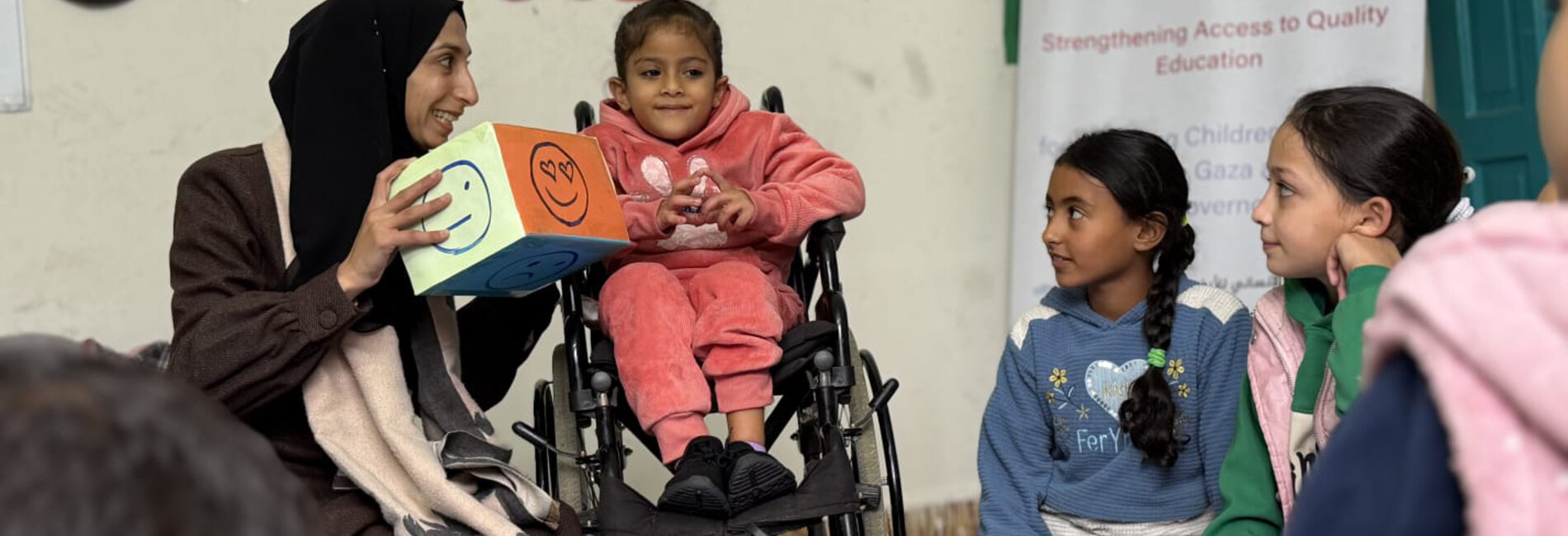
Supporting Dana’s recovery and return to learning
“Every time we were forced to flee, we had to leave suddenly, abandoning everything behind.” – Dana’s mother
With her family, six-year-old Dana*, from Az Zaytoun neighbourhood of Gaza city, was forced to flee her home and subsequent shelters repeatedly as hostilities escalated after October 2023. Each displacement came suddenly, under bombardment, leaving little time to gather belongings or prepare.
“Every time we were forced to flee, we had to leave suddenly, abandoning everything behind,” her mother recalls. “Dana would leave her toys, clothes, and little belongings, which caused her intense fear and made her overly attached to everything she owned.”
In July 2025, while the family was sheltering in the Al Rimal area, Dana was seriously injured when shrapnel from a nearby strike caused paralysis in her lower limbs. She now relies on a wheelchair. Alongside her physical injury, Dana struggled with the psychological impact of repeated displacement and the loss of several family members during the conflict. She withdrew from learning and social activities, spending long periods in silence as fear and anxiety took hold.
In mid-October 2025, Dana was referred to education and protection services supported by the Occupied Palestinian Territory Humanitarian Fund (OPT HF) and implemented by Palestine Save the Children (PSCF). Her mother learned about the available services through a public announcement and approached the project team to seek support. Following a consultation with Dana’s mother, a PSCF case manager assessed Dana’s needs and facilitated her referral to the project’s education and psychosocial support services, which reaches more than 3,000 conflict-affected children across the Gaza and Deir al Balah governorates, including those with severe physical or psychological needs.
At the project centre, a specialized team assessed Dana’s educational and emotional needs and developed a tailored support plan. She began attending classroom sessions and followed an individualized education plan adapted to her abilities, focusing on reading, writing, and numeracy through simplified and interactive activities. She also received school materials to support her return to learning.
Alongside education, Dana participated in individual and group psychosocial support sessions. Through drawing, play, and guided activities, she gradually learned to express her fears and emotions in a safe environment. Group sessions with other children helped rebuild her sense of safety and connection.
“Dana has become more confident in participating in educational activities and expresses her feelings much better compared with before she joined us,” says her teacher.
Her psychologist also observed a quiet but profound change: “When I see Dana moving around the centre in her wheelchair, I feel that she is rising differently… rising from within.”
The project also worked closely with Dana’s family, providing guidance to help her mother support her emotional recovery at home and encourage participation in daily activities.
Today, Dana is once again engaged in learning and interacting with her classmates. She speaks openly about her hopes for the future.
“When I grow up, I want to be a teacher,” she says, “so I can help children who have gone through difficult circumstances like mine.”
As families across Gaza continue to face uncertainty and damaged services, integrated education and protection initiatives like this help children affected by conflict regain a sense of stability, dignity, and hope, even in the most challenging conditions.
* Name changed to protect privacy.


subscribe to our mailing list
SUBSCRIBE TO RECEIVE OCHA'S INFORMATION PRODUCTS
 SUBSCRIBE
OCHA Sites










Follow Us
Support
Your donations go to relief organizations delivering quick and effective support to Palestinians in need.