
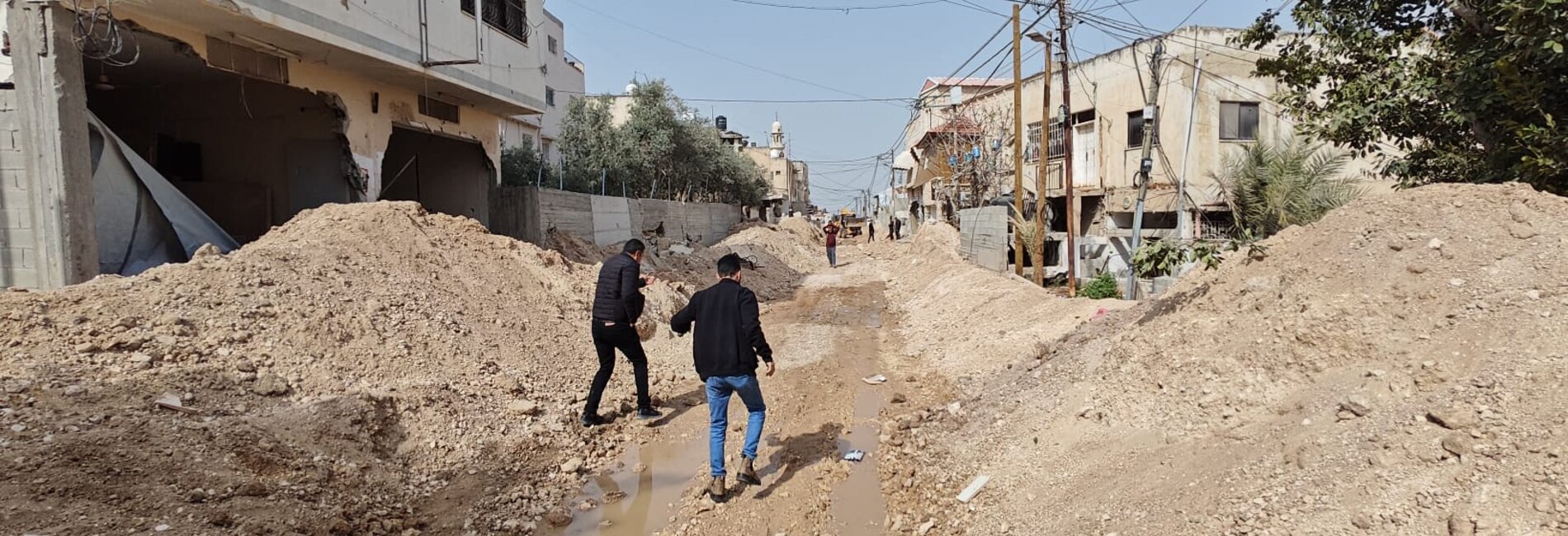
Providing rental cash support to displaced families
Samer* is one of more than 33,000 Palestinians who have been displaced and prevented from returning home since Israeli forces launched an ongoing operation in three refugee camps in the northern West Bank in January 2025.
Forced to flee Jenin Camp with little notice, he and his family left carrying only essential belongings, unsure where they would find shelter or how long their displacement would last. A father of four, Samer has been unemployed since his displacement.
“We had no choice but to rent,” Samer said. “But without stable work, it became very difficult to keep up with the payments.”
Samer’s family is not alone. Most people displaced from Jenin Camp turned to the private rental market, as formal displacement centres in the area are limited. While Samer’s family and others have received some food vouchers and other forms of assistance, renting remained the most burdensome recurring expense for many.
The occupied Palestinian territory Humanitarian Fund (oPt HF) has supported more than 1,400 of the displaced families with rental cash assistance. As this mass displacement entered its second consecutive year, Action Against Hunger (ACF), with funding from the oPt HF, provided 187 displaced households with rental cash support of NIS 1,000 (US$330) each per month for three months in early 2026.
When Samer received the support, he said it came at the right time. “It helped us stay in the house,” he explained. “Without it, we would have struggled even more.”
Rami*, who was also displaced from Jenin Camp, is facing similar challenges. He is staying in a rented house with an extended family of eight – including his parents, brother, wife, and two children. “There are many of us in one place now,” he said. “Expenses are high, and work is not stable.”
With limited income and increased responsibilities, Rami described the rental support as essential. “This was the first time we received support for rent,” he said. “It made a real difference for us.”
For families like Samer’s and Rami’s, this support helps ease some of the immediate financial pressure of displacement. While it does not resolve the broader challenges they face, it enables them to maintain a basic level of stability and avoid further disruption.
“For now, we can stay,” Samer said. “That is what matters.”
* Names have been changed to protect the people’s privacy.


subscribe to our mailing list
SUBSCRIBE TO RECEIVE OCHA'S INFORMATION PRODUCTS
 SUBSCRIBE
OCHA Sites










Follow Us
Support
Your donations go to relief organizations delivering quick and effective support to Palestinians in need.