
Local innovation helps reduce mosquito-related risks for displaced families
For Maha*, nights in displacement were marked by the constant sound of mosquitoes and the worry that her children would wake up covered in bites. After losing their home, Maha, a mother of eight, sought safety with her family at a displacement site in Gaza, only to face overcrowded conditions, limited access to basic services and stagnant wastewater nearby.
Across displacement sites in Gaza, damaged sanitation systems, accumulated waste, sewage in surrounding areas and stagnant water have contributed to the spread of pests and insects, increasing environmental health risks for families already facing severe hardship.
“We could not spend a few minutes outside after sunset,” Maha said. “Even inside our tent, we never felt protected. My children were constantly bitten and could not sleep peacefully.”
For Maha, the concern was not only the discomfort but also the health risks facing her children in an environment where families had few ways to protect themselves from mosquitoes and other insects.
“I was always worried about what these mosquitoes could bring,” she said.
Maha is not alone. Similar conditions are reported across hundreds of displacement sites in Gaza, where damaged sanitation infrastructure and stagnant wastewater create breeding grounds for mosquitoes and other vectors. Addressing these risks required more than routine mosquito control; it required practical solutions that can continue despite severe operational constraints.
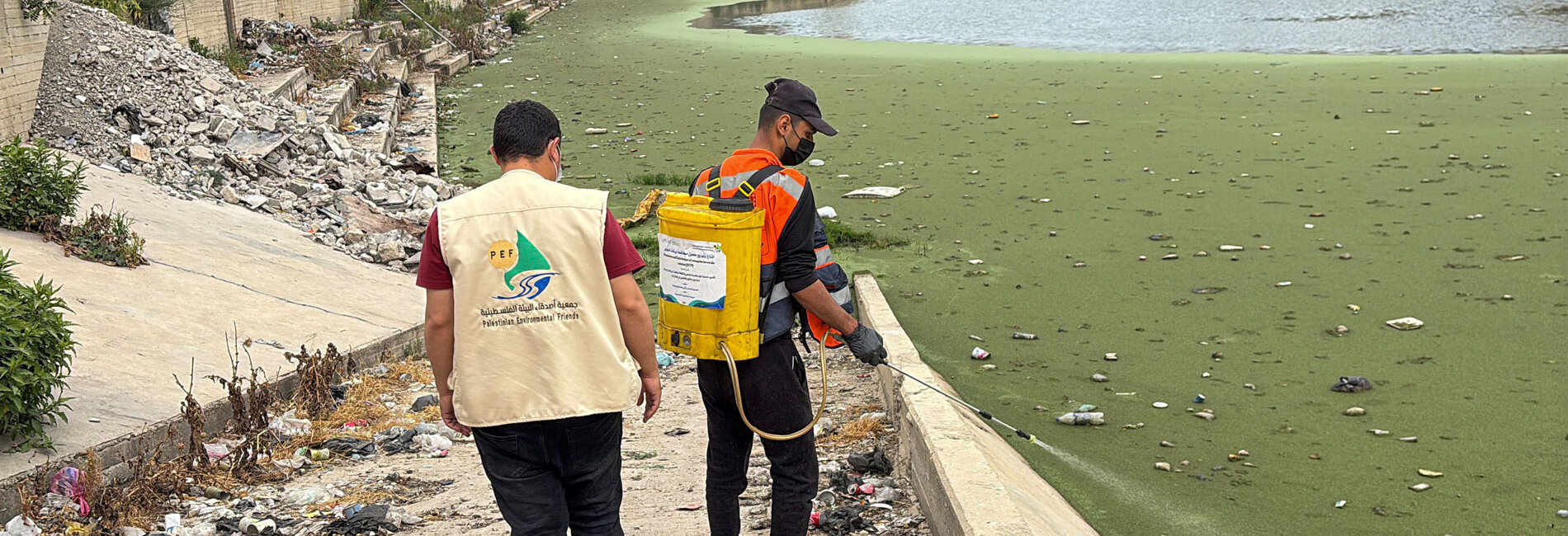
The local NGO Palestinian Environmental Friends (PEF) implemented a water, sanitation and hygiene (WASH) project to support safe, equitable and sustained WASH services for displaced families. The project delivered an integrated package of emergency services, including water supply, sanitation services, hygiene assistance and vector-control interventions. As part of these efforts, PEF treated 61 stagnant-water hotspots across 11 municipalities.
As part of this wider WASH response, PEF worked to reduce mosquito breeding linked to stagnant water. However, larvicide solutions normally used to target mosquito larvae were not readily available due to restrictions and limited access to supplies.
To overcome the shortage of larvicide solutions in Gaza, PEF’s laboratory team developed and produced biological larvicide locally, using materials available inside Gaza. The locally produced solution targets mosquito larvae in stagnant water and helps reduce reliance on supplies that are difficult to bring into Gaza. This innovative approach enabled vector-control activities to continue and demonstrated how local expertise can adapt to operational challenges in a humanitarian crisis.

The solution was distributed to municipalities, which carried out targeted spraying in mosquito breeding areas and locations affected by stagnant water. Under the project, PEF aimed to produce and distribute more than 4,000 litres of locally produced larvicide to support emergency mosquito-control interventions and help reduce mosquito-related risks for more than 2 million people in Gaza.
According to PEF field monitoring, mosquito larvae were no longer observed in the targeted areas within 48 hours of application.
Beyond the immediate technical results, the initiative demonstrated the critical role local organizations can play in sustaining humanitarian responses. By combining technical expertise with local knowledge, PEF developed a practical solution that municipalities could deploy quickly, reducing reliance on imported supplies while helping sustain essential public health interventions.

For families living near targeted areas, the impact was felt in small but important ways. As mosquito populations declined, families were able to spend more time outside their shelters, rest better at night, and feel more comfortable in their surroundings.
“My children could play around the shelter without constantly trying to keep mosquitoes away,” Maha said. “Our nights became quieter, and we were able to sleep peacefully again.”
For Maha’s family, the change helped reduce one of the daily pressures they faced in displacement.
“Some people may think mosquitoes are a small problem compared to everything we have lost,” Maha said. “But for us, reducing them made our daily life more bearable.”
Although the project could not remove the many hardships of displacement, it helped ease one of the daily pressures families faced. In a context where even the smallest improvements can make a meaningful difference, reducing mosquito-related risks contributed to cleaner, safer and more dignified living conditions for displaced families.
The initiative also highlights the value of flexible funding and locally led humanitarian action. Faced with severe access restrictions, supply shortages and highly constrained operating environment, local expertise and innovation enabled essential public health activities to continue, helping communities while demonstrating the adaptability and resilience of national responders working on the frontlines of the humanitarian crisis in Gaza.

* Name has been changed to protect privacy.


subscribe to our mailing list
SUBSCRIBE TO RECEIVE OCHA'S INFORMATION PRODUCTS
 SUBSCRIBE
OCHA Sites










Follow Us
Support
Your donations go to relief organizations delivering quick and effective support to Palestinians in need.