
Humanitarian Situation Update #353 | Gaza Strip
Between 17 December 2025 and 20 January 2026, one Humanitarian Situation Update is issued every week. The next Humanitarian Situation Update on the West Bank will be issued on 21 January and the next Humanitarian Situation Update on the Gaza Strip will be issued on 28 January. We invite you to take a moment to provide feedback on OCHA's regular publications covering the humanitarian situation in Gaza and the West Bank. You can access the survey at https://surveys-kobo.unocha.org/single/fdgdeISC. The survey is anonymous.
Key Highlights
- Heavy rains and flooding have rendered thousands of tents uninhabitable and placed nearly 800,000 people, almost 40 percent of the population, in flood-prone sites at heightened risk.
- UNICEF reports that over 100 children have been killed in Gaza since the ceasefire, highlighting that children remain at grave risk.
- Humanitarian aid entry has nearly tripled since the ceasefire, but damaged roads, limited storage capacity and restricted materials continue to impede effective delivery, response quality and durability, and longer-term response.
- Improved food deliveries have enabled monthly food rations with full coverage of minimum caloric needs for the first time since October 2023 and a 70-per-cent increase in meal and bread production over the past three months.
- Nearly 500,000 children received child protection services between October and December 2025, while winterization coverage for adolescents remains extremely limited, at four per cent, including among adolescents with disabilities.
Context Overview
- Airstrikes, shelling and gunfire continue to be reported across the Gaza Strip, resulting in casualties. The Israeli military remains deployed in over 50 per cent of the Gaza Strip, beyond the “Yellow Line,” where access to humanitarian facilities and assets, public infrastructure and agricultural land are either restricted or prohibited. Detonations of residential buildings and bulldozing activities continue to be reported, including near or east of the “Yellow Line.” Access for Palestinians to the sea remains prohibited and reports of Palestinian fishers being killed or detained at sea continue, including the reported killing of two fishers on 4 January and the reported detention of five fishers by Israeli forces on 6 January.
- According to the Ministry of Health (MoH) in Gaza, between 29 December 2025 and 14 January 2026, 36 Palestinians were killed, 100 were injured and 26 bodies were recovered from under the rubble. This brings the casualty toll among Palestinians since 7 October 2023, as reported by the MoH, to 71,439 fatalities and 171,324 injuries. According to the MoH, the total number includes 110 fatalities who were retroactively added between 26 December 2025 and 2 January 2026 after their identification details were approved by a ministerial committee. MoH reported that since the ceasefire, 449 Palestinians have been killed, 1,246 injured, and 710 bodies retrieved from under the rubble.
- On 8 January, the Israeli military announced that a failed projectile was launched from Gaza towards Israel and reported to have struck Palestinian armed groups and infrastructure in response. The spokesperson of the Palestinian Civil Defence (PCD) stated that multiple strikes were reported in the southern and northern Gaza Strip, where tents and homes sheltering displaced people were hit, adding that seven civilians, including five children, the youngest of whom was five years old, were killed. In total, according to the MoH in Gaza, 14 people were reportedly killed and 17 others injured between 8 and 9 January.
- On 13 January, the UN Children’s Fund (UNICEF) reported that more than 100 children have been killed in Gaza since the ceasefire in early October, roughly equivalent to one child killed every day during this period. These figures include at least 60 boys and 40 girls for which sufficient details were available, and the actual number of child fatalities is expected to be higher. Hundreds of children have been wounded. UNICEF Spokesperson, James Elder, emphasizes: “This is the time to turn reduced violence into real safety: open access for aid, massively increase medical evacuation, and make this the moment when the killing of children in Gaza truly ends.”
- According to the Israeli military, between 29 December 2025 and 14 January 2026, as of noon, no Israeli soldiers were killed in Gaza. The casualty toll among Israeli soldiers since the beginning of the Israeli ground operation in October 2023 stands at 471 fatalities and 2,995 injuries. According to Israeli forces and official Israeli sources cited in the media, more than 1,671 Israelis and foreign nationals have been killed, the majority on 7 October 2023 and its immediate aftermath. As of noon on 14 January, the remains of one hostage are in the Gaza Strip.
- On 11 January 2026, the Palestinian Prisoner’s Society announced the death of a detainee from Gaza while in Israeli custody. According to the Society, the 67-year-old prisoner was detained in November 2024, and his death was reported to have occurred in September 2025. As of January 2026, according to data provided by the Israel Prison Service (IPS) to Hamoked, an Israeli human rights NGO, there are 9,243 Palestinians in Israeli custody, including 1,293 sentenced prisoners, 3,328 remand detainees, 3,385 administrative detainees held without trial, and 1,237 people held as “unlawful combatants.” These figures do not include Palestinians who have been detained from Gaza since 7 October 2023 and are still held by the Israeli military. Between 7 October 2023 and 13 January 2026, the UN Human Rights Office (OHCHR) verified that at least 87 Palestinians (86 men and one boy), including 55 from the Gaza Strip, died in Israeli custody, with documented concerns about torture, ill-treatment, denial of medical care and restricted access for families and independent monitors. On 11 January, Israeli authorities reportedly released 12 Palestinian detainees, including one woman, who were transferred to Al Aqsa Hospital in Deir al Balah for medical examinations.
- Between 1 and 31 December 2025, the Protection Cluster, in coordination with the protection from sexual exploitation and abuse (PSEA) network, deployed 100 mobile protection teams to carry out 68 safeguarding-focused field visits, reaching approximately 5,300 people across 21 aid distribution sites in the Gaza Strip. Since the ceasefire, these visits have reached nearly 7,000 people and aimed to monitor risks of sexual exploitation and abuse, assess adherence to safe and dignified distribution standards, disseminate PSEA and protection messaging (including information on complaints and feedback mechanisms), reinforce accountability to affected populations, and mitigate protection risks during aid distributions. Through ongoing training and technical support, the Protection Cluster coordinates over 500 emergency protection responders who support safeguarding, protection monitoring, and service delivery in Gaza, helping ensure protection services and the safe and dignified delivery of assistance for people in need.
- In the first 10 days of January, 10 classrooms were renovated to serve as temporary learning spaces (TLS) in Gaza governorate. In total, over the past three months, renovation of 76 classrooms and installation of over 100 high-performance tents have enabled further expansion of TLS for children across the Gaza Strip, the Education Cluster reports. As of 13 January, more than 6,300 teachers are deployed across 449 TLS, serving over 270,900 children. To maximize coverage, and in line with minimum standards agreed with the Ministry of Education (MoE), each TLS operates two daily shifts (morning and evening) and two three-day rotations per week. However, the restoration of learning continues to face critical challenges that limit overall coverage; only about 42 per cent of Gaza’s school-aged population is enrolled in TLS for the 2025-2026 academic year.
- On 2 January, the UN Secretary-General expressed deep concern over the Israeli authorities’ announcement to suspend the operations of several international non-governmental organizations (INGOs) in the Occupied Palestinian Territory (OPT) and called for the measure to be reversed, stressing the essential role of INGOs in delivering life-saving humanitarian assistance. Separately, 53 INGOs warned that recent registration measures, including notifications to 37 INGOs that their registrations would expire at the end of 2025, could force organizations to cease operations within 60 days, potentially causing significant disruptions to humanitarian assistance at a time of extreme needs, despite the ceasefire. INGOs deliver more than half of food assistance in Gaza, support about 60 per cent of field hospitals, implement three quarters of shelter and non-food item activities, and provide all treatment for children with severe acute malnutrition. The suspension of their operations would substantially reduce the reach and continuity of life-saving services and undermine coordinated humanitarian response efforts and local partnerships.
Humanitarian Access
- On 11 January, for the first time since 7 October, a patient from Gaza in need of life-saving treatment was reportedly permitted to travel to the West Bank for urgent care, following a Jerusalem District Court ruling. On 5 January 2026, 18 patients and 36 accompanying persons were evacuated to Jordan for trauma care and treatment for cancer, gastrointestinal, renal, immunological, and other serious conditions. In 2025, the World Health Organization (WHO) facilitated the medical evacuation of 2,718 patients from the Gaza Strip for treatment abroad, out of more than 10,700 evacuated since October 2023 for specialized care in over 30 countries. Half of the evacuated patients were children (1,368), 30 per cent were men (805), and 20 per cent were women (545). The largest category of evacuated patients were trauma cases (29 per cent), followed by cancer patients (24 per cent). Sixty-one per cent of patients (1,673) were evacuated during the ceasefire period between 19 January and 17 March 2025 via Rafah Crossing, which has remained otherwise closed, and the rest were evacuated via Kerem Shalom Crossing. More than 18,500 patients in Gaza, including about 4,000 children, continue to urgently require medical evacuation, and WHO continues to call on additional countries to receive patients from Gaza and for evacuations to the West Bank, including East Jerusalem, to be restored. In November 2025, five human rights organizations petitioned Israel’s High Court of Justice to immediately resume medical evacuations from Gaza to hospitals in the West Bank, including East Jerusalem, citing the near-collapse of Gaza’s health system and the risk of preventable deaths.
- According to the UN 2720 Mechanism, three months into the ceasefire, more than 164,000 metric tons (MT) of humanitarian aid were collected by the UN and its partners from Gaza’s crossings, including nearly 19,000 MT in the first 10 days of January. This is a monthly average of about 54,000 MT, nearly three times the monthly average collected between 19 May 2025, when limited aid entry resumed after a 78-day blockade on the entry of supplies into Gaza, and the 10 October ceasefire. During the ceasefire period, reported incidents of looting declined significantly, with the last incident reported on 6 November 2025. While three crossings are operational, 74 per cent of aid (121,100 MT) was collected from Kerem Shalom Crossing. Zikim Crossing, which has allowed for direct aid entry into northern Gaza since 12 November 2025, is open three days per week. Aid continues to arrive via Egypt, Jordan, Israel, the West Bank and Cyprus, with the Israel route (including Ashdod port and Ben Gurion airport) accounting for 55 per cent of offloaded aid over the past three months.
- Marking continued efforts to improve food security in Gaza, Food Security Sector (FSS) partners report that, in January 2026* and for the first time since October 2023, stocks are sufficient to provide monthly food rations covering 100 per cent of minimum caloric needs of a household. As of 11 January, more than 86,000 households have received two food parcels and two 25-kilogramme bags of flour, supported by continuous food truck deliveries, particularly food parcels. Despite progress, operational challenges remain, notably fuel shortages affecting all partners. As of 10 January 2026, partners report the daily provision of about 1.6 million meals through 190 kitchens, alongside the production of about 170,000 two-kilogramme bread bundles. One third of bread bundles are distributed free in more than 400 shelters and two thirds are sold at a subsidized price of 3 NIS (US$0.32) through a retailer network, which has expanded to 146 shops in January 2026 from 118 in December 2025. This represents a nearly 70 per cent increase in cooked meal and bread production over the past three months, up from 954,000 meals through 177 kitchens and over 100,000 bread bundles produced daily as of 11 October 2025.
- While humanitarian truck deliveries have improved and food prices remained broadly stable, data from the Gaza Chamber of Commerce and Industry cited by the World Food Programme (WFP) in the December Market Monitor indicate that commercial truck entries declined by 25 per cent between 1 and 28 December compared with November. According to WFP, sustained commercial imports are critical to increase the diversity of food and other essential items on local markets, complementing humanitarian assistance, supporting supply continuity, and helping to reduce prices.
- Humanitarian movements inside Gaza continue to require coordination with Israeli authorities to and from crossings and in or near other areas where Israeli forces remain deployed. Between 30 December 2025 and 12 January 2026, 78 humanitarian missions were coordinated with the Israeli authorities, of which 43 were successfully facilitated, 19 were impeded, 12 were denied and four were cancelled by the requesting organizations due to operational, logistical or security reasons. In December, 56 per cent of coordinated movements (121 out of 217) were related to the collection of cargo from operational crossings (Kerem Shalom, Zikim and Kissufim), in addition to 10 road repair, assessment and debris-clearing missions to facilitate humanitarian and commercial truck movements.
- According to the Logistics Cluster, aid collection operations and onward delivery of aid continue to face multiple constraints, including limited access routes, road congestion and deterioration of road conditions due to adverse weather. These challenges hinder efficient movement planning, cause significant operational delays, and increase operational costs. WFP reports that road access remains extremely fragile; the southern section of Salah ad Din Road remains inaccessible and the coastal road is currently the only viable route for both humanitarian and commercial truck movements into Gaza and has sustained heavy damage during hostilities. Recent heavy rains have further degraded the road, increasing the risk of disruptions amid high daily truck volumes. WFP teams are undertaking emergency road repairs using basic equipment to prevent the route from becoming impassable, as any prolonged closure would severely disrupt humanitarian assistance and commercial supply flows.
- As of December 2025, the Logistics Cluster consolidated information from 20 humanitarian organizations on their warehouse capacity across Gaza. A total storage capacity of 183,594 square metres (m²) was reported, of which 101,494 m² (55 per cent) across 77 warehouses is operational, while 82,100 m² (45 per cent) across 10 warehouses remains non-operational due to access constraints and infrastructure damage. While the December mapping shows incremental improvements compared with October, largely due to improved access and repair works, overall capacity remains insufficient and unevenly distributed across locations. Rafah governorate continues to have no operational humanitarian warehouses, while North Gaza faces critically limited functional storage capacity. Overall, limited capacity, geographic imbalances, and access restrictions continue to constrain the scale-up and pre-positioning of humanitarian assistance.
Winter Storms
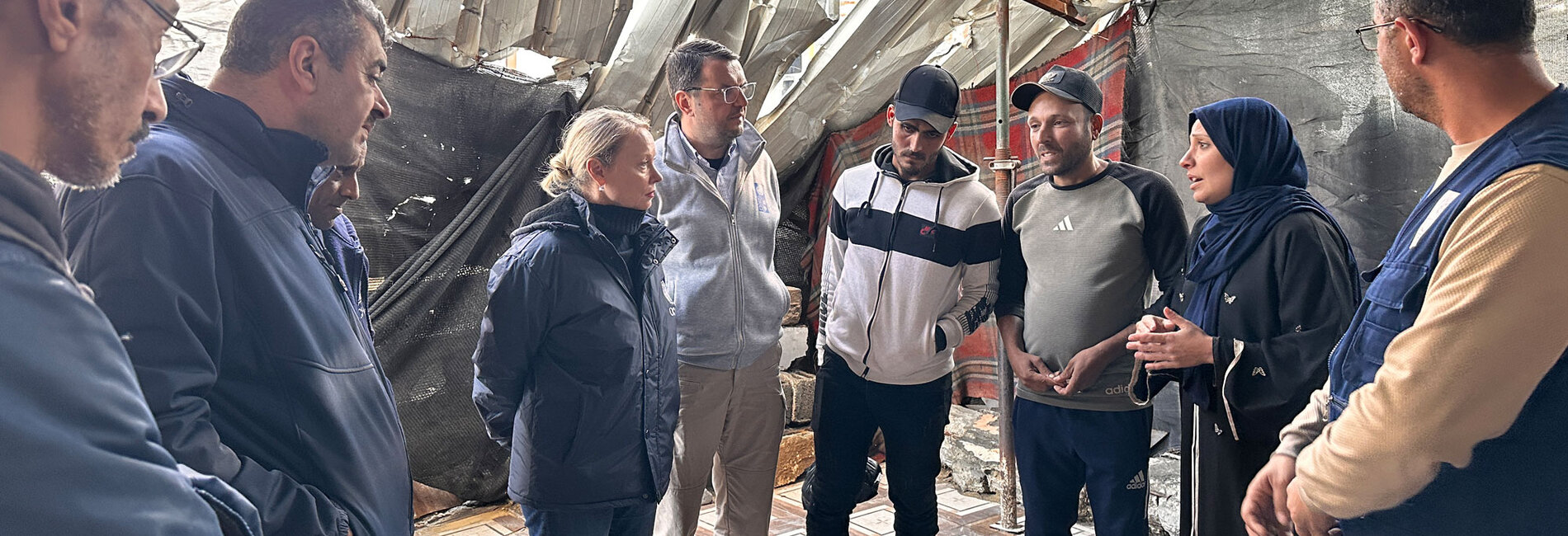
- Rain and stormy weather conditions persisted into the new year, worsening emergency shelter needs amid an already fragile shelter situation and limited access to heating. Nearly the entire population remains displaced, many multiple times, and more than one million people are estimated to be in need of emergency shelter assistance. According to the Shelter and Site Management clusters, storm impacts include tents being blown away, fabric tearing, structural failures under wind and water loads, and widespread flooding of displacement sites due to poor drainage and low-lying terrain, rendering thousands of tents uninhabitable. Since early December, humanitarian partners have reached about 128,000 households with tents and other shelter and non-food items brought into Gaza through UN Coordination or bilateral channels and have supported the relocation of 821 families, mainly from the shoreline and damaged buildings, in Khan Younis.
- In response to forecast heavy rainfall, humanitarian partners have issued flood alerts for high-risk areas, particularly low-lying and coastal displacement sites. Based on pre-winter flood-risk mapping, the Site Management Cluster (SMC) estimates that nearly 795,000 people (almost 40 per cent of the population) are sheltering across 761 displacement sites located in flood-prone areas, with coastal communities among the hardest hit as families pitch makeshift shelters on low, sandy land vulnerable to flooding from both rainfall and the sea. The cluster further notes that, prior to winter, some 4,400 families (24,500 people) were estimated to be living in high-risk coastal areas; while efforts were made to relocate the most vulnerable (see above), limited availability of safe land has meant that many families remain in exposed locations, including sites located directly on the beach.
- The UN Population Fund (UNFPA) reports that winter conditions are intensifying hardship, with families sheltering in flooded tents, newborns facing heightened risk of hypothermia, and pregnant women lacking safe spaces to rest or give birth, and has called for an urgent scale-up of assistance to protect health and support women and girls. According to the MoH in Gaza, between 1 December 2025 and 14 January 2026, seven children died of hypothermia, including four since the beginning of 2026. As rainwater has mixed with sewage, on 8 January 2026, Save the Children highlighted the especially severe impact flooding has had on children, leaving them exposed to water-borne diseases, such as hepatitis, diarrhoea and gastroenteritis. According to the Health Cluster, between 14 and 27 December, health partners carried out over 365,000 consultations, of which more than 21 per cent were related to communicable diseases. Of those, acute respiratory infections (ARI) accounted for over 56 per cent (some 43,600 consultations), while acute watery diarrhoea accounted for over 23 per cent (about 18,000), including 10 per cent among children under five.
- With no viable alternatives, people in Gaza remain in structurally compromised buildings, where recurrent rainstorms and winds significantly increase the risk of collapse. According to the MoH in Gaza, 25 people, including children, died since mid-December due to the collapse of previously damaged buildings due to weather conditions. PCD reported that on 5 January, a four-storey building collapsed in Al Maghazi Camp, in Deir al Balah, killing two Palestinians, including a man and his eight-year-old son and injuring five other Palestinians. According to the Shelter Cluster, as of 13 January, 67 inhabited buildings have been identified as being at risk of collapse in Gaza city. While no preventive evacuations have yet taken place due to severe space and land availability constraints, the Shelter Cluster has allocated tents for the affected families, and coordination with the local municipality on potential evacuations is ongoing.
- Additional storms are expected, but humanitarian partners remain limited to short-term, emergency fixes and are unable to implement sustainable flood-mitigation or recovery measures and families have limited supplies to winterize or rebuild shelters. This is due to the restricted entry of shelter and site-improvement materials, including drainage equipment (e.g. pumps, drainage pipes), heaters and solar equipment, and reconstruction items (e.g. cement, timber), many of which are classified as “dual-use” items, the Shelter and Site Management clusters report. Without these, displacement sites flood repeatedly, and shelters must be replaced. Over the past two years, SMC partners have been unable to bring in sufficient quantities or types of materials to carry out even basic site preparation, relying instead on improvised solutions, such as flour sacks repurposed as sandbags. Challenges are compounded by shortages of fuel, heaters and solar lights and by extremely limited safe, dry land for new displacement sites, as displaced populations are now effectively confined to less than half of the Gaza Strip. The Shelter Cluster emphasizes that tents cannot continue to serve as the primary shelter modality, and there is an urgent need to accelerate the transition to more durable and context-appropriate shelter solutions, alongside essential site-level interventions such as drainage, communal heating spaces, and solar lighting to improve safety and mobility at night.
Child Protection: Adolescents Face Heightened Risks
- Over one million children under 18 years of age in Gaza are estimated to require child protection and mental health and psychosocial support (MHPSS), including more than 58,000 children who have lost one or both parents, according to UNICEF. Amid widespread destruction and significantly weakened protective environments and coping capacities, economic hardship has worsened, forcing one in four families to resort to hazardous and exploitative child labour, including children as young as six. In this context, the Child Protection Area of Responsibility (AoR) led by UNICEF cautions that adolescents aged 11–17 years, including adolescents with disabilities, face heightened and distinct risks amid limited structured activities and age-appropriate support. Underscoring these protection, accessibility and inclusion risks, a situational analysis commissioned by the Global Disability Fund on persons with disabilities in the OPT highlights that over 25 per cent of those injured in Gaza are expected to have long-term disabilities, and that more than 5,000 children have already been identified as requiring life-long rehabilitation.
- Between 1 October and 31 December 2025, Child Protection partners reached nearly half-a-million children with a range of child protection services, including winterization support, distributing over 311,000 winter clothing sets, 112,000 pairs of shoes, 747,000 blankets, as well as thousands of mattresses, mats, plastic tarpaulins and family tents. At approximately 180 child-friendly spaces (CFS) and safe spaces, including 150 high-performance tents installed during the same period, partners delivered a range of services, including psychological first aid, counselling, group and individual sessions and recreational activities. However, funding constraints and insufficient supplies have limited the ability of partners to adequately expand services to address the needs of all children, including adolescents. These challenges were compounded by severe winter weather that caused damage to 40 CFS, interrupting MHPSS and protection services. As of 31 December 2025, according to the Child Protection AoR, humanitarian partners received only about 24 per cent of the funding (US$29.6 million out of US$121.2 million) requested under the 2025 Flash Appeal to address child protection needs in the Gaza Strip.
- Child Protection partners estimate, based on available information, that only about four per cent of adolescents between 11 and 17 years of age in Gaza were reached through household-level winter distributions, leaving the vast majority of this age group unserved – this is approximately 15,000 out of an estimated 400,000 adolescents, all of whom are assessed to require winter support. Coverage gaps affect both girls and boys, with additional barriers affecting adolescents with disabilities, such as mobility constraints, lack of adapted items, and limited inclusive programming. Analysis further indicates that the widespread loss of assistive devices has significantly restricted access to services and humanitarian assistance for persons with disabilities, including adolescents. During the first two months of the ceasefire, humanitarian partners distributed assistive devices to 467 children.
- To mitigate winter-related and protection risks affecting adolescents, Child Protection partners aim to scale up targeted, age-appropriate interventions, including: adolescent-focused MHPSS addressing stress, anger, trauma and risk-taking behaviours; life-skills, peer support, and peer-to-peer learning activities to strengthen positive coping and social cohesion; vocational orientation and skills-building initiatives, where feasible; expanded outreach and mobile programming for adolescents who do not regularly access CFS; and strengthened community-based awareness and protective presence, including engagement around risky behaviours such as unsafe street activities. However, partners warn that without additional and dedicated funding, these adolescent-specific interventions will remain limited in scale, leaving a significant proportion of adolescents without adequate protection, psychosocial support, and winter assistance during the current season and beyond.
Funding
- As of 14 January, Member States disbursed approximately $1.7 billion out of the $4 billion (41 per cent) requested to meet the most critical humanitarian needs of 3 million out of 3.3 million people identified as requiring assistance in Gaza and the West Bank, including East Jerusalem, under the 2025 Flash Appeal for the OPT. On 8 December 2025, the UN and its humanitarian partners launched a Flash Appeal for $4.06 billion to address the humanitarian needs of 2.97 million out of 3.62 million people identified as requiring assistance in Gaza and the West Bank, including East Jerusalem, in 2026. Nearly 92 per cent of those required funds are for the humanitarian response in Gaza, with just over eight per cent for the West Bank. In December, the oPt Humanitarian Fund managed 111 ongoing projects, totalling $61.1 million, to address urgent needs in the Gaza Strip (89 per cent) and the West Bank (11 per cent). Of these projects, 54 are being implemented by international NGOs, 44 by national NGOs and 13 by UN agencies. Notably, 48 out of the 67 projects implemented by international NGOs or the UN are being implemented in collaboration with national NGOs. For more information, please see OCHA’s Financial Tracking Service webpage and the oPt HF webpage.
SUBSCRIBE TO RECEIVE OCHA'S INFORMATION PRODUCTS
 SUBSCRIBE
OCHA Sites










Follow Us
Support
Your donations go to relief organizations delivering quick and effective support to Palestinians in need.