
Humanitarian Situation Report | 7 May 2026
Highlights
- Rapid response supported by the humanitarian community prevented loss of life near a solid waste dumpsite that caught fire in Gaza city.
- Rodents and insects continue to drive increases in skin infections and other health risks across Gaza.
- In the West Bank, the spread of foot-and-mouth disease is heightening humanitarian concerns for vulnerable Bedouin and herding communities.
- In just a week, 55 Palestinians were displaced in Area C and East Jerusalem due to administrative demolitions and recurrent settler attacks and intimidation.
- Amid ongoing movement restrictions and delays, the World Health Organization has documented 38 attacks on health care across the West Bank since January – affecting four health facilities and 33 ambulances.
Overview
Across the Occupied Palestinian Territory, people’s ability to stay safe, maintain livelihoods and access basic services is being steadily worn down. Violence, displacement, restrictions on access and movement and damage to essential infrastructure are deepening humanitarian needs. Relief partners continue to respond, but insecurity, access constraints, restrictions on key partners, and shortages of critical supplies are limiting the scale, timeliness and durability of assistance, leaving already vulnerable communities unprotected and with fewer ways to cope.
West Bank
Across the West Bank, the humanitarian situation continued to deteriorate amid ongoing operations by Israeli forces, settler violence, demolitions, and movement restrictions.
Between 28 April and 4 May (the reporting period of this section), these dynamics drove further casualties, displacement, and damage to homes and critical infrastructure, while undermining access to livelihoods, health care and other basic services. Bedouin and herding communities remained particularly vulnerable, facing recurrent settler attacks, repeated displacement, restricted access to grazing land and water resources, and the growing threat posed by the spread of foot-and-mouth disease.
Humanitarian partners continue to respond through emergency assistance, protective presence, health support and livelihood interventions although access constraints and insecurity continued to hamper response efforts.
Within these efforts, child protection partners delivered services and training, and carried out staff-care initiatives, for more than 2,000 children, caregivers and aid workers. This included mental health and psychosocial support (MHPSS) services for 879 children and 553 caregivers; awareness and life-skills sessions to 205 adolescents, children and caregivers; case management, rehabilitation, legal assistance and referrals to 56 children; and clothing kits, cash assistance and other in-kind support to 287 children to address urgent needs amid heightened protection risks. On 29 April, partners carried out an orientation session for 131 frontline child protection staff on Participatory Child Safety Walk and Safety Mapping tools, which are child-centered, community-based tools used by partners to identify, assess, and address risks and hazards that children face.
Casualties and Settler Attacks
Between 28 April and 4 May, Israeli forces shot and killed three Palestinians, including one child, while operating in Nablus, Hebron and Ramallah governorates, as follows:
- On 29 April, Israeli forces shot, killed, and withheld the body of a Palestinian man during a seven-hour raid in Silwad, in Ramallah governorate. According to local sources, Israeli forces raided a house, physically assaulted family members, and fatally shot the man after he reportedly intervened during the assault; his father and brother were subsequently arrested. The Israeli military stated that two soldiers were injured by two Palestinians, after which the troops opened fire.
- On 29 April, Israeli forces shot and killed a Palestinian child and injured a man during a raid in Hebron city. According to local sources, forces raided the headquarters of the Islamic Charitable Society and fired live ammunition, and the child was reportedly shot while leaving a nearby supermarket. The Israeli military stated that Palestinians threw stones at forces, who responded with live fire.
- On 3 May, Israeli forces shot and killed a Palestinian man and injured four others, including two children, during a raid in downtown Nablus city during peak daytime hours, firing tear gas canisters and live ammunition, while Palestinians threw stones. Forty additional people were treated for tear gas inhalation. The Israeli military stated that the stone throwing endangered the troops.
During the same period, about 70 Palestinians, including 10 children, were injured by Israeli forces or settlers, mainly within the context of search operations and other raids by Israeli forces and settler attacks.
So far in 2026, 44 Palestinians have been killed, including 13 by Israeli settlers, 30 by Israeli forces and one by Israeli settlers or forces. These fatalities include 14 people killed in settler attacks, including 13 by Israeli settlers and one by Israeli settlers or forces. In addition, one Palestinian woman died of injuries sustained in December 2023.
Over the past week, settler attacks against Palestinians continued, bringing to over 760 the number of incidents resulting in casualties or property damage in 2026 – a daily average of six incidents.
Among the key settler attacks recorded over the past week was a night-time attack on residents of Ein al Hilwa herding community, in Tubas governorate, in the northern Jordan Valley; settlers injured a father and his son with sticks and stones, damaged property (including water tanks), and stole livestock. In the H2 area of Hebron city, settlers attacked a Palestinian family with stones, injuring three people who were transported to hospital.
In Nablus governorate, settlers damaged part of the main electricity network in Jalud village, cutting off supply to three poultry farms and three residential buildings for 24 hours before repairs were made. In Tell al Khashaba herding community, settlers vandalized water and electricity networks, affecting at least 12 families; when repair teams attempted to restore services, settlers interrupted and harassed them, leaving families reliant on generators and water tankers, with services remaining disconnected as of the end of the reporting period.
In Ein Jaryout Bedouin community, in Ramallah governorate, repeated settler attacks and intimidation, including damage to solar panel cables, water tanks and residential structures, led this week to the displacement of four Bedouin households comprising 18 people (see section below).
Attacks on Health Care
During the reporting period, medical teams reported multiple incidents in which Israeli forces delayed ambulances transporting injured patients to hospitals, amid continued access constraints caused by checkpoint closures and other movement restrictions. According to the World Health Organization (WHO), ambulance teams were forced to take longer alternative routes and, in some instances, transport patients on foot through closed gates after ambulances were blocked.
According to WHO, between January and April 2026, 38 attacks on health care were documented in the West Bank, resulting in seven injuries and affecting four health facilities and 33 ambulances. Under WHO’s Surveillance System on Attacks on Health Care (SSA), these incidents are classified as attacks on health care because they involve obstruction and interference with the delivery of health services. Most incidents involved the use of force (35) and obstruction of access (35), alongside militarized searches (10) and detentions (13). Incidents were concentrated in Nablus governorate (20), followed by Salfit (5), Ramallah (4), and Hebron (4). This concentration mirrors broader casualty trends documented by OCHA, with Nablus also recording the highest number of Palestinian injuries during raids and other operations carried out by Israeli forces in the first four months of 2026: 99 of over 380 injuries documented across the West Bank, followed by Hebron with 85 injuries.
While the overall number of documented attacks on health care in 2026 is lower than during the same period in 2025, the higher number recorded in early 2025 coincided with the onset of large-scale operations by Israeli forces in the northern West Bank in January 2025. These operations have been characterized by prolonged raids in refugee camps and movement restrictions.
Displacement

During the reporting period, 22 Palestinian-owned structures were demolished for lacking Israeli-issued building permits, which are nearly impossible for Palestinians to obtain.
In Area C, 17 structures, including one home, were demolished, displacing a family of eight people, including six children. More than half of the structures were in three incidents in Hebron governorate. One of the three was in Ad Deirat community, east of Yatta, where Israeli authorities demolished a two-storey home and other structures, including a water cistern. This demolition displaced a family of eight people, including six children. Additional assets were destroyed, and part of the family’s belongings was buried under the rubble.
In East Jerusalem, five structures were demolished, displacing three families of 16 people, including eight children. These include three families forced to demolish their homes in Sur Bahir and Umm Tuba following the receipt of demolition orders, to avoid the payment of additional fines and fees. About half of the structures demolished in East Jerusalem so far in 2026 were demolished by their owners following the issuance of demolition orders by Israeli authorities, approximately one-third of them in the Silwan area.

In addition, six Palestinian families, comprising 31 people, including 14 children, were forcibly displaced between 28 April and 4 May in herding communities due to recurrent settler attacks and intimidation:
- In Bariyat Ash Shuyukh area of Hebron, two families of 13 people, including five children, who had previously been displaced in November 2023, were forced to relocate following continuous harassment and threats, including the risk of livestock theft. Their displacement followed a pattern of attacks in the community, from which five other families had already been displaced during the previous year. The families were able to take their residential shelters and animal fencing but were forced to leave behind water tanks and other essential belongings.
- In Ein Jaryout Bedouin community, in Ramallah, four Bedouin families comprising 18 people, including nine children and five women, were displaced following repeated settler attacks and intimidation over the past month. Reported incidents included damage to water and energy infrastructure, daily presence of settlers around residential structures, damage to solar panel cables, the emptying and damaging of water tanks, and harassment of residents, particularly women and children.
These incidents are part of a broader escalation in settler attacks, with over 4,500 attacks that resulted in casualties or property damage documented between 2023 and 2025, the majority of which were in Ramallah, Nablus and Hebron governorates.
Since January 2023 and up to 4 May 2026, 117 communities across the West Bank have experienced full or partial displacement due to settler attacks and related access restrictions, predominantly in Bedouin and herding communities in Area C. These include 45 communities comprising over 3,500 people that have been fully displaced: 14 communities in 2023 (10 of them in the aftermath of 7 October 2023), 10 in 2024, 12 in 2025 and nine so far in 2026. Overall, more than 5,900 Palestinians have been displaced in this context, including about 2,000 people – nearly 900 of them children – in 2026 alone.
For more information, please see OCHA’s latest map on the impact of settler attacks.
For key figures and additional breakdowns of casualties, displacement and settler violence between January 2005 and March 2026, please refer to the OCHA West Bank March 2026 Snapshot.
Foot-and-Mouth Disease Outbreak Compounds Vulnerabilities among Herding Communities
The spread of Foot-and-mouth disease (FMD), a highly contagious viral illness affecting cloven-hoofed animals, has emerged as a growing concern in the West Bank, with the identification of a new strain and increasing reports of suspected and confirmed cases across multiple areas. According to the Food Security Sector (FSS), response efforts are underway, including the procurement of vaccine doses by the Ministry of Agriculture (MoA) and the Food and Agriculture Organization (FAO); however, available quantities remain insufficient relative to needs, amid broader procurement constraints and challenges in reaching vulnerable herding communities, particularly in remote and access-restricted areas. Movement restrictions and insecurity further complicate timely vaccination and veterinary response efforts, raising concerns about continued disease transmission and livestock losses.
The outbreak is of particular humanitarian concern for Bedouin and herding communities, for whom livestock constitutes a primary source of income, food, and resilience. These communities are already among the most vulnerable in the West Bank, facing heightened exposure to settler violence, displacement pressures, and restricted access to grazing land and water resources. According to FSS, the spread of FMD risks further undermining livelihoods and food security, particularly as response efforts continue to face resource shortfalls and operational constraints in reaching vulnerable communities, particularly in hard-to-reach areas.
Gaza Strip
The humanitarian situation in Gaza remains dire, with many displaced families staying in overcrowded tents or severely damaged buildings due to the lack of safe alternatives. Basic services are poor, access to clean water is unstable, and waste is largely left untreated, creating serious public health risks. Security conditions also remain volatile, with frequent incidents including strikes and exchanges of fire occurring in residential areas and near humanitarian facilities.
Access to water remains challenging. With water infrastructure still destroyed, some 40 partners are delivering approximately 20,000 cubic metres of water by truck each day – an operation heavily dependent on fuel and increased funding. Operational costs and water‑filling times have increased further following the suspension of operations at the Al Mansoura filling point after two contractors were killed there. To meet drinking and cooking needs, families are required to collect water directly from those trucks at approximately 2,000 distribution points. Many of them lack adequate containers to collect and store the water. This distribution modality has resulted in increased competition and in people's access to water being inequitable.
The spread of rodents and insects is driving a growing public health crisis, with increasing cases of skin infections and other diseases reported among displaced families. Rodents are heavily infesting emergency shelters, displacement sites, and tents, biting people and contaminating living spaces. UN and partners are improving sanitation and pest control. However, to contain the risks of a wider public health crisis, humanitarian partners are engaging with Israeli authorities to allow debris-removal machinery into the Strip and restore access to waste disposal sites.

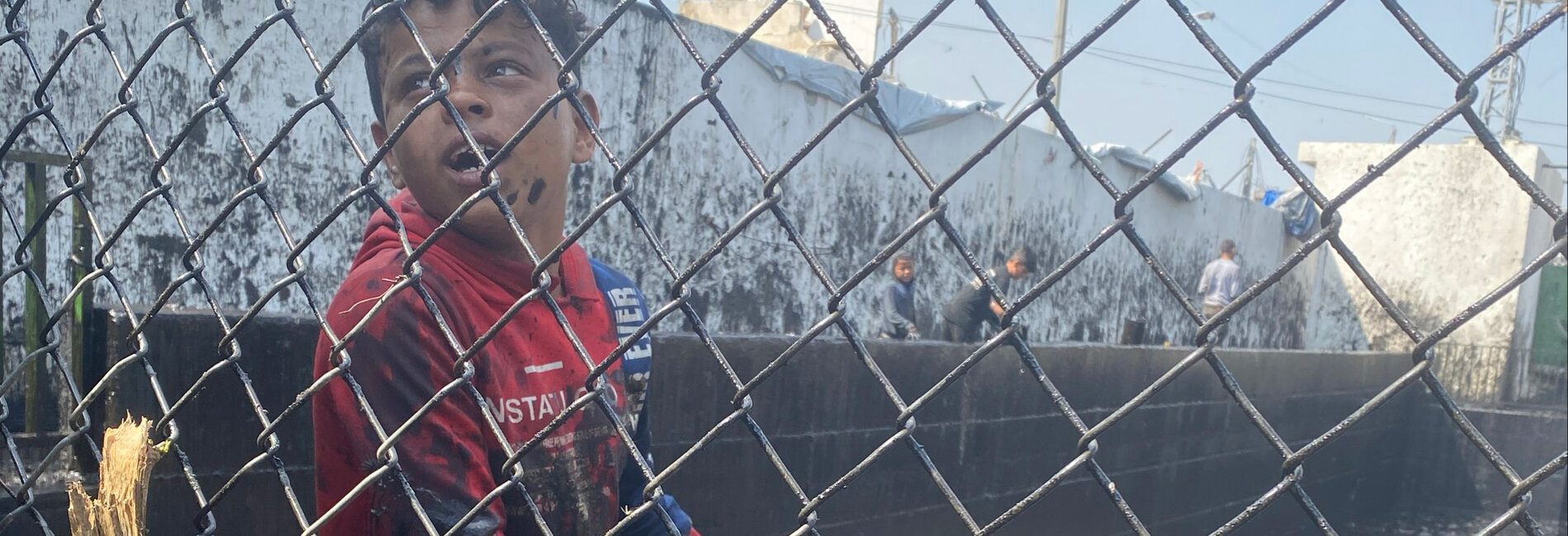
On 1 May, the emergency solid waste dump site in Gaza city, located at Firas Market, caught fire. This historic market, near the Old City, has become the largest solid waste accumulation site during 2024, receiving mixed waste streams including household waste, medical waste, and debris from damaged buildings. Waste now covers an entire block and has reached a height of approximately 14 metres. The fire was most likely caused by a buildup of methane gas from decomposing organic waste, compounded by rising temperatures. It was successfully contained through following a rapid intervention by municipality workers and other crews, supported by multiple UN agencies, who mobilized water tankers and heavy machinery used to put out the flames with water and sand.
The incident underscores the significant risks associated with temporary dump sites located in densely populated areas, including fire hazards, structural collapse, pest proliferation, and increased risks of disease and environmental contamination.

Solid waste management remains a critical operational challenge across Gaza, with severe congestion and heightened risks of further fires, particularly during the summer. The Water, Sanitation and Hygiene (WASH) Cluster estimates that about 470,000 cubic metres of waste have accumulated in the southern region alone.
Urgent restoration of access to the sanitary landfills at Al Fukhari (Sufa) and Johr Al Deek, the only two sanitary landfills – both located near the Israeli perimeter fence – is critical to mitigate these risks and prevent further environmental and public health deterioration.
Site management partners overseeing designated emergency shelters are facing significant operational challenges, particularly in maintaining water pump generators that have not been serviced for extended periods. The lack of essential spare parts, most notably lubricant oil, threatens the continued functionality of these generators. If this shortage is not urgently addressed, there is a serious risk that water pumping operations will halt, severely affecting the availability of drinking water and posing significant public health risks for displaced people currently residing in these shelters.
Restrictions on fuel and spare parts have hindered waste management and debris removal, leading to the accumulation of solid waste and rubble, creating conducive environments for pests and increasing public health risks, while also delaying the repair of essential water and sanitation infrastructure.
In the first two weeks of April, 68 per cent of the population reported relying on burning waste as source of fuel, amid shortages of cooking gas, according to Food Security Sector. This marks a 13 per cent increase compared with the previous month and reflect the growing reliance on harmful coping mechanisms.
According to the latest World Food Programme (WFP) Palestine Market Monitor and Food Security Analysis covering April 2026, commercial and humanitarian inflows into Gaza decreased following the regional escalation that began on 28 February, with a gradual but partial increase observed in April, although levels remained below pre‑escalation levels. This disruption has negatively affected both markets and food security. Many food items have increased in price, most notably wheat flour and fresh vegetables. The percentage of people relying on local markets to buy food has decreased compared with March, while reliance on humanitarian aid has increased. In the first half of April 2026, food consumption declined compared with March, with vegetables, fruit, and protein sources consumed only once a week or less. In March, vegetables were consumed on average 1.8 days per week and fruit on 2.3 days per week. Although the third week of April saw slight decreases in the prices of some food commodities, prices remain higher than they were before the Iran crisis, particularly when compared to February levels.
Incoming Supplies
Kerem Shalom and Zikim remain the only operational entry points for humanitarian and commercial goods into Gaza.
On the commercial front, data shared with the Cash Working Group indicates that between 27 April and 3 May, 750 private sector truckloads entered the Gaza Strip. This marks a notable increase and approaching averages recorded before the 28 February regional escalation and suggests a partial recovery in commercial flows compared with previous weeks.
Of the 750 truckloads, 85 included hygiene items and 53 included shelter materials. Notably, three truckloads included electrical and communication equipment and three included medical supplies. These types of supplies have not been recorded for several months, indicating a slight improvement in the availability of critical supplies. The share of non-essential commodities decreased to 24 per cent, reflecting progress; however, further reductions toward 10 per cent remain a priority to support market recovery.
The UN is only able to confirm the entry of supplies tracked by UN 2720. For breakdowns of those, see the online UN 2720 Mechanism Dashboard.
Between 30 April and 6 May, UNOPS facilitated the entry of more than 1.1 million litres of diesel and almost 52,000 litres of petrol into Gaza and distributed just over 1 million litres of diesel (including from stocks that entered before that period) in support of humanitarian operations.
For a detailed account of the latest humanitarian operations in Gaza, see Annex 1 below.
Funding

Sources: Financial Tracking System and oPt HF
Annexes
Annex 1: Humanitarian Operations in the Gaza Strip by Cluster
Read more
This section covers 27 April to 3 May unless otherwise specified.
Food Security
- As of 3 May, partners have provided general food assistance to 8,300 households (30,000 people) for the May monthly food distribution. Each family receiving two parcels, one 25-kilogram flour bag and 2.5 kilograms of high energy biscuits, covering 75 per cent of minimum caloric needs – the same as in April.
- As of 29 April, partners continued to prepare and serve almost 1.1 million meals every day through 121 kitchens and to almost 2,000 different locations. This includes 312,000 daily meals produced in northern Gaza and 786,000 meals in the south.
- Bread production continues, with approximately 130,000 two-kilogram bread bundles produced daily through 28 UN-supported bakeries. One fifth of the bread is distributed free of charge to more than 300 shelters and community sites, while the remainder is sold at a subsidized price of NIS 3 (US$0.95) per bundle through 168 retailers. Production has steadily increased as the bakeries strengthen their customer base and slowly establish increasingly larger networks of sales points and retailers to sell their bread.
Health
- Partners supported the medical evacuation of 196 patients, including 92 children, with 246 companions, through Rafah or Kerem Shalom.
- Since the announcement of a ceasefire on 10 October 2025, partners have supported the establishment or restoration of 110 health service points, including 65 in Gaza city and North Gaza. Still, significant gaps remain, particularly in North Gaza.
- In April 2026, 72 partners reported reaching an average of 370,100 people weekly, with general clinical services accounting for the largest share (246,300), followed by sexual and reproductive health, non-communicable diseases, child health, and mental health and psychosocial support services.
For more information, see the online Heath Cluster Dashboard.
Shelter
- Partners delivered life-saving shelter and noon-food items through in-kind and voucher modalities, reaching 4,471 households. Distributions included 4,982 bedding items, 600 bedding kits, 1,532 sealing-off kits, and 442 tents.
- In Khan Younis, they installed 150 improved emergency shelters made from available materials such as plastic sheets and designed as an immediate solution that can be upgraded into transitional shelters once materials are allowed entry.
For more information, see the Shelter Cluster website.
Site Management
- Following the rapid displacement site review in February, the Site Management Cluster has introduced an interactive tool that allows partners to easily retrieve information on individual sites, to inform their response and improve collective coverage.
Protection
- Partners reached at least 14,000 people through static sites and mobile outreach. Services included mainly MHPSS, as well as legal assistance (covering civil and family issues), community-based protection, disability-inclusive support, and awareness-raising activities.
- They offered services to 253 Palestinians who returned from Egypt, bringing the total number of returnees offered such services since the reopening of Rafah on 2 February to 2,069; including 316 who are still receiving follow-up protection services.
- They also held 17 focus group discussions and conducted 151 key informant interviews across 16 neighborhoods, reaching 1,765 people, as a means of monitoring protection needs and services.
- Protection partners also reached around 6,000 people through distributions of hygiene items, clothing, and food.
For more information, see the online Protection Cluster dashboard.
Child Protection
- Partners provided over 3,500 children and caregivers with MHPSS interventions, including group activities, individual counselling, psychological first aid, and resilience-building support to address trauma and distress and strengthen caregiver coping.
- Partners also reached 150 high-risk children with case management services. The rising number of complex and high-risk cases, including abuse, neglect, child marriage, and suicide-related concerns increase the need for response but capacity for follow-up and specialized services remains limited.
- Community-based child protection prevention and outreach activities remain active, reaching 2,500 children and caregivers through awareness sessions on protection risks and safe behaviors. Participatory approaches, including child safety walks and safety mapping, are being implemented across multiple locations, engaging children in identifying risks in their environments. Preliminary findings indicate heightened risks in public and communal spaces, including harassment, unsafe infrastructure, and limited safe access, particularly for girls. Based on children’s inputs, partners have initiated community-level risk mitigation actions, with early implementation underway in selected areas. Further scale-up and cross-sector engagement are planned to support integrated responses.
Mine Action
- UNMAS conducted 37 explosive hazard assessments in support of debris removal and other partner activities, and four emergency response team missions.
- Explosive ordnance risk education activities continued between 23 and 30 April, reaching almost 12,600 people in Gaza city, Deir al Balah, Khan Younis, and Rafah.
- Since the announcement of a ceasefire on 10 October 2025, 98 accidents have been recorded, leading to 246 Palestinians injured and 49 killed.
Education
- Partners distributed 66 School-in-a-Carton kits to a temporary learning space (TLS) in Khan Younis, benefiting 2,640 learners. They also delivered four Early Childhood Development kits benefitting 250 pre-school children, while three recreational kits benefitted the same 2,640 learners.
- As part of efforts to scale up alternative learning spaces, given that 93 per cent of school buildings require major rehabilitation or reconstruction, 27 High-Performance Tents (HPTs) have been installed across five sites to serve as TLS classrooms.
- Light rehabilitation of vacated classrooms is ongoing. In Nuseirat, Deir al Balah, partners completed the rehabilitation of 12 classrooms in a public school on 3 May. This enabled over 1,500 learners to access improved learning environments.
- A total of 30 participants have completed training on disability-inclusive programming, aimed at strengthening data quality and promoting more inclusive education responses. This is particularly critical given the increasing number of children with disabilities and the persistent barriers to their inclusion.
For more information, see the online Education Cluster page.
Multi-Purpose Cash Assistance (MPCA)
- Multi-Purpose Cash Assistance distributions continue at scale, reaching 138,996 households (approximately 765,000 people) in April, again exceeding the monthly threshold of 100,000 households assisted.
- Data from recent studies indicate that the average household size has increased from 5.5 to 6 persons, raising the estimated monthly reach of MPCA to over 600,000 people.
Emergency Telecommunications
- On 27 April, partners completed the configuration of the UNDP firewall at the Jerusalem level, restoring connectivity of the Security Communications System (SCS) between Jerusalem and Gaza.
- Between 29 and 30 April, the Emergency Telecommunications Cluster Field Coordinator delivered SCS training to 28 humanitarian staff in Gaza, strengthening operational communications capacity.
- On 30 April a partner began restoring the main generator in Gaza city, a critical step to maintain connectivity, after the Israeli authorities approved on 29 April the entry of spare parts and consumables into Gaza.
** Double asterisks indicate that a figure, sentence, or section has been rectified, added, or retracted after the initial publication of this update.
SUBSCRIBE TO RECEIVE OCHA'S INFORMATION PRODUCTS
 SUBSCRIBE
OCHA Sites










Follow Us
Support
Your donations go to relief organizations delivering quick and effective support to Palestinians in need.