
Humanitarian Situation Report | 10 July 2026
Highlights
- Across the Occupied Palestinian Territory, Israeli access restrictions, insecurity and funding shortfalls continue to constrain humanitarian operations.
- In the West Bank, successive movement restrictions have effectively isolated approximately 12,000 Palestinians in communities west of Ramallah, where the transfer of a four-month-old Palestinian baby to hospital was delayed at an Israeli-staffed road gate. The infant was later pronounced dead at the hospital.
- In 2026, over 3,200 Palestinians have been displaced across the West Bank by settler attacks and demolitions for lack of Israeli-issued building permits – an average of 17 people per day, double the daily rate over the preceding three years.
- In Hebron's H2 area, Israeli forces installed a gate that restricts one of the last remaining access routes to the Old City, further expanding an increasingly institutionalized system of movement restrictions affecting about 7,000 Palestinians.
- In Gaza, with most people already displaced, new displacement along the “Yellow Line” continues amid ongoing military operations.
- Aid work is increasingly exposed to insecurity and delays as external actors exploit humanitarian shipments to smuggle high-value items into Gaza, where the de facto authorities attempt to locate and confiscate them.
- The number of families receiving shelter assistance in Gaza fell by 37 per cent from May to June due to funding shortfalls.
Overview
Across the Occupied Palestinian Territory (OPT), humanitarian space continues to shrink as insecurity, expanding movement and access restrictions, repeated displacement and funding shortfalls increase humanitarian needs while constraining humanitarian operations. In the Gaza Strip, military activity, expanding access-restricted areas and repeated displacement continue to expose civilians to heightened protection risks and deteriorating living conditions despite sustained humanitarian assistance. In the West Bank, expanding movement restrictions, Israeli forces' operations, demolitions, settlement expansion and recurrent settler violence are increasingly driving displacement, restricting access to essential services and livelihoods, and isolating Palestinian communities. Together, these developments are increasing humanitarian needs while making it more difficult for humanitarian partners to reach affected people and sustain assistance across the OPT.
West Bank
The reporting period for this section is 30 June to 6 July unless otherwise specified.
Israeli forces' operations, expanding movement restrictions, demolitions, settlement expansion and settler violence continue to drive displacement, heighten protection risks and restrict Palestinians' access to housing, livelihoods and essential services across the West Bank, including East Jerusalem. This is compounded by deteriorating economic conditions, the fiscal crisis facing the Palestinian Authority, and persistent funding shortfalls, which further strain household resilience and constrain humanitarian operations.
These dynamics were highlighted during a field visit led by the Humanitarian Coordinator on 30 June for donors and diplomats from more than 20 countries to East Jerusalem and surrounding areas. Humanitarian partners and community representatives described the humanitarian impacts of demolitions, forced evictions, settlement expansion and movement restrictions, while highlighting growing protection concerns, including child protection risks and increasing mental health and psychosocial support (MHPSS) needs.
Despite movement restrictions, insecurity and persistent funding shortfalls, humanitarian partners continued to deliver critical assistance. During the first half of 2026, child protection partners reached more than 5,300 children and 1,670 caregivers in Jerusalem governorate through MHPSS, parenting support, child protection awareness, case management and emergency assistance. Across the West Bank, including East Jerusalem, Education Cluster partners supported approximately 60,000 children through catch-up and remedial learning programmes and completed emergency rehabilitation works in 32 schools.
However, access to education continued to deteriorate in some of the most affected areas. Six UNRWA schools in Jenin and Nur Shams refugee camps remained inaccessible, six UNRWA schools in East Jerusalem remained closed, and 10 schools in Area C were abandoned following the full displacement of their communities due to recurrent settler attacks. Following the displacement of the communities they served, eight of these schools had been vandalized by Israeli settlers and two had been demolished by 6 July. In addition, 84 schools remained under threat of demolition or subject to stop-work orders, placing about 13,000 students at risk of losing access to education. Sixty-one detained students were also unable to sit or complete their Tawjihi examinations.
Casualties and Settler Violence
Between 30 June and 6 July, Israeli forces shot and killed a 16-year-old Palestinian child during a raid and search operation in Qalandiya Camp in Jerusalem governorate, and 39 Palestinians and four Israeli activists were injured by Israeli forces or Israeli settlers. No Israeli casualties by Palestinians were reported. In addition, a four-month-old Palestinian infant was delayed while being transferred to hospital at a road gate staffed by Israeli forces at the entrance to Deir 'Ammar village in Ramallah governorate and was later pronounced dead at the hospital (see case study below).
In 2026, 16 Palestinian children have been killed and 187 injured by Israeli forces or Israeli settlers across the West Bank, including East Jerusalem, while more than 1,500 children have been displaced due to recurrent settler attacks, demolitions for lack of Israeli-issued building permits and forced evictions.
During the reporting period, OCHA documented at least 35 incidents involving Israeli settlers that resulted in casualties, property damage or both. This brings the total number of such incidents documented since the beginning of 2026 to more than 1,200 across over 240 Palestinian communities, averaging about six incidents per day.
A notable feature of incidents documented during the reporting period was the targeting of Palestinians and protective presence actors accompanying communities seeking to access agricultural land and grazing areas. On 30 June and 4 July, Israeli settlers injured six Palestinians, four protective presence activists accompanying vulnerable communities in Ramallah governorate. In East Tayba Bedouin community, settlers twice attacked a Palestinian family, injuring a Palestinian woman and a protective presence activist and damaging water infrastructure and other property. In a separate incident, settlers believed to be from a nearby newly established settlement outpost attacked Palestinian farmers and activists cultivating land between Khirbet Abu Falah and Turmus'ayya villages with pepper spray, stones and clubs, injuring eight people.
Protective presence is an anticipatory humanitarian protection intervention implemented by longstanding Protection Cluster partners in coordination with Palestinian, Israeli and international solidarity organizations. Through regular in-person and remote accompaniment, and rapid protective presence response, it seeks to reduce immediate protection risks, support safer access to livelihoods and essential services, and strengthen communities' ability to remain safely in place.
Protection partners report that, with the increased protection risks affecting communities, they themselves are also being targeted through movement restrictions, injuries, detention and deportation procedures. These constraints are limiting partners' ability to maintain a regular presence in high-risk communities despite growing demand.
In 2026, 19 Israeli and international protective presence activists have been injured by Israeli settlers in 12 separate incidents while accompanying Palestinian communities.
Since the beginning of 2026, Protection Cluster partners in coordination with Palestinian, Israeli and international solidarity organizations, have maintained regular weekly or twice-weekly accompaniment visits and ad hoc rapid protection presence response in more than 100 high-risk Palestinian communities across the West Bank, including East Jerusalem. Partners are also expanding community self-protection initiatives in these high-risk areas through first aid training, legal awareness, training in documentation of protection incidents, and preparedness assistance, including first aid kits, solar lighting, surveillance cameras and fire extinguishers. Nevertheless, partners report that current protective presence capacity remains insufficient to meet growing needs.
Case Study: Access Restrictions Isolate Communities West of Ramallah
On 5 July, the transfer of a four-month-old Palestinian baby to hospital was delayed for approximately 25 minutes after Israeli forces prevented the family's passage at an intermittently staffed checkpoint with a closed road gate blocking the southern entrance to Deir 'Ammar village. Despite reportedly being informed of the medical emergency, Israeli forces kept the gate closed while an ambulance waited on the other side. During the delay, Israeli forces fired tear gas canisters and sound grenades towards Palestinians gathered at the checkpoint. The infant was eventually carried on foot to the ambulance through a back-to-back transfer. Because the southern road gate remained closed and Palestinian passage is generally not permitted through the two northern checkpoints connecting the area to Road 465, the ambulance was forced to take an approximately 40-kilometre detour to reach a hospital in Ramallah city. The infant was later pronounced dead at the hospital.
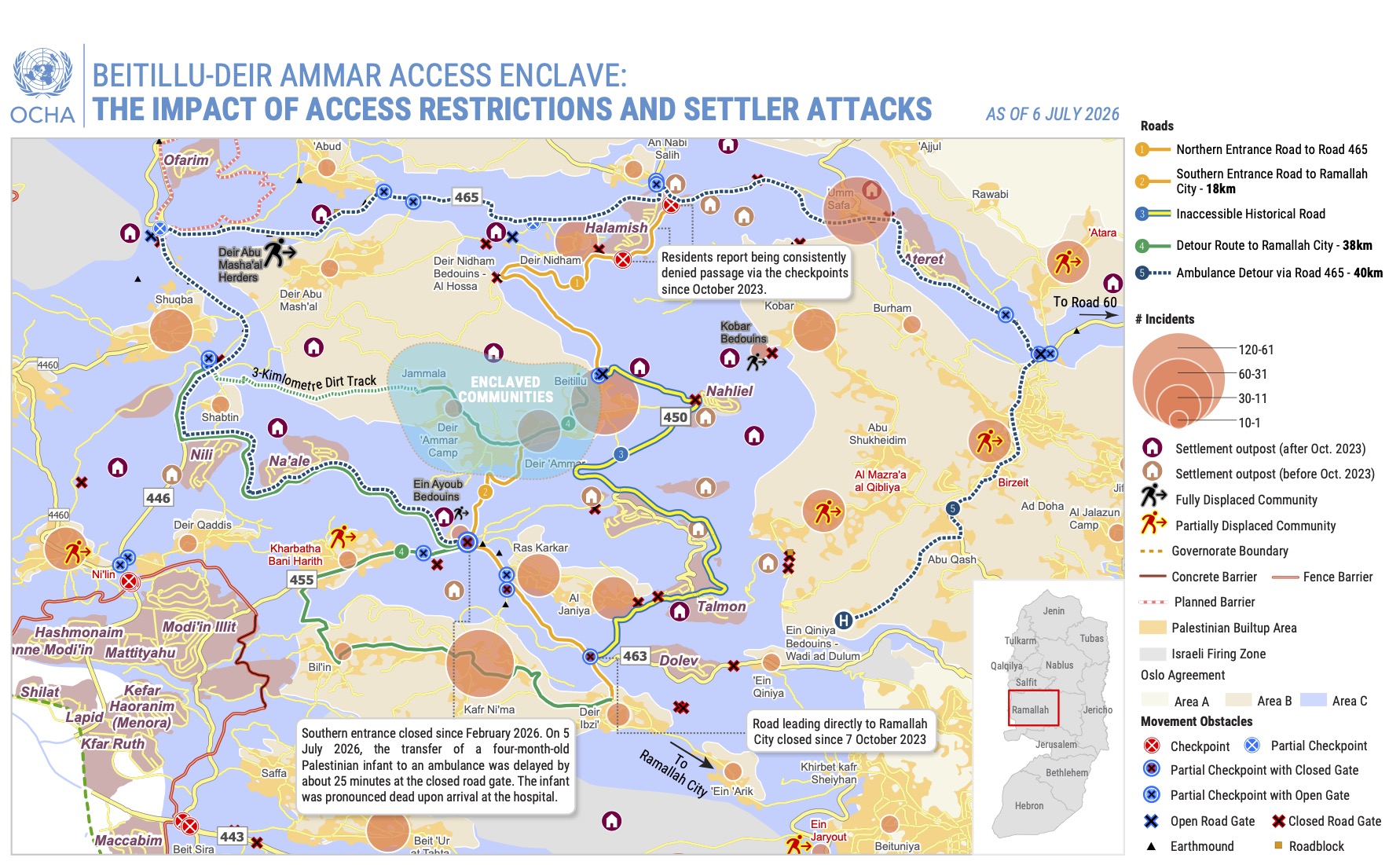
The incident occurred against the backdrop of successive movement restrictions affecting Beitillu, Deir 'Ammar, Deir 'Ammar Camp and Jammala, home to approximately 12,000 Palestinians. The cumulative closure of multiple access points has effectively isolated these communities, leaving them connected to the rest of the West Bank through a single remaining access route.
Since October 2023, the two checkpoints leading to Road 465 – the communities' main connection to northern Ramallah governorate and the wider road network – have consistently prevented Palestinian vehicular access, according to residents. The road connecting the area and other surrounding villages to Ramallah city has also been blocked by a partial checkpoint with a closed road gate. In January 2025, Israeli forces installed a partial (intermittently staffed) checkpoint with a closed road gate at the southern entrance to Deir 'Ammar, which since 28 February 2026 had remained continuously closed, leaving residents dependent on a single western access route that includes a three-kilometre dirt track. On 9 July, the Israeli military reopened the road gate at the southern entrance to the Deir 'Ammar–Beitillu area. At the time of publication, the two northern checkpoints leading to Road 465 continued to prevent Palestinian vehicular access.
During more than four months of continuous closure of the southern road gate, residents of Beitillu, Deir 'Ammar, Deir ‘Ammar Camp and Jammala, relied on detours that increased the journey to Ramallah from approximately 18 kilometres to about 38 kilometres, extending travel times. The restrictions disrupted access to workplaces, schools, markets and health services while delaying emergency medical care. Patients requiring regular treatment, including approximately 10 people dependent on dialysis, relied on back-to-back ambulance transfers or private vehicles because passage through the road gate was routinely prevented.
The isolation of these communities coincided with rapid settlement expansion in the surrounding area. Since January 2024, at least five settlement outposts have been established nearby. Since the first of these outposts was established in early 2024, more than 60 settler attacks affecting Beitillu, Deir 'Ammar, Jammala and the nearby Ein Ayoub Bedouin community were documented, resulting in casualties, property damage or both, compared with just nine such attacks during the preceding four-year period (2020 – 2023). The nearby Ein Ayoub Bedouin community was fully displaced in August 2025 following recurrent settler attacks and related access restrictions.
Displacement
During the reporting period, Israeli authorities demolished 12 Palestinian-owned structures for lacking Israeli-issued building permits, which are nearly impossible for Palestinians to obtain. Ten of the structures were in Area C and two were in East Jerusalem. On 2 July, the Israeli Civil Administration demolished five structures in Ein al Hilwa community in Tubas, two of which had been provided as humanitarian assistance following a demolition in the same community on 20 May 2026, displacing two households comprising five people.
In addition, on 3 July, one Palestinian refugee Bedouin household comprising six people, including four children, was displaced after Israeli settlers attacked and set fire to their home in East Tayba Bedouin community in Area C of Ramallah governorate. According to local sources, settlers believed to be from a nearby settlement outpost entered the community late at night, threw flammable materials at the family's home and fled the area. The family, who were inside at the time, evacuated safely, but the structure was destroyed together with all furniture and personal belongings. The displaced family is currently staying with relatives in the same community. East Tayba has been subjected to near-daily settler attacks in recent months, including repeated incursions into residential areas, grazing on cultivated land and harvested fodder, movement restrictions, and threats against Palestinian families to leave the community, contributing to an increasingly coercive environment and heightened risks of further displacement.
Across the West Bank, settler attacks and related access restrictions have intensified since January 2023, particularly in Bedouin and herding communities in Area C. Between January 2023 and 6 July 2026, 121 Palestinian communities experienced full or partial displacement. Of these, 46 communities have been fully displaced, including 10 so far in 2026. Overall, more than 6,200 Palestinians, including over 3,000 children, have been displaced in this context since January 2023. Of them, more than 2,300 people, including over 1,000 children, were displaced in 2026 alone. The cumulative impact of repeated displacement, recurrent settler attacks, damage to homes and infrastructure, and restrictions on access to land and essential services continues to increase humanitarian needs while undermining the resilience of affected communities.
More than 3,200 Palestinians have been displaced due to demolitions for lacking Israeli-issued building permits and settler attacks in 2026, averaging more than 17 people per day – nearly double the daily average observed between 2023 and 2025.

The increase has been driven primarily by a sharp rise in displacement following recurrent settler attacks and related access restrictions, which has already exceeded the annual total recorded in each of the past three years and accounts for over 70 per cent of all displacement recorded in these two contexts so far this year. The figures point to a significant shift in displacement patterns, with settler attacks and related access restrictions emerging as the principal driver of displacement in 2026.
Amid these conditions, humanitarian partners continued to scale up emergency response efforts. Water, Sanitation and Hygiene (WASH) Cluster partners responded to prolonged service disruptions through emergency water trucking to communities in Masafer Yatta, Hebron, where at least 10 communities remain disconnected from the water network, as well as to herding communities in the northern Jordan Valley, including those affected by demolitions and displacement in Ein al Hilwa community on 2 July. In the northern West Bank, where more than 33,000 Palestinians have remained displaced from Jenin, Tulkarm and Nur Shams refugee camps and surrounding areas since early 2025, partners completed and brought into operation a new water network in Dhinnaba, in Tulkarm city, providing safe water access to 220 households, predominantly internally displaced families from nearby refugee camps. The intervention enabled the transition from emergency water trucking to a more sustainable and cost-effective water supply system.
Update on Movement Restrictions in the H2 Area of Hebron
On 20 May, Israeli forces installed a new metal gate, which was immediately closed by Israeli authorities, on the main road leading to Hebron's Old City near the old municipality square (Bab al Baladiya). The gate is located next to the former municipal building, now occupied by Israeli settlers, and a neighbouring building where a Palestinian carpentry workshop was sealed in July 2025 after its Palestinian tenant was forced to vacate. According to local sources, the measure directly affects approximately 130 Palestinian families and further restricts one of the last remaining access routes to the Old City, including the remaining functioning sections of the Old Souq and the Ibrahimi Mosque. The gate forms part of a broader pattern of measures related to Israeli settlements in the area and their security, including the installation of a military watchtower on the former municipal building and repeated identity checks at mobile ("flying") checkpoints.
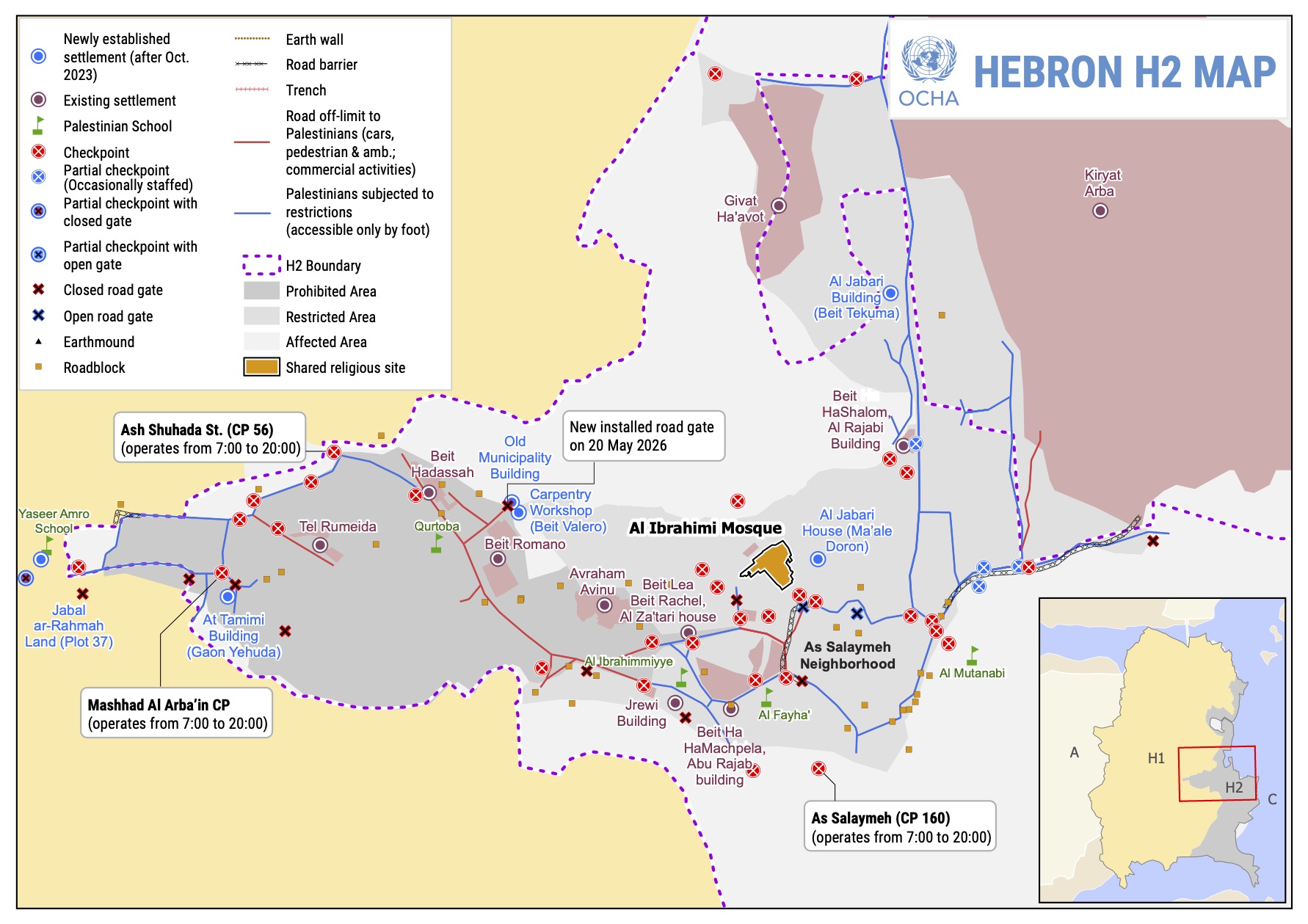
Since October 2023, Israeli forces have implemented a new system regulating the movement of Palestinian residents through three designated checkpoints operating daily between 7:00 and 20:00, restricting movement between Palestinian neighbourhoods within the prohibited and restricted areas of H2, where about 7,000 Palestinians reside, as well as access to the Ibrahimi Mosque, markets, health services and other essential facilities. Since October 2023, OCHA has documented the detention of over 400 Palestinians, including over 50 children, at permanent and mobile checkpoints across H2.
Movement restrictions have also expanded within residential areas. Since October 2025, Israeli forces have sealed several of the main entrances to at least four residential buildings in the As Salaymeh neighbourhood in the restricted area of H2 area of Hebron city, affecting 18 Palestinian families comprising 104 people, including 49 children. Residents now reach their homes by passing through neighbouring houses, crossing open land and climbing ladders over surrounding walls. The closures have also affected access to education for 25 kindergarten children attending a facility in one of the affected buildings and complicated access to health care for residents requiring regular treatment, including people with chronic illnesses and disabilities.
For key figures and additional breakdowns of casualties, displacement, and settler violence between January 2005 and May 2026, please refer to the OCHA West Bank May 2026 Snapshot. For key figures on the impact of settler attacks, please refer to the West Bank – The Impact of Settler Attacks, January 2023 – April 2026.
Gaza Strip
This section covers 29 June to 5 July unless otherwise specified.
People across the Gaza Strip remain confined to less than half of the land area, exposed to airstrikes, other military activity, new and protracted displacement, and persistent protection risks. Throughout the reporting period, overcrowding, inadequate shelter, and limited access to medical services, safe water, and sanitation continued heightening public health concerns and undermining people’s safety, dignity, and well-being.
According to the Ministry of Health (MoH) in Gaza, which operates under the de facto authorities, 44 Palestinians were reported killed, including those who died of wounds and had their bodies retrieved from under the rubble, and 85 people were injured between 30 June and 8 July. This brings the overall reported casualty toll since the announcement of a ceasefire agreement on 10 October 2025 to 1,084 fatalities and 3,491 injuries, according to MoH.
Displacement from areas near the "Yellow Line" continues as military operations and the expansion of access-restricted areas further reduce the space available for civilians. On 7 July, families were reportedly started to be displaced from the Dahab displacement site in southern Gaza after fleeing advancing tanks, with shooting and injuries reported nearby.
Military operations have reportedly followed the same pattern for three consecutive days, impacting four sites in southern Gaza, with families leaving their shelters early each morning ahead of tank advances and returning only after military withdrawal later in the afternoon. Those unable to evacuate reportedly remain trapped for hours, sheltering on the ground to avoid stray bullets until the area becomes accessible again. Approximately 2,500 people are reportedly staying in the affected area. To date, four families have reportedly been displaced from the area, with many families reported are seeking safer locations but remain unable to leave due to lack of available areas. The situation is further compounded by the nature of makeshift shelters, which cannot be easily dismantled, leaving families at risk of losing their limited belongings each time they are forced to move.
Access to essential services has been severely disrupted by the ongoing military operations. Humanitarian partners are endeavouring to better assess the situation with the aim of providing a coordinated response.
Newly displaced families often lose their shelters and belongings every time they are forced to move. Part of the pressure on those along the “Yellow Line” to move away is generated by Israeli military operations nearby, which compound existing safety risks while rendering their living areas underserviced, as municipality teams and emergency responders would often not go there.
Humanitarian partners continue to respond to the needs of newly displaced families by providing tents, emergency shelter items and other assistance (See the Intersectoral Support section in Annex 1 below). At the same time, they maintain support for those in protracted displacement.
Despite all ongoing response efforts, communicable diseases remain widespread, with more than 243,000 consultations reported by Health Cluster partners through 206 disease surveillance sites during the reporting period, and over one in five consultations linked to reportable infectious diseases. Acute respiratory infections and skin diseases remain the leading causes of illness, while waterborne diseases – including acute watery diarrhoea, bloody diarrhoea and acute jaundice syndrome – continue to increase, particularly in Khan Younis. During the reporting period, more than 18,000 cases of chickenpox, ectoparasite infestation and impetigo were recorded by Health Cluster partners.
At the same time, essential services for an estimated 350,000 people living with chronic diseases remain severely disrupted, reports the Non-Communicable Disease (NCD) Committee under the Health Cluster, co-led by local health authorities. Shortages of medicines, diagnostics and specialized equipment continue to affect the treatment of hypertension, diabetes, kidney disease, cancer and cardiovascular conditions. Insufficient quantities of insulin analogues have forced many insulin-dependent patients to switch from insulin pens to vials, increasing the risk of dosing errors among vulnerable groups. Approximately 700 patients requiring haemodialysis remain at risk due to shortages of critical consumables, while cardiac and oncology services remain available only on a very limited basis. Partners of the World Health Organization and the Health Cluster continue to strengthen disease surveillance, support infection prevention and control measures, and facilitate the procurement and entry of essential medical supplies, but the response continues to be hampered by damaged health, water, sanitation and hygiene (WASH) infrastructure, supply shortages and access constraints.
Shortages of critical items and inputs – including fuel, engine oil, generators, specialized equipment – persist across all sectors (see a focus on food security below). They are linked both to funding shortfalls (see the Funding section below) and to Israeli restrictions that limit what and how much can be taken into Gaza (see the Incoming Supplies section below).
Humanitarian operations more generally are also affected by Israeli-imposed access restrictions inside Gaza (see the overview on access-restricted areas in the 26 June 2026 report). On 8 July (outside the reporting period), the World Central Kitchen announced that a driver working for their partner logistic company was killed by Israeli forces while transporting goods from the Kerem Shalom crossing to one of the NGO’s warehouses in Gaza. The shooting reportedly took place within the access-restricted areas, in a movement coordinated with the Israeli authorities.
On top of these challenges, relief efforts are increasingly affected by unidentified external actors exploiting the humanitarian community’s blind spots along the supply chain to plant high-value non-humanitarian items inside aid cargo being shipped to the Gaza Strip. There, the de facto authorities attempt to locate and confiscate items, supposedly those same smuggled goods. In the seven-day reporting period, the UN recorded one case where the de facto authorities confiscated small packages that had been planted in between humanitarian supplies placed on two aid pallets. It was during one of seven instances during that same week where individuals identifying themselves as agents of the de facto authorities searched humanitarian warehouses or convoys; in six of seven cases, nothing was found. Through private engagement with authorities in Gaza and outside, the humanitarian community has raised concerns on the misuse of aid shipments for smuggling, on the need to reduce blind spots along the supply chain, on search practices that jeopardize the safety, integrity or efficiency of relief efforts, and on failure to respect the inviolability of UN premises.
On 9 July**, the Humanitarian Coordinator led a virtual diplomatic field visit to one of the displacement sites in Al Mawasi, Khan Younis. The visit was attended remotely, through a video link, by members of a dozen diplomatic missions who observed the living conditions and relief efforts at the site, interacting with displaced children and adults, as well as aid workers. Diplomats could not attend the visit in person because of tight restrictions imposed by the Israeli authorities on the entry of people to Gaza. At a distribution point within the site, diplomats joining the virtual visit saw how community members, including children, collected water carried by truck. This project is operated by a local partner and funded by the Occupied Palestinian Territory Humanitarian Fund. Displaced people told the diplomats that they needed sustainable water services, especially during the hot summer days, and emphasized the need for cash-for-work opportunities to feed their families. Participants were also led through hundreds of tents crammed along the shoreline.
Incoming Supplies
During the reporting period, scanner issues at Ashdod Port in Israel continued to disrupt cargo flow until the problem was resolved on 2 July. The Egypt Corridor continued to experience high return and rejection rates, with only 56 per cent of the manifested cargo successfully offloaded at Kerem Shalom (up from 42 per cent offloading last week).
The UN is only able to confirm the entry of supplies tracked by UN 2720. For breakdowns of those, see the online UN 2720 Mechanism Dashboard.
For a detailed account of the latest humanitarian operations in Gaza, see Annex 1 below.
Funding

Sources: Financial Tracking System and oPt HF
Annexes
Annex 1: Humanitarian Operations in the Gaza Strip by Cluster
Read more
This section covers 29 June to 5 July unless otherwise specified.
Intersectoral support
- Partners from across the humanitarian community responded to 11 incidents affecting 974 households throughout Gaza through a rapid joint distribution mechanism. They provided tents, blankets, mattresses, hygiene and dignity kits, jerrycans, tarpaulins and food assistance, with support tailored to the level of damage and needs identified through rapid assessments. The incidents included airstrikes, new displacements linked to military activities and the movement of the "Yellow Line," domestic fires and sewage flooding.
Food Security
- Between 1 and 5 July, partners provided general food assistance to more than 53,500 people via 36 distribution sites as part of the monthly distribution cycle. Each family received two parcels, one 25-kilogram flour bag and 2.5 kilograms of high energy biscuits, covering 75 per cent of the minimum caloric needs. To preserve emergency stocks, the distribution of 2.5 kg high-energy biscuit top-ups provided in previous months was suspended in July. Continued shortages of food parcel stocks, caused by a scanning backlog in Ashdod, constrained the pace of distributions.
- As of 1 July, partners were preparing almost 698,000 meals each day through 102 kitchens and delivering them across over 1,100 locations. Overall, meal production levels have remained largely stable since late May, despite minor week-to-week fluctuations.
- Through the “diesel-only” production model that started on 25 April, six private bakeries continue to receive free fuel from humanitarian partners to produce bread for their communities while managing their operations independently, including pricing of the bread package. Production increased steadily, reaching an average of 38.5 metric tons (MT) of bread per day in early July, compared with 29 metric tons per day in late June. An additional four bakeries are expected to begin operating under this operational model during July.
Health
- Partners strengthened infection prevention and control measures through the distribution of more than 920 cleaning kits to health facilities, while efforts continue to secure the entry of critical supplies and laboratory materials.
- MoH, with support from WHO and the WASH Cluster also continued water quality monitoring , with corrective measures implemented in high-risk locations by joint Health and WASH cluster Rapid Response Teams. However, surveillance and response activities remain constrained by damaged water, sanitation and hygiene (WASH) infrastructure, shortages of supplies and spare parts, and delays in obtaining Israeli approvals for the entry of surveillance equipment and laboratory supplies needed to sustain disease monitoring and laboratory testing capacity.
- The Emergency Medical Teams (EMT) Coordination Cell supported two humanitarian staff rotations, facilitating the entry of 24 EMT personnel into Gaza and the departure of 11 personnel.
- As of 5 July, 11 EMT partner organizations were supporting 31 EMT activities across the Gaza Strip. Approximately 70 per cent of these activities were delivered through specialized care teams embedded within Ministry of Health facilities. A total of 60 international EMT personnel remain operational in Gaza, providing specialized clinical and surgical support. However, ongoing travel restrictions on entry through Jordan linked to the Ebola crisis and Israel continue to hinder staff rotations and affect operational continuity for several EMT partners. One of the two National EMTs deployed at the Al-Shifa Hospital in Gaza city was also scaled down due to funding constraints. Despite the reduction in staff capacity, the team continues to provide services at the hospital, while the EMTCC is working to identify solutions.
Water, Sanitation and Hygiene (WASH)
- Solid waste collection capacity remains at 86 per cent of the waste generation rate, with approximately 4,200 cubic metres of waste produced daily. The clearance of Firas Market has reached 70 per cent, with about 10,000 cubic metres of waste being transported each day. Progress on the Abu Jarad site remains pending the arrival of geomembrane material.
- Pest control teams continue systematic rotations across accessible areas and have now treated 3,250 pest hotspots since beginning of June.
- During the reporting period, partners distributed 68,184 water containers, 13,374 hygiene kits, 2,000 bars of soap, 54 water tanks, 800 self-built latrine kits, and 200 self-built latrines for people with special needs, supporting approximately 400,000 people in total.
- Partners delivered 19,000 cubic metres of drinking water per day, on average, through 2,153 distribution points.
Shelter
- Between 28 June and 4 July, partners installed 229 emergency shelter kits, benefiting 139 households in Khan Younis, 67 in the North Gaza and Gaza city governorates and 23 in Deir al Balah.
- In June, partners supported 36,210 households with shelter and non-food items. This represents approximately 63 per cent of the households reached in May, reflecting a 37 per cent decrease in coverage. The decline is caused by the reduced operational capacity of partners resulting from prolonged restrictions on access to shelter materials, as well as the compounding challenges affecting humanitarian response efforts.
For more information, see the Shelter Cluster website.
Site Management Cluster
- The Site Management Cluster finalized revisions to its Site Alert Tool for partners. This tool will strengthen the Cluster’s ability to identify and flag needs, incidents, and service gaps at the site level, while enabling the triggering, tracking, and monitoring of responses. The revised tool will improve response monitoring, help close the feedback loop, and contribute to reducing the duplication of assistance.
- SMC identified nine local partner organizations and is currently conducting onboarding and capacity-building activities on site management approaches and standards. Upon completion of the induction process, the partners will be assigned sites where they will implement site management activities. The successful onboarding of all nine partners is expected to increase the number of sites receiving site management support and improve overall coverage across displacement sites.
Protection
- Partners delivered multilayered protection services across to over 31,000 people. This includes:
- Mental health and psychosocial support (MHPSS), psychological first aid (PFA), counselling, structured and unstructured psychosocial support, psychiatric support, and recreational psychosocial activities reaching 3,832 people;
- Caring for Carer activities reaching 20 frontline workers;
- Capacity-building on conflict-sensitive media, media integrity, and safe journalism practices reaching 129 journalists;
- Training, capacity-building, professional and technical supervision, self-care activities, peer training, and Protection Committee strengthening activities reaching 257 participants;
- Legal counselling, legal awareness, mediation, legal representation, civil documentation support, and alternative dispute resolution services reaching 627 people;
- General protection awareness and risk mitigation activities on safeguarding, prevention of sexual exploitation and abuse (PSEA), safe reporting channels, complaints and feedback mechanisms, and community protection reaching 4,410 people;
- Digital safety workshops and online blackmail awareness sessions reaching 148 participants;
- Case management, case follow-up, and referral services reaching 237 people;
- Explosive ordnance risk education (EORE) and conflict preparedness and protection (CPP) awareness activities reaching 5,890 people;
- Disability inclusion, rehabilitation, speech and language therapy, and physiotherapy services reaching 593 people, including people with disabilities and injured people;
- Site-level cleaning campaigns implemented across 30 displacement sites;
- Economic empowerment and vocational training activities reaching 105 participants;
- Intersectoral assistance for protection-sensitive cases reaching 14,445 people and 77 vulnerable families through collective meal assistance, kitchen and water-supply kits, tarpaulins, mattresses, tailored relief assistance, and cash-based protection support.
- Partners offered services to 79 returnees, including PFA, emergency assistance, and referral services. This brings the cumulative number of returnees assisted since the reopening of the Rafah Crossing to 3,755. Of these, 1,379 are currently receiving ongoing protection support, including initial needs assessments and specialized psychosocial services.
- In June, 1,049 key informant interviews and 119 focus group discussions were conducted with community members across accessible areas. These activities covered 17 neighbourhoods and reached 12,315 people.
- The scale-up of the response continued to face significant operational constraints, including funding shortfalls, staffing and supply shortages, and logistical challenges. Despite these obstacles, partners adapted their operations through flexible delivery approaches and strengthened coordination, while expanding services with the establishment of two new safe spaces for women and girls in Gaza city.
For more information, see the online Protection Cluster dashboard.
Child Protection
Partners undertook the following activities:
- MHPSS, PFA, individual and group counselling, life-skills activities, child-friendly recreational activities, and other psychosocial support interventions reaching more than 10,000 children, alongside more than 3,500 caregivers through MHPSS, positive parenting, guidance, and community-engagement activities;
- Case management, individual follow-up, and referral services reaching at least 250 children at risk across Gaza city, North Gaza, and Khan Younis; caregivers also received targeted case management and counselling support to strengthen their capacity to respond to children’s protection and psychosocial needs;
- Child protection awareness sessions, community-based prevention activities, child safety mapping, and Explosive Ordnance Risk Education (EORE) reaching children and caregivers;
- Emergency assistance integrated into child protection service delivery, including 8,103 breakfast meals and juice, 3,000 cartons of milk for 1,500 children participating in safe-space activities, at least 913 hygiene kits, cash assistance reaching 550 vulnerable children, bread support for 10,200 families, and 688 shopping vouchers for vulnerable children and families, including children with disabilities, orphaned children, and displaced families living in tents and informal sites;
- Reviewed and updated the Gaza referral pathway for high-risk child protection cases, including care arrangements, in coordination with partners, Ministry of Social Development (MoSD) focal points, and key child protection service providers, to strengthen timely and coordinated referrals for high-risk cases;
- Developed preparedness and response measures to address increasing reports of chickenpox among children attending child-friendly spaces and temporary learning spaces, implemented in coordination with Education, Health, and WASH partners, including the dissemination of operational guidance on prevention measures, referral procedures, and risk communication to support the safe continuation of child protection and education activities where feasible.
Addressing Gender-Based Violence (GBV)
Partners undertook the following activities:
- Developed sector-specific recommendations to support clusters in integrating GBV risk mitigation measures into planning and implementation processes;
- Conducted an online training session on the Inter-Agency GBV Pocket Guide, focusing on how to support survivors when specialized GBV actors are unavailable, reaching more than 103 participants from various sectors;
- Provided multiectoral services addressing GBV through 129 service delivery points, including 79 functioning Women and Girls’ Safe Spaces (WGSSs) and two safe shelters; however, 19 spaces remained closed across the Gaza Strip due to funding constraints;
- Delivered MHPSS, individual case management, cash assistance, sexual and reproductive health services, and legal support through WGSSs and other GBV service delivery points;
- Facilitated an average of two group sessions per day, reaching approximately 25 women per session through psychosocial support, awareness-raising, and other group-based activities;
Mine Action
- Partners conducted 96 explosive hazard assessments in support of debris removal and other partner activities. Seven emergency response teams were also carried out in support of UNDSS.
- Partners delivered explosive ordnance risk education and conflict preparedness and protection (EORE-CPP) activities through in-person sessions, training of trainers, mass media campaigns, and emergency awareness initiatives to reduce risks posed by explosive ordnance. In June, six partners reached 120,148 people across the Gaza Strip through interpersonal EORE-CPP and emergency awareness sessions, supporting communities to adopt safer behaviours and reduce their exposure to explosive hazards.
- Partners also continued supporting victim assistance efforts by facilitating timely access to essential protection, rehabilitation, and other support services for victims of explosive ordnance incidents. In June, 55 victims, including 21 children, were referred to relevant partners and specialized service providers for case management, medical care, rehabilitation, psychosocial support, and other forms of assistance, helping affected people access the services needed to support their recovery and well-being.
Education
- To reduce the risk of disease transmission in learning environments, the Education Cluster, with the Child Protection partners, finalized and disseminated practical guidance on the prevention and management of chickenpox in temporary learning spaces (TLSs) and child-friendly spaces (CFSs). The guidance, available in both English and Arabic, has been shared with partners to support the safe management of suspected cases while ensuring the continuity of education and child protection services.
- The distribution of education supplies continued across the Gaza Strip. More than 2,000 school-in-a-carton kits, containing schooling material, were dispatched to partners for distribution to TLSs, helping to improve access to essential teaching and learning materials for 7,500 children participating in ongoing education activities. The supplies will also support the implementation of summer learning activities, which are scheduled to commence on 11 July.
- The Tawjihi examinations were successfully completed, with an estimated attendance rate of 98 per cent. Examination results are expected to be released simultaneously with those in the West Bank, including East Jerusalem.
Emergency Telecommunications Cluster (ETC)
- The ETC supported UNDSS in standardizing Very High Frequency (VHF) radio communications across the Gaza Strip by reconfiguring radio assets and coordinating with UN agencies to integrate additional users into a shared security communications network.
- On 29 June, the ETC and the Gaza Security Operations Centre reviewed contingency measures for potential disruptions affecting Gaza’s three VHF repeaters, updating communication protocols and strengthening information-sharing arrangements with UN agencies to ensure continuity of security communications.
** Double asterisks indicate that a figure, sentence, or section has been rectified, added, or retracted after the initial publication of this update.
SUBSCRIBE TO RECEIVE OCHA'S INFORMATION PRODUCTS
 SUBSCRIBE
OCHA Sites










Follow Us
Support
Your donations go to relief organizations delivering quick and effective support to Palestinians in need.