
Humanitarian Situation Report | 10 April 2026
Highlights
- In the northern West Bank, Israeli forces extended for two months a military order that further prolongs the displacement from three refugee camps of over 33,000 people since January 2025.
- Another 5,700 Palestinians have been displaced because of settler attacks and access restrictions since January 2023.
- Israeli settler violence has further escalated, with March recording the highest number of Palestinian injuries by Israeli settlers in the last 20-years.
- Between 31 March and 5 April, taking approved supplies into Gaza was undermined by the reduced opening of Kerem Shalom, lower scanning capacity in Ashdod, custom-related delays and other disruptions to the supply chain.
- People in half of the displacement sites in Gaza are affected by skin diseases while rodents and pests are frequently observed in 80 per cent of the sites.
- A critical shortage of lubricating oil for electric diesel generators is expected to trigger a decrease in water production for drinking and domestic purposes.
Overview
Across the Occupied Palestinian Territory, people continue to be exposed to high levels of violence and restrictive policies, resulting in casualties and property damage, prolonging existing displacement, triggering new displacement and deepening humanitarian needs. At the same time, efforts by humanitarian partners to address people’s needs continue to be hindered.
West Bank
On 31 March, Israeli forces extended a military order titled “Restriction of Movement and Traffic” for Tulkarm, Nur Shams and Jenin refugee camps and surrounding neighbourhoods until 31 May 2026. The order designates “closure areas,” where entry and exit are prohibited without a permit issued by the Israeli military commander or an authorized official; such permits may be personal or general and limited by area, time, purpose, or route. The extension of these movement restrictions takes place against the backdrop of a protracted operation in the northern West Bank that has generated what has become the longest and largest displacement crisis in the West Bank since 1967. Since January 2025, operations by Israeli forces in refugee camps and surrounding areas have displaced more than 33,360 Palestine refugees, according to the United Nations Relief and Works Agency for Palestine Refugees in the Near East (UNRWA).
Between 31 March and 6 April, Israeli soldiers or settlers injured 50 Palestinians, including 10 children and five women, in the West Bank, including East Jerusalem: 27 were injured by Israeli forces and 23 by Israeli settlers. Of the total, about 70 per cent (36) were injured during settler attacks and the remaining 30 per cent were mainly during Israeli forces’ raids on Palestinian communities.
Between 31 March and 6 April, at least 47 Israeli settler attacks against Palestinians across 36 communities in the West Bank, resulting in casualties, property damage, or both. Most incidents were recorded in Ramallah governorate (14), followed by Nablus (10) and Tubas governorates (7). These attacks involved arson, stone-throwing, physical assaults, and vandalism of homes and livelihoods, resulting in the injury of 36 Palestinians (including 23 by Israeli settlers and 13 by Israeli forces) and damage to more than 250 Palestinian-owned trees and saplings, seven homes, five animal and agricultural structures, key infrastructure, including water and electricity networks, and at least 20 Palestinian-owned vehicles.
For key recent settler attacks, see Annex 1 below.
In 2026, violence and coercive policies and practices by Israeli forces and settlers against Palestinians in the West Bank, including East Jerusalem, have remained high. Over 580 settler attacks resulting in casualties, property damage, or both have been documented across more than 190 communities in 2026, including at least 47 attacks in 36 communities between 31 March and 6 April. Displacement linked to settler violence and access restrictions has also sharply escalated in 2026. As of 6 April, more than 1,800 Palestinians have been displaced, over 60 per cent of them in the Jordan Valley, exceeding the total number of people displaced as a result of settler violence in all of 2025.
Moreover, since 1 January 2026, 79 Palestinian-owned structures have been demolished in East Jerusalem, resulting in the displacement of 30 households comprising 142 people, including 72 children. Almost half (36 out of 79) have been demolished by their owners.
In response to property damage and displacement incidents, shelter partners continued to address urgent shelter needs across affected communities. According to the Shelter Cluster, during the past week, 573 people from 107 households received shelter and non-food items (NFI) assistance. This included the distribution of 527 kits (such as bedding, tents, kitchen sets and clothing) to 22 households, shelter for three households, and minor to moderate repairs for six households.
Following repeated settler attacks that caused damage to water and sanitation infrastructure, partners have continued to respond to emerging needs across affected communities. According to the Water, Sanitation and Hygiene (WASH) Cluster, 10 partners supported 73 communities in March, reaching some 29,500 people with hygiene kits, water tank distribution, water trucking, wastewater removal, and the construction or rehabilitation of water networks, cisterns, and latrines.
For key recent incidents causing displacement in the West Bank, see Annex 2 below.
Injuries during settler attacks have surged, with about 360 Palestinians injured by Israeli settlers in 2026, nearly equivalent to the annual total for each of 2023 and 2024 and amounting to a daily average of 3.8 Palestinians injured by settlers. This exceeds the daily average of 2.3 Palestinians injured by settlers in 2025, when a total of about 830 Palestinians were injured by Israeli settlers in settler attacks. In March 2026 alone, about 170 Palestinians were injured by Israeli settlers, the highest monthly number of injuries by settlers during settler attacks since documenting settler violence began to be documented in 2006 (see chart). In 2026, eight Palestinians were killed by Israeli settlers in attacks, compared with 13, three and eight Palestinians killed in similar circumstances in 2023, 2024 and 2025, respectively.

Gaza Strip
Living conditions across the Gaza Strip remain dire, with most families still displaced and reliant on humanitarian assistance. Civilians often cannot afford basic commodities and lack adequate protection from environmental exposure and violence. Airstrikes, shelling, and gunfire continue across residential areas, reportedly resulting in civilian casualties and damage to critical facilities, further undermining services as critical as water production.
According to the Ministry of Health (MoH) in Gaza, between 2 and 8 April, 20 Palestinians were killed, three died of wounds, three bodies were retrieved and 97 people were injured, bringing the overall reported casualty toll since the announcement of the ceasefire in October 2025 to 736 fatalities and 2,035 injuries.
Throughout the regional escalation, from 28 February through 10 April, Israeli authorities kept the Zikim Crossing into northern Gaza closed, citing security concerns. As a result, stock replenishment by aid organizations could only take place through the southern Kerem Shalom Crossing, where congestion occurred and, most recently, operating hours were significantly reduced during the holiday period. This led to lower volumes of aid entering Gaza. Further, aid had to be transported from the south to the north of the strip, resulting in longer travel times over damaged roads, increased operational costs, and higher fuel consumption.
Between 1 and 8 April, 17 patients, along with 33 caregivers, were medically evacuated from Gaza. Their evacuation was carried out, with support from the World Health Organization (WHO), through the Rafah Crossing in a single operation that took place on 5 April. It was followed by the return of 50 Palestinians into Gaza that day through the same crossing. On 6 April, a person contracted to provide services to WHO in Gaza was killed in a security incident. Two WHO staff members were present but were not injured. The incident is under review by relevant authorities. WHO suspended support to medical evacuations until further notice.
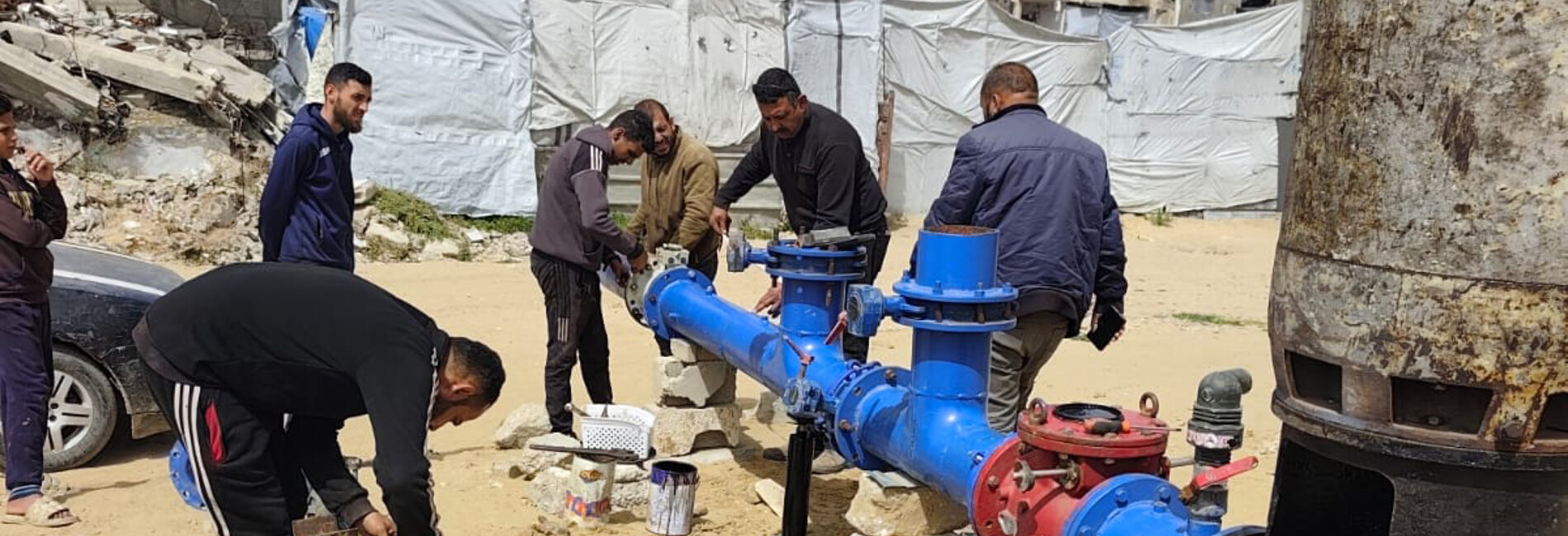
On 27 March, the Coastal Municipalities Water Utility (CMWU) issued an urgent alert regarding a critical shortage of lubricating oil for electric diesel generators. The depletion of these stocks has forced CMWU to suspend the distribution of lubricating oil, reducing the working hours of generators in supported facilities. This is expected to reduce water production for domestic and drinking purposes, including water delivered by trucks to displacement sites and shelters.
Humanitarian partners report alarming rates of ectoparasitic, lice, scabies, rat and other pest infestations in displacement sites. Findings from the latest rapid assessment conducted by the Site Management Cluster in March, spanning more than 1,600 active displacement sites, show that 80 per cent have frequent and visible rodent and pest presence, while skin diseases are widespread in 48 per cent of the sites. Between 1 and 6 April alone, the Site Management Cluster received 41 alerts from partners reporting rodent infestations, with requests for hygiene items and pest control support. For more information, see the “Gaza Humanitarian Operations” section below, under “Health” and “Water, Sanitation and Hygiene (WASH).”
According to satellite imagery analysis conducted by UNOSAT, as of 11 October 2025, over 320,600 housing units in Gaza were estimated to have been damaged. Since December 2025, Shelter Cluster partners have been conducting damage assessments to better gauge conditions, quantify the extent of repairs required and inform response prioritization. As of 5 April, 17,432 buildings comprising over 91,000 housing units were assessed: of these, some 40,000 units were classified as totally damaged and nearly 51,000 as partially damaged. Among the assessed partially damaged units, 9,075 are considered uninhabitable, while 40,095 -- or 44 per cent of the total assessed -- are deemed habitable. A dashboard is currently being developed, which will include key information to guide partner interventions targeting minor and moderately damaged housing units with emergency repair support.
In early April, MoH – supported by the World Health Organization, UNICEF, UNRWA, donors and partners – launched the third and final round of the catch-up vaccination campaign. This five-day effort aims to vaccinate children under the age of three who have missed routine vaccination in the past 30 months. It is implemented through 146 teams delivering life-saving vaccines through fixed health facilities and mobile outreach to those unable to access services.
Food Prices and imports
According to the latest World Food Programme (WFP) Gaza Market Monitor, food consumption showed partial recovery in March, compared with February. Despite these improvements, overall consumption remains well below pre-October 2023 levels, and with the onset of the regional escalation and continued restrictions on commercial supplies, a decline in dietary diversity was noted between early and late March due to reduced availability of some commodities and higher prices, most significantly vegetable consumption (that stood at 1.8 days/week in late March, down from 2.5 days in early March), and protein sources (meat, poultry, eggs) consumption (that declined from 3 days/week in early March to 1.3 days/week in late March). This underscores the urgent need to stabilize supplies of fresh items to maintain affordability and nutritional balance.
The fourth week of March witnessed a sudden increase in the price of wheat flour, with a 25- kilogram bag averaging 75 NIS, in addition to a rise in the prices of frozen goods, particularly chicken and their derivatives, as their availability also decreased compared with the previous week. WFP assesses that this surge was driven by severe supply shortages due to the sharp decrease in humanitarian and commercial supplies entering Gaza in March compared with the two months prior, and monopolization by traders.
According to WFP, this sudden decrease hindered the already fragile stability of the markets, with 71 per cent of surveyed retailers reporting stock levels below normal. Diesel prices also rose sharply to 35-40 NIS per litre; an increase of 438 per cent compared with the months leading to the October 2025 ceasefire agreement. Cooking gas was sold in March, through official channels, at 65 NIS for eight kilograms in limited quantities, while on the informal market prices spiked to some 95 NIS per kilogram. As a result, WFP says that 55 per cent of the surveyed population still reported relying on waste burning as an alternative to cooking gas in March.
The trends seen in March continued into the first week of April. While only the Israeli authorities currently have full oversight on what enters Gaza, available information shared by the Gaza Chamber of Commerce indicates that between 30 March and 5 April, only 327 commercial trucks were collected from the crossing, compared with 432 over the previous week, with none entering between 2 and 4 April, further undermining market resilience, increasing price volatility, and weakening people’s ability to meet basic needs. The chamber’s data suggests that most commercial supplies were food commodities and cooking fuel, while only 11 truckloads comprised hygiene items and nine were of shelter materials – both of which are now critically low in stock. Food items accounted for 61 per cent of total imports this week, down from 70-75 per cent the previous weeks, while 96 truckloads (29 per cent) were of items classified as “other,” including non‑essential goods.
Gaza Humanitarian Operations
Humanitarian operations continue across the Gaza Strip in all sectors. To navigate restrictions of certain critical items and on crossing operations, partners are adapting their approaches. This includes adjusting the balance between in‑kind assistance and cash or voucher modalities, which helps support economic recovery thereby shifting away from aid dependency and allowing families to cater for their specific needs.
For a detailed account of the latest humanitarian operations in Gaza, see Annex 3 below.
Incoming supplies
During April, the Israeli authorities limited the opening of Kerem Shalom in line with the holiday-related schedule: it was fully closed on 2 and 8 April and operated on half‑day schedules on 1 and 7 April. The reduced opening led humanitarian organizations to submit manifests (detailed documentation of aid cargo on each truck for review and clearance by the Israeli authorities) for smaller volumes of supplies, as half‑day operations effectively halved offloading capacity and limited the number of truckloads that could be processed.
Outstanding custom clearances required from the Israeli authorities further delayed cargo movements, particularly from Egypt. Between 31 March and 5 April, the UN and partners manifested fewer truckloads through this route and, of those, only 70 per cent were offloaded at the Kerem Shalom Crossing, with the remaining 30 per cent being returned to Egypt. This is down from a 93 per cent offloading rate via the same route the previous week.
Through Ashdod, volumes also remained constrained due to technical issues affecting scanning capacity. Compared with the week between 3 and 8 March – after the Kerem Shalom Crossing reopened – the number of truckloads manifested shrunk by 65 per cent between 31 March and 5 April, though the offloading rate remained consistently high.
Between 1 and 7 April, UNOPS facilitated the entry of just over 560,750 litres of diesel into Gaza and distributed 785,188 litres to partners to support life-saving humanitarian operations.
All data in this section, on incoming supplies, refers to humanitarian cargo tracked by the UN 2720 mechanism; as such, it does not include bilateral donations and the commercial sector.
For more information on incoming supplies, see the online UN 2720 Mechanism Dashboard.
Funding

Sources: Financial Tracking System and oPt HF
Annexes
Annex 1: Settler Attacks in the West Bank
Read more
Between 31 March and 6 April, the following are some of the key incidents:
- In Nablus governorate, Qusra village (about 6,000 people) witnessed three settler attacks that resulted in casualties or property damage. On 1 April, Israeli settlers attacked Palestinian houses, stole five sheep and an agricultural water tank from a barn after breaching the fence, and vandalized vehicles. On 5 April, Israeli settlers threw stones at two houses under construction and caused damage to windows and surveillance cameras, triggering confrontations with Palestinian residents who threw stones at settlers in response. One Palestinian and one Israeli settler were injured by stones. Israeli forces subsequently arrived and fired tear gas cannisters, injuring 10 Palestinians, including seven children, due to tear gas inhalation. Following the incident, Israeli settlers set fire to a structure in the nearby village of Jalud. So far in 2026, 27 settler attacks have been documented. They resulted in casualties or property damage in Qusra village, the highest number of attacks in a single community during this period, during which one Palestinian was killed and eight were injured by settlers.
- Also in Nablus governorate, Israeli settlers set fire on 5 April to multiple structures in Jalud village, including a workers’ residence, poultry facilities and vehicles, and physically assaulted and injured a Palestinian worker, injuring him and leaving him unconscious. On the same day, to the north of Al Lubban ash Sharqiya village (about 3,000 people), Israeli settlers set fire to two vehicles and one guest tent for Bedouins and physically assaulted a Palestinian man while inside the tent, injuring him. In Tell (about 6,000 people) and Asira al Qibliya (about 3,000 people) villages, Israeli settlers set fire on 6 April to an agricultural structure and damaged water infrastructure and equipment, including water tanks and tools.
- In Ramallah governorate, in Al Mughayyir village (about 3,000 people), Israeli settlers destroyed on 31 March a greenhouse, damaged agricultural equipment, metal fences and at least three water tanks. On 5 April, in Beitillu village (about 4,000 people), Israeli settlers damaged agricultural facilities, cut water pipelines and stole a water pump serving at least eight plots of land, affecting at least eight households. On 6 April, in Yabrud village (about 600 people), Israeli settlers physically assaulted and injured four Palestinians, including a pregnant woman, damaged at least four houses, and stole livestock, including at least 10 sheep, and some belongings from an animal shelter.
- In Hebron governorate, near Beit Ula village (about 18,000 people), an Israeli settler opened fire on 3 April at a Palestinian vehicle carrying a family who reportedly were working their land in the area, injuring two. In Khirbet al Fakheit (about 400 people), Israeli settlers broke on 6 April into a residential structure, displaced a Palestinian family of 10 people, and caused damage to the house.
- In Tubas governorate, Israeli settlers attacked on 5 April a Palestinian herder near Khirbet Tell al Himma (about 100 people), physically assaulted him, damaged his personal property and cut water pipelines connected to the community’s main water source, obstructing temporarily the access for almost the entire community to water used for both domestic and agricultural purposes.
- In Qalqiliya governorate, Israeli settlers cut electricity lines on 5 April in Far’ata village (about 1,000 people), disrupting power supply to at least 10 houses in one neighborhood of the village. The village council fixed the power on the same day.
Annex 2: Incidents Causing Displacement in the West Bank
Read more
Between 31 March and 6 April, the following are some of the key incidents:
- Demolition of a house extension that served as a children’s bedroom in Umm Tuba area of East Jerusalem for lacking Israeli-issued building permits, which are nearly impossible for Palestinians to obtain. The family was forced to demolish the structure to avoid the payment of fines following the receipt of a demolition order a month earlier.
- Seven Bedouin families comprising 47 people, including 28 children, were forcibly displaced in Tubas governorate due to Israeli settler attacks. The families were forced to leave their homes in the Safeh Tayasir area on 1 April due to repeated settler attacks following the establishment of a new Israeli settlement outpost near the community. Incidents included trespassing, prevention of livestock grazing, and threats of physical assault against herders. One family reported that settlers broke into their shelters, threatened them with expulsion, and forbade them from grazing. The families reported fears escalated after settlers - believed to be from the same settlement outpost - attacked residents on multiple occasions between 27 and 31 March, assaulting and injuring an elderly man, setting tents and vehicles on fire, and causing extensive property damage to their structures. An additional eighth family had been displaced from the area under similar circumstances on 27 March.
- In Jenin governorate, Israeli forces have forcibly displaced three Palestinian families, comprising 13 people including five children, from their homes in Arraba town since 1 March, and have intermittently used their homes as military observation points near a previously evacuated military site that was recently announced to be reactivated. According to local community sources, in one incident when a homeowner attempted to return following a temporary withdrawal of Israeli forces, the forces returned, reportedly assaulted him, and forced the family to leave again.
Annex 3: Humanitarian Operations in Gaza by Cluster
Read more
Food Security
- Between 1 and 6 April, Food Security Sector (FSS) partners provided general food assistance at the household level to more than 47,000 families (approximately 235,000 people) as part of the April monthly distribution cycle. Each family received two parcels, one 25-kilogram flour bag and 2.5 kilograms of high energy biscuits, covering 75 per cent of minimum caloric needs; this up from 50 per cent of the daily caloric needs covered through these distributions with the February and March cycles. Additional caloric needs are covered through other modalities.
- While some households continue to receive assistance through in‑kind monthly food distributions, an increasing number of households are being supported through monthly multi-purpose cash assistance, coordinated by the Gaza Cash Working Group.
- Bread production remains stable, with approximately 130,000 two‑kilogram bread bundles produced daily through 26 UN‑supported bakeries. One‑fifth of the bread is distributed free of charge to more than 400 shelters and community sites, while the remainder is sold at a subsidized price of NIS 3 (US$0.95) per bundle through an expanding network of retailers, that have increased to 164 since 1 April, up from 138 in March.
- Between 15 March and 1 April, partners provided some 2,300 herders and 56 owners of working animals with three 50‑kilogram bags of animal feed each.
- On 31 March, partners provided conditional cash assistance to more than 1,000 farmers to support the reactivation of local crop production. While this is expected to allow the production of about 5,000 metric tons of vegetables and feed nearly 95,000 people for one year, it is barely half of what these farmers could achieve were continued restrictions on the entry of agricultural inputs eased.
- Response capacity remains constrained by the limited entry of commercial goods, including wheat flour, fresh vegetables and cooking gas. Increased inflows of food supplies via the private sector are essential to support local markets, increase humanitarian response capacity and ensure households can meet their basic needs.
- The reconstruction of farms and other agricultural facilities, which is critical to scale up local production, requires full and unrestricted entry of agricultural inputs and equipment through commercial and humanitarian channels.
Health
- As of 6 April, 269 health service points – or 43 per cent of all 630 mapped facilities functional prior to October 2023 – were operational across the Gaza Strip, the majority only partially. These include 19 hospitals, 13 field hospitals, 114 primary health-care centres, 123 medical points, and 22 ambulance dispatch centres. Most service points are run by national NGOs (118), followed by international NGOs (85), UN agencies (38), government providers (23), and a small number of other partners. Geographically, the largest concentration of services is in Deir al Balah (92), followed by the Gaza governorate (84), Khan Younis (78), North Gaza (9), and Rafah (6).
For more information, see the online Heath Cluster Dashboard.
Water, Sanitation and Hygiene (WASH)
- Between 31 March and 4 April, the Gaza Electricity Distribution Corporation, with support from UNICEF, carried out two successive repairs to the F11 electricity supply line serving the Southern Gaza Desalination Plant. Following the completion of repairs on 4 April, the plant resumed full operations and is now producing approximately 15,000 cubic metres of drinking water per day. The F11 line had been damaged by an airstrike on 25 March, forcing the desalination plant to rely exclusively on back-up generators, with an 80 per cent reduction in water production capacity which triggered severe drinking water shortages for over 500,000 people in Deir Al Balah and Al Mawasi area of Khan Younis.
- To address ectoparasitic, lice, scabies, rat and other pest infestations (see above), the WASH Cluster is working with local partners. Together, they are identifying interim mitigation measures while clearance is being secured from the Israeli authorities to allow the entry of pesticides needed to fully address the issue.
- Between 31 March and 6 April, to mitigate the dire WASH conditions amid restrictions, WASH Cluster partners distributed 3,600 hygiene kits, 1,000 baby kits, 1,000 dignity kits for women and girls, 5,200 soap bars, 10,500 water jerrycans, 4,000 20‑litre water containers, and 246 latrine slabs – benefiting 21,500 people.
- Also see above, on CMWU’s measures regarding lubricating oil.
Shelter
- In March, Shelter Cluster partners reached over 46,500 households with shelter and non-food items (NFIs). This included the distribution of emergency and weather-proofing items, such as 1,881 tents, 2,575 tarpaulins, over 33,000 bedding items, 6,827 bedding kits, and 9,773 sealing-off kits, alongside kitchen sets, clothes, and emergency shelter kits.
- In the first week of April, partners provided 11,536 households with 16,650 bedding items, 3,126 bedding kits, and 210 clothing kits.
- To overcome operational constraints, items are delivered through in-kind and voucher-based modalities.
- In response to appeals by families who were affected by rainfall, shelter partners conducted field visits and rapid assessments. Between 30 March and 5 April, through the Rapid Joint Distribution Mechanism aimed at providing immediate, life-saving relief to families who lost their shelter or belongings due to adverse weather, 1,393 households were supported with emergency shelter and essential household items. This included 272 full assistance packages, comprising tents and NFIs, and 2,242 tarpaulins.
- Between 31 March and 4 April, partners took into Gaza 7,600 new bedding kits, 18,864 blankets and mattresses, as well as 300 tents, which have been integrated into the Rapid Joint Response Mechanism to support ongoing and planned distributions.
- Since January 2026, UNDP has taken into Gaza 1,705 relief housing units (RHUs), of which 570 RHUs have been installed to date across three main displacement sites. An additional 62 RHUs have been installed in health facilities to support the expansion of essential services.
For more information, see the Shelter Cluster website.
Site Management
- The Site Management Cluster received urgent requests for over 100 tents and 460 tarpaulins to address the immediate needs of affected families, whose shelters were destroyed or damaged due to the storm which struck Gaza between 30 March and 5 April. Efforts are ongoing to meet needs jointly with other clusters.
- In addition to working with WASH and Health partners to address rodent infestations, the Site Management Cluster is coordinating with the Food Security Sector to repurpose 70,000 flour sacks to be used as sandbags to help anchor and protect shelters from heavy winds and rain. Since the beginning of the winter season, the Cluster has received over 200 flour bags from FSS partners to compensate for the absence of sandbags. Due to multiple rejections of sandbags in 2024, Site Management partners did not procure in 2025.
Protection
- Between 30 March and 5 April, Protection Cluster partners reached an estimated 12,000 people across the Gaza Strip through static, mobile, and community-based interventions. Services included mental health and psychosocial support (MHPSS), case management and counselling, legal assistance and awareness, explosive ordnance risk education (EORE), response to gender-based violence (GBV), referrals, and support to persons with disabilities, alongside the distribution of selected relief items as part of protection programming.
- The response faced persistent challenges, including bad weather, overcrowding, insecurity, fuel shortages, and movement restrictions, all of which affected service continuity and quality. A key gap remains the lack of safe and private spaces for confidential services, undermining effective case management and participation, especially for women, girls, and vulnerable groups. Mobility constraints and shortages of assistive devices further limited service delivery and case resolution.
For more information, see the online Protection Cluster dashboard.
Child Protection
- Between 29 March and 5 April, Child Protection partners reached about 4,700 children and caregivers across the Gaza Strip through structured group MHPSS sessions, individual counselling, mind–body therapy, recreational and resilience‑building activities, speech therapy, and family‑based psychosocial support. Services focused on addressing psychosocial distress, strengthening coping mechanisms, and promoting safer and more protective environments for children affected by ongoing displacement and dire humanitarian conditions.
- Approximately 50 children facing heightened protection risks received targeted case management assistance, alongside 23 individual counselling and psychological consultation sessions. In addition, 301 children with disabilities, without parental care or otherwise experiencing acute stress received rehabilitation services, including physiotherapy, occupational and speech therapy. Prevention and community‑based child protection activities also continued across displacement sites. More than 2,500 children and caregivers were reached through child protection awareness sessions, EORE and messaging on child protection risks, prevention of family separation, and safe behaviours. These activities aimed to strengthen community‑level protection mechanisms, enhance caregivers’ capacity to support children, and reduce children’s exposure to protection risks in overcrowded and high‑risk environments.
- Child protection partners additionally supported winterization and emergency assistance across the Strip, including through the distribution of 207 sanitation kits, 500 newborn kits, and 150 winter blankets, alongside cash assistance for 751 children.
Addressing Gender-Based Violence
- Partners addressing GBV continued delivering critical services through 68 safe spaces for women and girls, two safe shelters for cases most at risk, and several additional service delivery points. Between 30 March and 5 April, partners reached over 14,150 people, including 13,133 women and girls.
- Key services provided across the Gaza Strip included MHPSS through group activities and individual counseling; legal support through awareness sessions and social and legal mediation; sexual and reproductive health awareness; GBV case management, including cash assistance; and the distribution of dignity and menstrual hygiene kits. Notably, 600 women received dignity kits during between 30 March and 5 April.
- In parallel, partners initiated the implementation of an inter‑cluster safety audit aimed at identifying GBV risks faced by women and girls in Gaza city, Khan Younis, and Deir al Balah. Led by a dedicated consultant, the process engages the Site Management, Shelter, and Protection clusters. Consultative meetings have commenced, alongside the development of data collection tools.
- Despite these efforts, partners continue to face significant operational challenges, including sharply increased costs for activity materials (such as baking and handicrafts) and transportation. Fuel shortages and extreme weather conditions during the week further hindered service accessibility for many women and girls.
Mine Action
- Between 30 March and 5 April, partners conducted 68 explosive hazard assessments in support of debris removal activities and other partner activities.
- Explosive ordnance risk education activities continued, reaching almost 12,000 people in Gaza city, Deir al Balah and Khan Younis between 29 March and 2 April.
- Mine Action partners are still waiting for clearance from the Israeli authorities to conduct the full spectrum of explosive ordnance disposal activities and bring into Gaza critical equipment which the authorities still deemed “dual-use,” making them restricted.
Nutrition
- In the second half of March, Nutrition partners screened 50,250 children aged 6-59 months for acute malnutrition, of whom 1,937 (4 per cent) were admitted for treatment. This includes 269 children (0.5 per cent) diagnosed with severe acute malnutrition. With these new enrollments, the total number of children who received ready‑to‑use therapeutic food between 1 and 15 March reached 6,083.
- During the same period, 21 infants under six months of age who were at risk of poor growth were referred and admitted for inpatient care at stabilization centres for acute malnutrition, while five other infants were newly enrolled to receive ready‑to‑use infant formula to ensure appropriate feeding. Furthermore, six children above the age of five diagnosed with severe wasting and/or nutritional oedema were also admitted for inpatient nutritional treatment.
- Partners equally screened 38,100 pregnant and breastfeeding women, of whom 919 (2 per cent) were admitted for acute malnutrition treatment.
- A total of 41,541 pregnant and breastfeeding women and other caregivers received a combination of group and individual counselling on infant and young child feeding in emergencies.
Education
- Between 30 March and 5 April, at least 20 High Performance Tents were installed across five locations (three in Khan Younis and two in North Gaza), contributing to the scale-up of learning spaces. Overall, 584 temporary learning spaces (TLSs) are now operational, with an enrolment capacity of approximately 357,476 pre-school and school-aged children. This represents significant progress, with around 51 per cent of the 2026 Flash Appeal target supported in accessing basic education.
- In addition, cluster partners completed light rehabilitation works in at least five classrooms within one public school. Rehabilitation works continue in 17 classrooms across two additional schools. However, the continued use of the limited repairable school infrastructure as shelters by displaced families is slowing down debris removal, rehabilitation efforts, and the reactivation of classrooms for education purposes.
- Access to learning materials remains highly constrained. Only 392 school-in-a-carton kits were received on 31 March, sufficient for approximately 15,680 learners, and no additional supplies have been received in April to date. This shortfall continues to limit the quality and scale of the education response, particularly as the academic year draws to a close – a critical period for supporting student progression and transition to the next grade.
- Furthermore, the continued lack of teacher remuneration due to economic challenges, coupled with limited funding for incentives by humanitarian partners, is significantly affecting the quality and continuity of education services. This has led to reduced teacher availability, lower motivation, and increased reliance on volunteer teachers, ultimately undermining structured learning, consistency of instruction, and the overall effectiveness of the education-in-emergency response in Gaza.
For more information, see the online Education Cluster page.
Emergency Telecommunications
- The Emergency Telecommunications Cluster (ETC) continues to strengthen secure communication systems in Gaza. Between 30 March and 5 April, the cluster reprogrammed 20 very high frequency (VHF) radios belonging to three UN agencies, repaired faulty units, and restored a small number of depleted batteries. Additionally, the cluster provided technical guidance to UN agencies on securely installing satellite tracking devices in armored vehicles to prevent hardware damage.
** Double asterisks indicate that a figure, sentence, or section has been rectified, added, or retracted after the initial publication of this update.
SUBSCRIBE TO RECEIVE OCHA'S INFORMATION PRODUCTS
 SUBSCRIBE
OCHA Sites










Follow Us
Support
Your donations go to relief organizations delivering quick and effective support to Palestinians in need.