
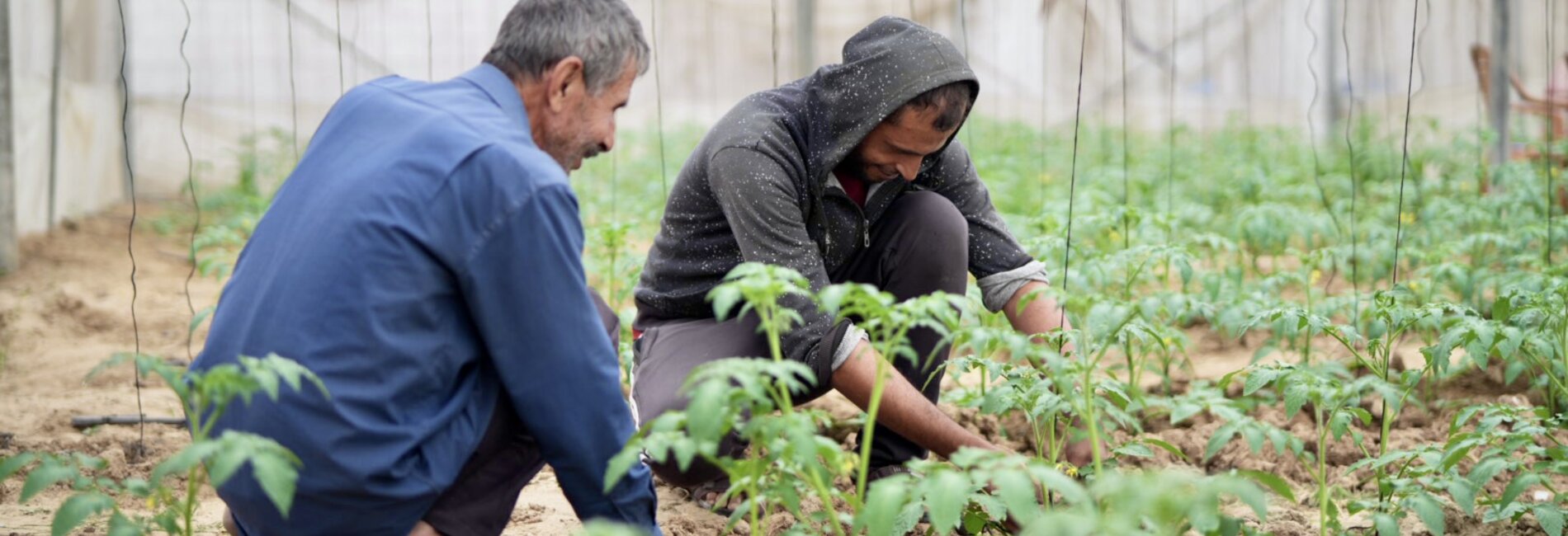
Helping greenhouse farmers in Gaza restore their livelihoods
“I wish one kilo of vegetables would cost one shekel so poor people can eat… so everybody can eat.” – Kareem, a Palestinian farmer
In Az Zawaida, in the central Deir al Balah governorate of the Gaza Strip, farming has long been the main source of livelihood for Kareem,* a small-scale farmer who has worked in his greenhouses for more than 30 years. Growing crops such as tomatoes, cucumbers, leafy greens and wheat, he has relied on farming to support his family across generations.
The war in Gaza severely damaged Kareem’s livelihood. His greenhouse, which he relies on to grow high-value crops, was hit by gunfire, leaving the plastic riddled with holes and in urgent need of repair. Despite the damage and worsening conditions, he continued farming throughout the past two years, focusing on limited crops while facing soaring production costs and unstable markets. With his greenhouse as his only source of income, Kareem struggled to manage debts and secure enough resources to sustain his family.
With support from the Occupied Palestinian Territory Humanitarian Fund (OPT HF), Première Urgence Internationale (PUI), in partnership with the Palestinian Agricultural Relief Association (PARC), implemented a project to support greenhouse farmers in Gaza through livelihood restoration and labour assistance. Kareem was among 40 farmers selected to receive agricultural inputs, marking the first organized support he had received since hostilities escalated in October 2023.
The project provided high-quality seedlings and agricultural inputs for his damaged greenhouse, allowing Kareem to focus on tomato production. By receiving these inputs, he was able to redirect his limited funds toward covering the high costs of water needed to irrigate his crops.
“Tomatoes need a lot of water and special care. With the tomato seedlings and agricultural inputs I received, I was able to save money to pump water. Pumping water costs a huge amount of money,” he explained.
The assistance arrived after the intense summer heat, a critical period when young seedlings are particularly vulnerable. For Kareem, the support eased financial pressure and helped prevent further debt, while providing a more stable source of income for the season ahead. He contrasted this with earlier losses: “I tried planting parsley before this help came, but the seeds were worthless. We lost the entire crop.”
Despite the challenges, Kareem remains deeply connected to his community. “I wish one kilo of vegetables will be one shekel so poor people can eat… so everybody can eat,” he said.
By restoring access to essential agricultural inputs, the project supports small-scale farmers like Kareem to continue producing food and sustaining their livelihoods and supply their communities with vegetables amid ongoing conflict and economic strain in Gaza.
* Name changed to protect privacy.


subscribe to our mailing list
SUBSCRIBE TO RECEIVE OCHA'S INFORMATION PRODUCTS
 SUBSCRIBE
OCHA Sites










Follow Us
Support
Your donations go to relief organizations delivering quick and effective support to Palestinians in need.