
Helping displaced families in Gaza protect their children’s health
“Rasheed started playing, laughing and enjoying time with his brothers and sisters; for me, this means everything.” - Suad, mother of 3-year-old Rasheed.
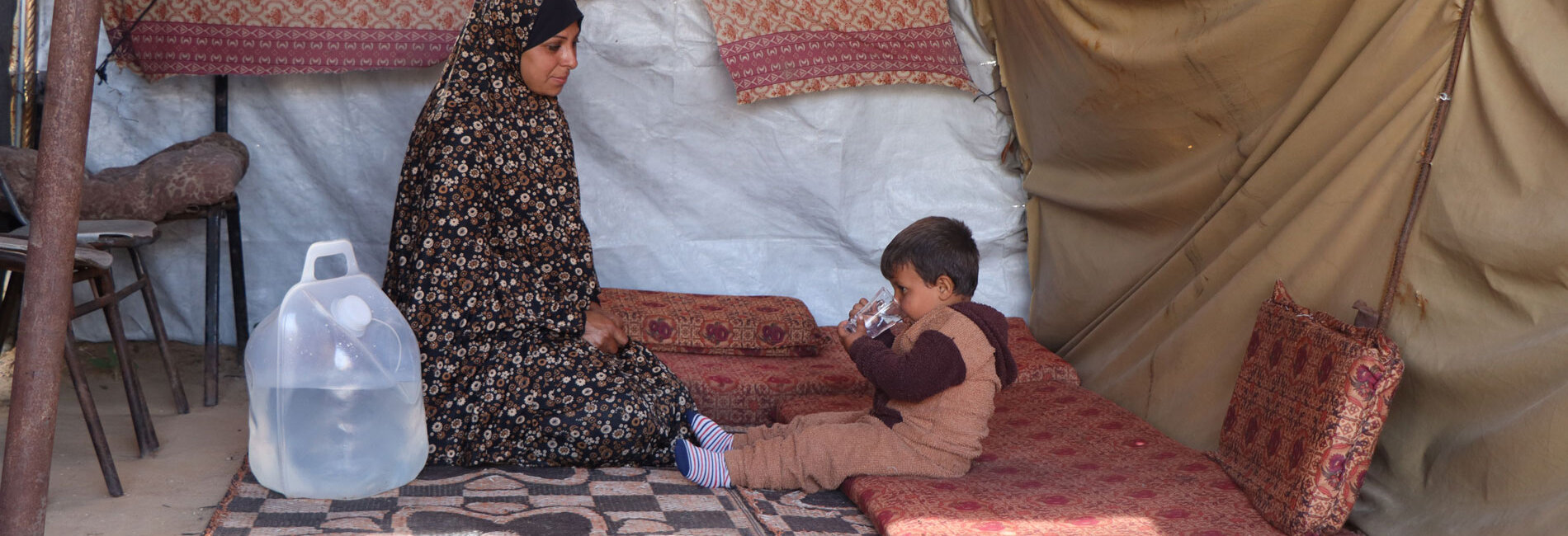
Three-year-old Rasheed* lives with his family in a displacement site in Deir al Balah area of the Gaza Strip, after their home in northern Gaza was destroyed in mid-2024.
His family of seven now lives in difficult conditions, with limited access to income, food, medicine, clean water and basic sanitation. For his mother and father, Suad* and Abdallah*, one of the most urgent concerns has been finding enough safe water for their children.
“Rasheed would wake up at night crying and asking when he would get better and be able to play with his siblings again,” his father said.
Rasheed lives with an enlarged liver, a serious health condition that requires regular medical care, strict hygiene and access to clean, safe water. His family says that the lack of safe water and poor sanitation made it even harder to protect his health. Despite receiving treatment, Rasheed’s condition remained fragile, and his mother often had to make difficult choices about how to divide the little drinking water they had. For a child in his situation, clean water is not a luxury, but essential to help prevent infections and reduce the risk of further health complications.
“I used to save the clean drinking water for Rasheed alone,” Suad said. “When his siblings were very thirsty, I had no choice but to give them salty water. Watching them struggle to drink it was very painful, but it was the only way to keep them going.”

Like thousands of displaced families across Gaza, Abdallah and Suad faced daily challenges accessing safe drinking water, while overcrowding and inadequate waste management increased health risks. At the displacement site, water was not always available when families needed it. Supply trucks were sometimes delayed for days, forcing Abdallah to walk long distances in search of a few litres of water for his family. At the same time, accumulated waste, insects and rodents made daily life even more difficult and increased health risks for displaced families.
“Unsafe water and the lack of hygiene affected every attempt to help him recover,” Abdallah said.
Between early 2025 and mid-2026, the local NGO Beit Lahia Development Association (BLDA), with funding from the occupied Palestinian territory Humanitarian Fund (oPt HF), supported displaced households in Khan Younis and Deir al-Balah by providing 8,400 people with safe water for drinking, cooking and hygiene. Rasheed’s family was among those reached, with their displacement site receiving 10,000 litres of safe water every day.
For Abdallah’s family, this reduced the daily pressure of searching for water and allowed all the children to access safe drinking water. “Clean water used to feel like something far away,” Suad said. “Now it is available for all my children. I no longer need to hide it or keep it only for Rasheed.”
The project also helped improve sanitation conditions at the site. A cleaning campaign was carried out, during which some 150 tons of waste were removed, creating a cleaner and safer environment for all and reducing the presence of insects and rodents. The activity was implemented with the participation of paid laborers from the site creating work opportunities that remain scant in Gaza.
In addition, BLDA organized six awareness sessions for women at the site, focusing on handwashing, safe water handling and storage, food hygiene, and personal hygiene. Suad attended some of the sessions and said the information helped her take practical steps to better protect her family in a difficult environment.
Suad believes Rasheed’s condition has improved, with reduced need for constant medical consultations. “Rasheed started playing, laughing and enjoying time with his brothers and sisters,” she said. “For me, this means everything.”
For families like Suad and Abdallah’s, access to safe water, improved sanitation and hygiene awareness cannot remove the hardship of displacement. But it can reduce daily risks, ease pressure on caregivers, and help children regain small parts of their routine in a safer and more dignified environment.

* Names have been changed to protect privacy.


subscribe to our mailing list
SUBSCRIBE TO RECEIVE OCHA'S INFORMATION PRODUCTS
 SUBSCRIBE
OCHA Sites










Follow Us
Support
Your donations go to relief organizations delivering quick and effective support to Palestinians in need.