
Humanitarian Situation Update #346 | West Bank
The Humanitarian Situation Updates on the Gaza Strip and on the West Bank are both issued every Wednesday/Thursday. The next Humanitarian Situation Update on the West Bank will be published on 10 or 11 December.
Key Highlights
- Half of the 227 Palestinians killed by Israeli forces or settlers between 1 January and 1 December in the West Bank were in Jenin and Nablus governorates.
- Operations by Israeli forces trigger new displacement, movement restrictions, school closures, and service disruption in communities already affected by recurrent militarized operations since early 2025.
- Over 95,000 Palestinians were affected by expanded operations by Israeli forces in the northern West Bank this week, particularly in Jenin and Tubas governorates.
- OCHA documented 1,680 attacks by Israeli settlers in more than 270 communities across the West Bank so far in 2025 - an average of five incidents per day.
- The olive harvest continues to be marked by widespread settler violence, with 178 attacks documented in October and November in 88 communities.
Humanitarian Developments
-
Between 25 November and 1 December, Israeli forces killed four Palestinians, including one child, bringing the total number of Palestinians killed by Israeli forces or settlers in 2025 to 227. Nearly half of all fatalities this year were recorded in the Jenin and Nablus governorates. During the same reporting period, Israeli forces and settlers injured 212 Palestinians across the West Bank, including East Jerusalem. Over 75 per cent of all injuries (163) occurred during the Israeli forces’ operation in Tubas governorate, including 107 people injured by live ammunition and 56 due to physical assault or tear-gas inhalation (see more information below). Also, this week, in Hebron city, a 17-year-old Palestinian boy injured an Israeli female soldier in a car-ramming attack, after which Israeli forces shot and killed him. The following are details of the incidents that resulted in fatalities:
-
On 26 November 2025, Israeli forces shot and killed a Palestinian man during a raid by Israeli forces into homes and shops in Qabatiya town, in Jenin governorate. According to local sources, Palestinians threw stones at Israeli forces, and the forces fired live ammunition. The Israeli military stated that they opened fire at the man after he threw an improvised explosive device (IED) at them, and they destroyed other IEDs found in his car.
-
On 27 November, Israeli forces killed and withheld the bodies of two unarmed Palestinian men whom they shot at close range in Jenin city during a raid concentrated in the eastern side of Jenin refugee camp, particularly Jabal Abu Dhair neighbourhood. The incident was caught on film by a TV channel. The Israeli military stated that they are investigating the incident. In a statement on 28 November, the spokesperson for the UN High Commissioner for Human Rights said the Office was “appalled at the brazen killing” of the two Palestinians, describing it as “an apparent summary execution.” OHCHR stressed that impunity for Israeli forces’ “unlawful use of force, and ever-growing Israeli settler violence, must end,” urging independent, prompt and effective investigations and accountability.
-
On 1 December, a Palestinian carried out a car ramming attack at one of the checkpoints on Road 35 near Farsh al Hawa leading to Hebron city, injuring an Israeli female soldier. Israeli forces sealed the entrances to Hebron city, deployed flying checkpoints, and conducted raids across the city, including in the yards of four hospitals, in search of the assailant. On 2 December, Israeli forces announced that they had killed the assailant in Hebron city. He was later identified to be a Palestinian boy from Hebron city, and his body has been withheld by Israeli authorities.
-
-
On 2 December (outside the reporting period), Israeli forces shot and killed a Palestinian man near Umm Safa village, in Ramallah governorate, after he stabbed and injured two soldiers when he was stopped for inspection at a flying checkpoint on Road 465. Israeli forces subsequently closed nearby checkpoints and road gates in western Ramallah governorate. Additionally, the forces broke into Beit Rima village, the hometown of the man, and searched his family’s house.
-
Between 25 November and 1 December, OCHA documented the demolition of 11 Palestinian-owned structures for lacking Israeli-issued building permits, which are almost impossible for Palestinians to obtain. Six of the structures were in four communities in Area C of the West Bank, while five were in Beit Hanina and Sur Bahir in East Jerusalem. Among the demolished structures in Area C were an under construction, three-storey residential building in Al Khader village, in Bethlehem governorate, and a 1,200-square-metre cow farm in Jinsafut village in Qalqiliya governorate. In total, five people, including a child, were displaced in one incident in East Jerusalem, and 48 people, including 20 children, were otherwise affected.
-
On 1 December, Israeli forces raided and sealed the offices of the Union of Agricultural Work Committees (UAWC) in Al Bireh and Hebron cities, posting military closure orders on the gates of both premises. During the raids, Israeli forces vandalized office contents, confiscated all electronic devices and documents, and detained employees, keeping them blindfolded and handcuffed, including several women who were released after a few hours. In Al Bireh city, Palestinians threw stones at the forces, who fired rubber bullets and tear-gas canisters, injuring four Palestinians. UAWC is a Palestinian non-governmental organisation that has supported farmers and rural communities across the West Bank since the late 1980s. The UN Human Rights Office (OHCHR) in the Occupied Palestinian Territory (OPT) said the raid “comes amidst an escalating Israeli targeting of Palestinian civil society and human rights defenders, most recently in the context of the olive harvest season.”
Operations by Israeli Forces in the Northern West Bank
- Israeli forces continue to carry out large-scale operations across the northern West Bank, particularly in parts of Jenin and Tubas governorates, imposing curfews, taking over residential buildings and converting them into military posts, and significantly restricting movement and Palestinians’ access to essential services. On 28 November, Save the Children reported that these operations forced it to “halt its remedial education classes and child protection work, including mental health support, in these areas, with no indication of when programmes might be able to resume,” affecting over 700 children.
- Between 25 November and 1 December, expanded operations triggered new displacement, movement restrictions and school closures, and disrupted access to basic services, affecting over 95,000 Palestinians and compounding the humanitarian impact on communities already affected by recurrent militarized operations since early 2025. In some cases, families have remained displaced. For example, at least 11 families comprising about 55 people have remained displaced since 7 November after their homes were converted into military posts in Ya’bad town (pop ~16,000), in Jenin governorate, where Israeli forces continued to carry out extensive raids, primarily in the southwestern area of the town.
-
On 26 November, Israeli forces carried out a large-scale, four-day operation across Tubas city and the towns of Tammun, Aqqaba, Tayasir, and Wadi al-Fara’, with a combined population of over 58,000 Palestinians. The operation involved the use of drones, aircraft, bulldozers and wide-ranging movement restrictions, resulted in the injury of 163 Palestinians, and caused extensive damage to homes and infrastructure, displacement, and prolonged disruption of access to essential services. On 28 November, Israeli forces withdrew from Tammun, where some homes that were converted into military posts sustained extensive damage and a 1,700-metre road was destroyed. As a result, the main water network between eastern Tammun and the communities of Khirbet ‘Atuf and Khirbet as Ras al Ahmar was destroyed, causing a three-day water cut that affected nearly 17,000 people and greenhouses. On the same day, the operation expanded into Al Far’a refugee camp, where Israeli forces raided or occupied at least 10 residential structures, forcing at least 20 families to leave their homes, imposed a curfew, as well as detained and interrogated dozens of Palestinians before withdrawing.
-
On 27 November, Israeli forces shot and injured two Palestinian children (aged 14 and 16 years) with live ammunition in Jenin refugee camp, shortly after the Palestinian DCL coordinated a two-hour window for 12 displaced families to briefly return and collect belongings from their homes, which they have been unable to access for nearly ten months. According to UNRWA, nearly 32,000 Palestinians, including more than 12,000 children, continue to be displaced from three refugee camps in the northern West Bank.
- Since 30 November, in Salfit governorate, Israeli forces have carried out extensive operations in multiple villages, with movement restrictions still in place as of the time of reporting. In Az Zawiya village, Israeli forces blocked the main entrance with an earth mound, affecting roughly 7,000 Palestinians, searched homes, confiscated security cameras, and arrested more than 30 people. An elderly man was physically assaulted and injured by Israeli forces. Five schools were forced to close, affecting about 1,300 students. In nearby Mas-ha village, Israeli forces closed the only access road with military jeeps and carried out multiple home raids, detaining residents for several hours. In parallel, road gates leading to Deir Ballut and Rafat villages were closed.
- On 1 December, a day after withdrawing from Tammun town following a four-day operation (see above), Israeli forces launched another large-scale, three-day operation in Tubas city and the surrounding towns and villages, including Aqqaba, and imposed an open-ended curfew. During the operation, Israeli forces closed five main roads with earth mounds, including three in Tubas city and two in Aqqaba, and several secondary roads, severely restricting movement for about 30,000 Palestinians. In both towns, Israeli forces converted at least eight residential buildings, each consisting of multiple homes, into military posts, forcibly displacing at least 11 families.
- On the afternoon of 2 December, Israeli forces launched a three-day operation in the southern outskirts of Jenin city, imposing an open-ended curfew that initially affected Qabatiya town (~28,000 people) and was expanded on 3 December to Misliya village (~3,300 people). According to Qabatiya municipality, Israeli forces searched over 20 houses, intermittently occupied rooftops and turned them into observation points, and forcibly evacuated at least two families from their homes, converting them into military posts and field interrogation centres for the duration of the operation. In Misliya village, where the curfew was announced less than an hour before taking effect, one school was abruptly evacuated. The Palestinian DCL reported that ambulance movements were permitted without prior coordination in both communities.
Israeli Settler Attacks
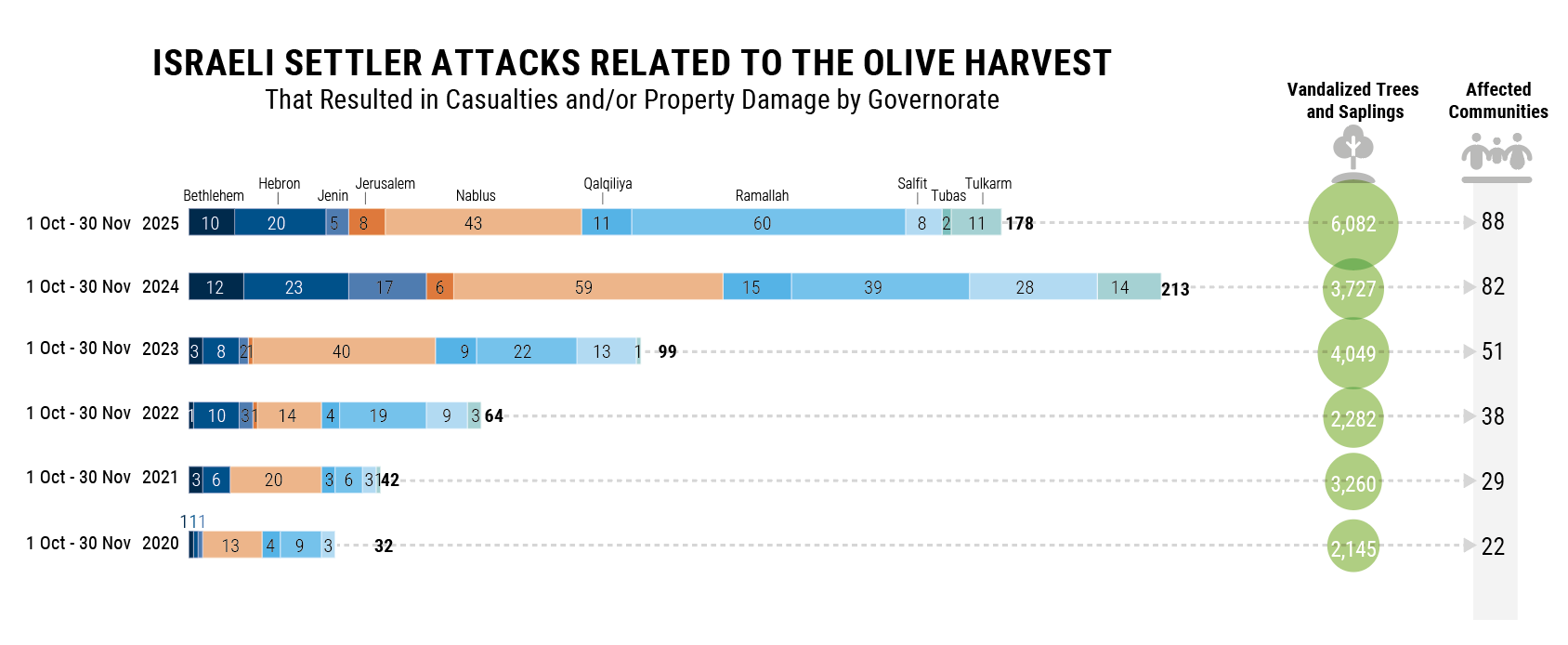
- With the olive harvest season nearing completion, the 2025 season has been marked by widespread settler violence, severe access restrictions, and low yields. Between 1 October and 30 November 2025, OCHA documented 178 olive-harvest-related settler attacks resulting in casualties, property damage or both. These incidents included attacks on farmers inside or on their way to olive groves, theft of crops and harvesting equipment, and vandalism of olive and other trees and saplings. While lower than the 213 attacks recorded during the corresponding period in 2024, this figure remains significantly above pre-2023 levels, when annual totals for the same period were roughly in the range of 30 to 60 attacks. The geographic scope of attacks has expanded, with 88 Palestinian towns and villages affected so far this year, the highest number recorded since 2020, more than double the number of communities affected in 2022, and four times the number of communities affected in 2020. Damage to olive trees and saplings has similarly reached its highest level in six years, with over 6,000 trees and saplings vandalized in 2025, nearly double the trees and saplings vandalized in 2024 and three times the levels documented in 2020 (see chart).
-
Between 25 November and 1 December, OCHA documented 35 Israeli settler attacks against Palestinians that resulted in casualties, property damage or both in the West Bank, including East Jerusalem. The attacks led to the injury of 29 Palestinians, including 20 by Israeli settlers and nine by Israeli forces. More than 150 Palestinian-owned (mainly olive) trees and saplings were vandalized. The number of settler attacks during this past week has been consistent with the weekly average of approximately 35 attacks recorded since the beginning of 2025. OCHA documented 1,680 attacks by Israeli settlers in more than 270 communities across the West Bank so far in 2025 - an average of five incidents per day.
-
Settler attacks, threats, and harassment continued across several governorates this week, predominantly affecting communities located near old or newly established settlement outposts. Incidents involved repeated assaults, raids, and damage to agricultural and water infrastructure, including in communities where some families had been displaced following settler violence. Key incidents resulting in casualties and property damage included the following:
-
In Bethlehem governorate, residents of Khallet al Louza village, with a population of about 700 people, have faced sustained attacks by Israeli settlers since September 2023, following the establishment of a settlement outpost on the village’s land. The situation further intensified after additional outpost structures, including new caravans, were installed in August 2024. OCHA has documented 21 settler attacks in the village since the establishment and subsequent expansion of these outposts, compared with only three attacks recorded between January 2017 and August 2023. This week, on 29 November, 10 Palestinians, including one woman, were injured when settlers attacked a family after the landowner asked a settler grazing sheep inside his land to leave. Settlers called in additional settlers from a nearby settlement outpost and began throwing stones at the house, injuring nine people and damaging a vehicle and two surveillance cameras. During the attack, settlers opened live fire, injuring one person. A PRCS team treated six people on-site and transported four others, including the gunshot casualty, to hospital.
-
Also in Bethlehem governorate, Israeli settlers attacked Palestinian farmers ploughing their land on 27 November in Arab ar Rashaydeh Bedouin community, injuring nine people, including four children. When the farmers refused settler demands to leave, clashes ensued. Israeli forces intervened by firing tear-gas canisters, one of which landed in the yard of a kindergarten, causing cases of tear-gas inhalation among children. In total, nine people were injured and received medical treatment by a PRCS team. On 14 September, four families comprising 31 people, including 23 children, were forcibly displaced from this community following repeated settler raids and threats to burn their homes and belongings.
-
In Jericho governorate, in Ein ad Duyuk al Fauqa village, settler attacks intensified over the past two months, reportedly by settlers believed to be from a settlement outpost established in August 2024, near three outposts established in the area since 2012. Residents report near-daily raids and harassment by settlers from this outpost, heightening insecurity. Settlers from this outpost are also believed to have perpetrated attacks against the nearby Bedouin community of Al Mu’arajjat East, whose residents were fully displaced following two major settler attacks in October 2024 and July 2025. This week, on 27 November, settlers broke into Ein ad Duyuk al Fauqa on quad bikes, moved among the shelters, and harassed residents. On 30 November, settlers raided a house hosting four foreign activists present to support the community in the context of recurrent settler attacks; settlers broke down the door, physically assaulted and injured the activists, and stoned the house, smashing windows and solar panels. All four were transported to hospital.
-
In Ramallah governorate, in Rantis village, settler attacks have sharply increased following the establishment of a new settlement outpost in September 2024, contributing to the displacement of two herding families in 2024 and 2025 and sustained restrictions on access to agricultural and grazing land. Since the establishment of the settlement outpost in September 2024, OCHA has documented 17 settler attacks in Rantis, compared with only one incident recorded between 2017 and the period prior to the outpost’s installation. This week, at least three settler attacks were documented in the community. On 25 November, settlers broke into privately owned farmland, destroyed about 20 olive saplings, damaged two water tanks, and cut a metal fence. On 26 November, settlers physically assaulted a Palestinian farmer while he was working his land, beating him with a stick and injuring his hand before chasing him out and preventing his return. On 28 November, settlers raided the area again, destroying dozens of olive saplings, vandalizing stone fencing, and damaging the agricultural water network.
-
Also in Ramallah governorate, on 30 November, Israeli settlers damaged critical water infrastructure in Ein Samiya, where a Bedouin community was fully displaced due to settler violence in May 2024. Settlers raided Ein Samiya spring area and damaged the connection cables linking the well to the main monitoring and supply system, which serves some 100,000 Palestinians in 20 villages. While the Jerusalem Water Undertaking (JWU) managed to maintain the water flow without interruption, it reported repeated daily settler incursions targeting the facility, posing serious risks to the continuity and security of the water supply. So far in 2025, OCHA has documented at least 10 attacks in which settlers infiltrated the spring area in Ein Samiya, damaged surveillance cameras, stole equipment belonging to the JWU, and assaulted maintenance staff who arrived to carry out repairs.
-
- For key figures and additional breakdowns of casualties, displacement and settler violence between January 2005 and October 2025, please refer to the OCHA West Bank September 2025 Snapshot.
Funding
- As of 4 December, Member States disbursed approximately $1.6 billion out of the $4 billion (40 per cent) requested to meet the most critical humanitarian needs of 3 million out of 3.3 million people identified as requiring assistance in Gaza and the West Bank, including East Jerusalem, under the 2025 Flash Appeal for the Occupied Palestinian Territory. Nearly 88 per cent of the requested funds is for the humanitarian response in Gaza, with just over 12 per cent for the West Bank. In November, the oPt Humanitarian Fund managed 128 ongoing projects, totalling $73.5 million, to address urgent needs in the Gaza Strip (89 per cent) and the West Bank (11 per cent). Of these projects, 61 are being implemented by international NGOs, 51 by national NGOs and 16 by UN agencies. Notably, 58 out of the 77 projects implemented by international NGOs or the UN are being implemented in collaboration with national NGOs. For more information, please see OCHA’s Financial Tracking Service webpage and the oPt HF webpage.
SUBSCRIBE TO RECEIVE OCHA'S INFORMATION PRODUCTS
 SUBSCRIBE
OCHA Sites










Follow Us
Support
Your donations go to relief organizations delivering quick and effective support to Palestinians in need.