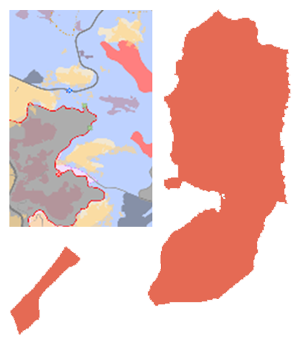
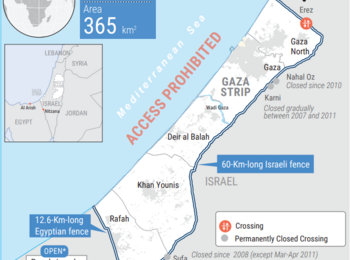
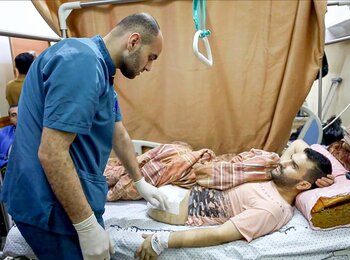
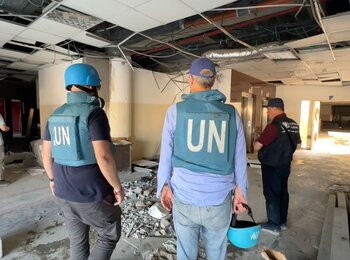
A map atlas that includes 31 maps (including infographics and statistics) on humanitarian issues facing Palestinians in the occupied Palestinian territory including: access and movement, protection (settler violence, demolitions etc.), water scarcity and more. It was designed to be printed on A3 (297 × 420 mm) paper. Paper copies of the atlas are available in our offices. High resolution complete version is available at
Humanitarian
Atlas [100 MB] .
View
Since 1967, Israel has implemented measures and policies which have altered the
status of East Jerusalem, contrary to international law and UN Security Council
resolutions, and significantly increased the humanitarian vulnerability of East
Jerusalem Palestinians. Israeli measures have also increasingly separated East
Jerusalem from the remainder of the occupied Palestinian territory – physically,
politically, socially and culturally. This report is designed to document the
impact of these measures on the Palestinian population in East Jerusalem, in
order to raise awareness, offer recommendations, and contribute to an enhanced
response to humanitarian, early recovery and development needs.
Download Full Version
Arabic | English | Hebrew
This Special Focus draws attention to the range of measures currently impeding
the humanitarian communitys ability to provide assistance to vulnerable
Palestinians. The delivery of principled humanitarian assistance requires an
operating environment that is conducive to the regular and continued deployment
of staff and supplies, and managed in accordance with the principles of
impartiality, neutrality and independence. In the occupied Palestinian
territory, however, the humanitarian community is facing a number of obstacles
to the movement of staff and goods and other restrictions impacting day-to-day
operations that limit its ability to efficiently and effectively respond to
existing needs.
Arabic | English | Hebrew
This OCHA Special Focus covers the planning and zoning regime applied by the
Israeli authorities in Area C of the West Bank. Under this regime, Palestinian
construction is effectively prohibited in some 70 percent of Area C, while in
the remaining 30 percent, a range of restrictions virtually eliminate the
possibility of obtaining a building permit. In practice, the Israeli authorities
generally allow Palestinian construction only within the boundaries of an
Israeli-approved plan and these cover less than one percent of Area C, much of
which is already built-up. As a result, Palestinians are left with no choice but
to build "illegally" and risk demolition of their structures and displacement.
The consequences of the current regime are wide-ranging and extend to the entire
Palestinian population of the West Bank.
Arabic | English | Hebrew